Voters in 10 states will consider 17 education-related ballot measures during the midterm elections, the most impactful of which seek to settle culture-war fights by amending state constitutions.
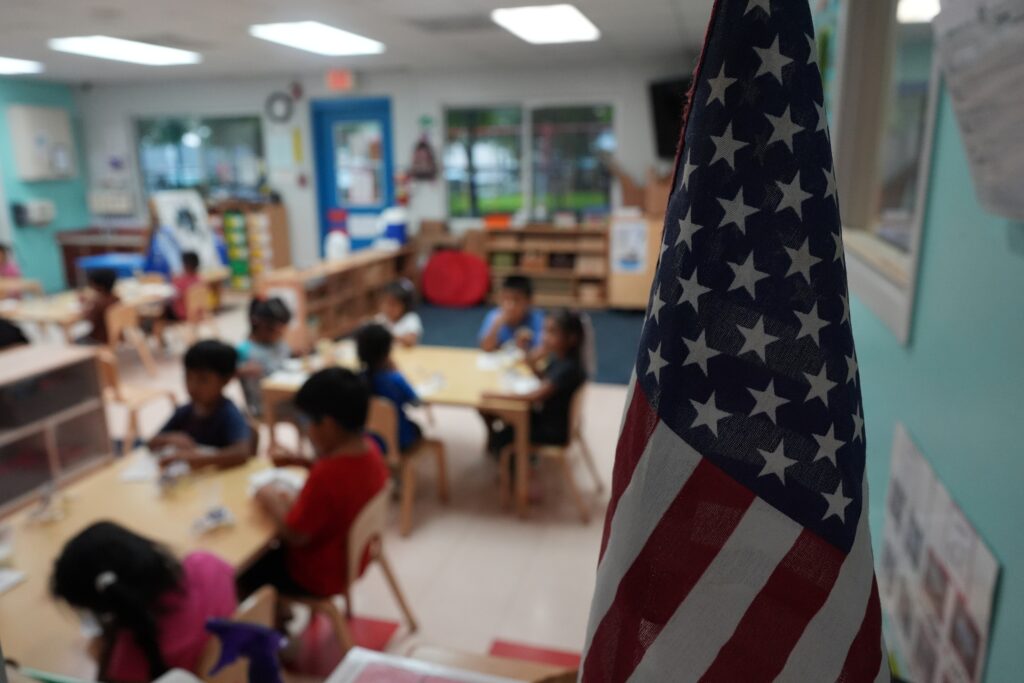
A measure in Alabama asks voters to amend the state’s constitution to require public K-12 schools to allow student-led prayer at the start of each day. If approved, students would also have to recite the Pledge of Allegiance daily.
A separate ballot initiative would mandate weekly broadcasts of “The Star-Spangled Banner” in schools, also altering Alabama’s constitution to do so.
In Nebraska, voters will weigh an initiative that could enshrine in its constitution an existing law that prohibits transgender students from playing on girls’ and women’s sports teams. It also would require school teams to be designated as male, female or co-ed.
The approach, backers say, will help insulate the policy changes from future challenges. Constitutional amendments are harder to undo than other laws.
“Legislatures and governors change with the tide,” said Robert Schafer, a University of Nebraska regent and a sponsor of Fairness for Girls. The conservative campaign said it collected more than 200,000 signatures to get its measure on the ballot. “Sometimes you have to legislate, or even have to change the constitution to embed the right thing,” he added.
This year has brought a total of 19 ballot initiatives related to K-12 and higher education, the most since the midterms in 2018, according to a database maintained by the National Conference of State Legislatures. Two initiatives in Louisiana — one regarding school governance and another that would have given raises to teachers — failed during the primaries in May.
School funding measures in New Mexico, Minnesota and California; initiatives to block transgender student-athletes from competing on teams that align with their gender identity in Washington, Colorado and Arizona; and an effort in North Dakota to guarantee free school meals will also appear on ballots in November.
“It has been notable to see the education measures increase so sharply,” said Helen Brewer, a senior policy specialist at the National Conference of State Legislatures. There were 17 school-related initiatives during the 2024 midterms, up from 12 in 2022 and 11 in 2020.
An influx of measures addressing transgender athletes accounts for much of the increase. They come as the Trump administration continues to target states or schools that allow transgender students to compete on female-designated sports teams with threats to withhold funding.
The administration has also thrown its support behind religious expression in schools, and conservative states have found ways to inject religion into the school day.
The Alabama ballot measure, if approved, would allow students to volunteer to lead a prayer for their classmates. Children who are uncomfortable or do not want to participate would be able to wait in the hallway until the prayer is over, said State Rep. Reed Ingram (R), who sponsored the proposed amendment.
The prayer would not be limited to any specific religion, the lawmaker added.
“A lot of times, these kids go into school and find something to gravitate towards, whether it’s cigarettes, marijuana, drugs, or just running with the wrong crowd,” Ingram said. “I just thought that maybe we could try to go back to [prayer] to see if we could give these kids an opportunity to find something different.”
Ingram said there’s broad support for in-school prayer in Alabama — even if it tests the boundary between church and state. In the state, 75 percent of adults support Christian prayer in schools, according to polling by the Pew Research Center.
Alabama state law already requires schools to conduct the Pledge of Allegiance, although Ingram said some campuses do not comply. And students are already allowedto pray in school, as long as it does not occur during instructional time, according to federal guidance from the Education Department.
Ingram, acknowledging these laws are difficult to enforce, said he hopes enshrining them in the state’s constitution will encourage compliance. “It puts more meat on it,” he said. “I think it sends a signal if it passes that this is what the state wants.”
It’s not uncommon for states to update their constitutions in this way, Brewer said. Voters have previously addressed marijuana legalization, same-sex marriage, abortion and other social issues through similar ballot measures. Idaho voters are weighing a constitutional amendment that designates English as the state’s official language.
Still, critics have questioned why prayer in schools needs to be written into Alabama’s constitution.
“A lot of times, I think it’s just a way to keep the divide going,” said Democratic State Rep. Marilyn Lands. She added she is worried the policy on student prayer could lead to bullying. “I just feel for the child that does have a different faith and feels excluded.”
The League of Women Voters of Alabama, a nonpartisan voting rights group, has urged voters to oppose the amendment because it blurs the line between church and state and does not specify that prayers would be nonsectarian.
“Which religion’s prayers are you going to choose? Are you going to do all of them?” asked Kim Bailey, the group’s president.
In Nebraska, local advocacy groups, including OutNebraska, have been urging voters to oppose the amendment that targets transgender athletes.
Fewer than 1 percent of K-12 students in Nebraska are transgender, said Rachel Tomlinson Dick, the group’s executive director.
“It’s like the culture war issue du jour,” Tomlinson Dick said. “To put this in a constitutional amendment that is supposed to be this durable kind of lasting contract between a state and its citizens, and it just seems very odd. It seems very inappropriate.”
The post School prayer, trans athletes and other education issues are on midterm ballots appeared first on Washington Post.