Chuck Hoskin Jr. fondly recalls watching a room full of Cherokee immersion students crowd around a screen to watch How to Train Your Dragon. Except Hiccup and Astrid weren’t speaking English—the protagonists were speaking Cherokee, dubbed by voices from the local community.
“They’re hearing it in our mother tongue—that didn’t happen a generation ago,” Hoskin Jr., principal chief of the Cherokee Nation, tells WIRED. “We’re a long way, thankfully, from rote classroom instruction and memorization to a world where kids can see the sort of creativity that sparks imagination and helps every kid become more articulate and literate.”
The Cherokee Nation has around 1,500 active speakers left, and most are over 70. Hoskin Jr. says the community is rapidly losing that generation, which is why it has spent time training up second-language learners. It even has a baby immersion program, hoping their first words are Cherokee.
“The foes we’ve had historically are the so-called Age of Discovery, colonization, the displacement of our people economically and geographically, boarding schools,” he says. “But it’s nothing compared to the mathematics we’re up against now. Which is why we’re filled with this urgency every day to do all we can to find partners that can help us accelerate what we want to do.”
One of those accelerants is Apple. The Cherokee Nation has long collaborated with the iPhone maker, and Cherokee was the first Native American language included in iOS in 2010. Today, Apple says its iOS keyboard supports more than 200 languages and language variants, with a handful added last year in iOS 26, like Haitian Creole and Nez Perce. In iOS 27, it expanded support for Indigenous languages to include other Native American languages like Blackfoot, Comanche, and Northern East Cree.
The goal is to meet young people where they already spend much of their waking hours: phone screens. Hoskin Jr. says that to revitalize and save a language, it has to become accessible. Apple says the effort isn’t as simple as translating words. It’s a multi-year endeavor that requires deep research, and the company leans on community members for their expertise.
But the process doesn’t start in Cupertino. It actually begins with Unicode. You may have heard of the name—it’s the organization that approves and standardizes the new emoji that appear on your smartphone every year. It also handles time zone localization, currency names, imperial versus metric, and so on.
Before you can type or read a character on a smartphone screen, it needs to exist as a recognized character in the Unicode Standard. “Everything does start with Unicode in terms of a language, but it actually starts with characters and scripts,” says Unicode CEO Toral Cowieson. “We now have more than 157,000 characters that are included.”
Cowieson calls Unicode a kind of digital Switzerland—a neutral consortium where rivals like Apple, Microsoft, and Google sit at the same table as linguists and volunteer contributors. (Cowieson told WIRED earlier this year that Unicode had only four full-time employees.) Proposing a language, verifying it, and then encoding the character set can take three to five years.
After a script is encoded, platforms like Apple and Google need to add font support. Without this step, a character could appear as an empty box—often called “tofu.” Next is orthography: a set of rules and systems for writing a language. Often, languages have a well-defined orthography, but when it’s not standardized, communities use ad hoc replacements because historically available keyboards don’t support it.
Take the glottal stop—the speech sound made in the throat between the syllables when you say, “uh-oh.” Some languages have distinct characters for glottal stops, but as some keyboards don’t support them, many indigenous cultures use alternatives, like a question mark, to represent the sound. That’s when Apple connects with the community to figure out the best way to represent the sounds in digital text.
That brings us to the keyboard layout. When a community already has an established physical keyboard layout—like Osage—Apple adapts it directly to the software keyboard. Some cultures prefer the QWERTY layouts people are already familiar with.
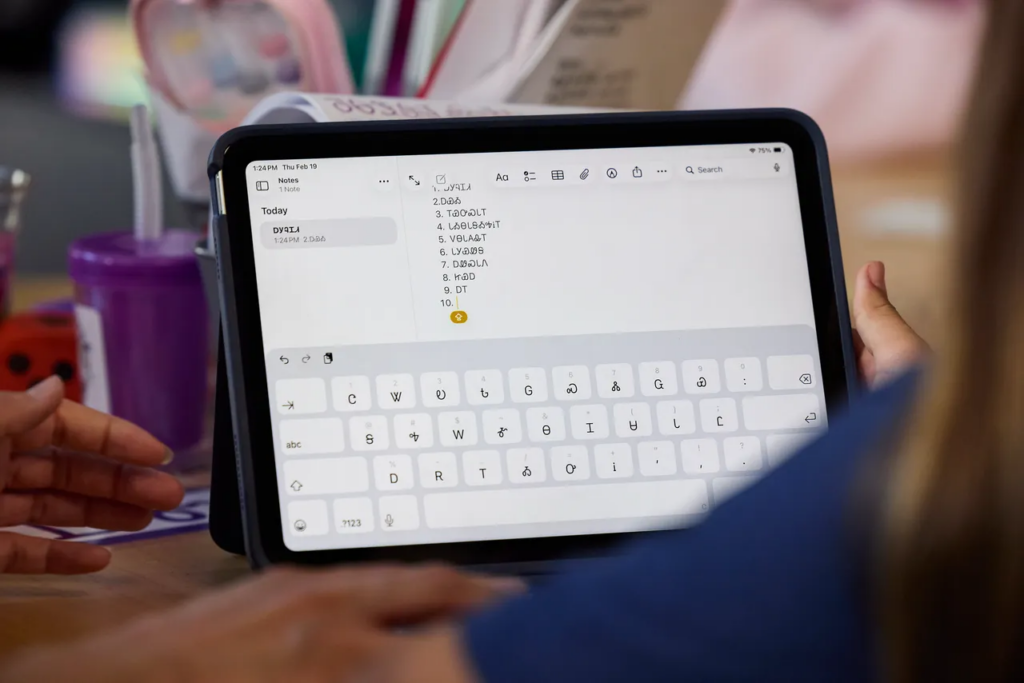
Other languages need more custom approaches. For example, Nez Perce, or Nimipuutímt, does not use capital letters. Rather than having the Shift key toggle traditional uppercase letters, Apple repurposed it to reveal an accented secondary layer, so users don’t have to hold down individual keys to see those characters, which can slow typing. In the Cherokee language, each character mostly represents a consonant combined with a vowel sound, a form known as syllabary. Apple added adaptive vowel keys on the bottom row, so when a user types a consonant, these keys change to show the vowel combinations they can make.
That’s a newer change to the Cherokee keyboard—one Apple approached the community about, meaning building a keyboard for a language isn’t a one-and-done project.
But digitizing an indigenous culture’s language hasn’t always been harmless. Genner Llanes-Ortiz, a Maya scholar and researcher at Bishop’s University, studies how Indigenous people use digital technologies to reclaim language heritage. He recalls how Māori speakers rejected proposals to sell their language to tech companies.
“There’s a historical memory about the ways of dispossession that Indigenous peoples have experienced in the world,” Llanes-Ortiz says. “Māori working in their own revitalization efforts have been very firm in protecting access and storage of their linguistic materials because they have been exploited. They have experienced extraction of knowledge in the past.”
Language sovereignty and data ownership are top of mind, according to Chirasree Mandal, an Apple software engineer. “We don’t own anything, and we make it very clear that we are not trying to silo any data that we gain from this process,” she says. “It’s about making sure that the best choice for representing someone’s language is being made on our platform so they feel good using it.”
For its part, a Google spokesperson tells WIRED it has a long history of bringing lesser-known and Indigenous languages to its platforms so people can communicate, pointing to collaborations to integrate languages like Manx and Māori. Google also says it’s exploring how generative AI can simplify the coding and research required for new languages, but “successful integrations require direct participation from native speakers” for the keyboard to meet the community’s needs.
Hoskin Jr. says that writing in syllabary is seen as a badge of honor for young Cherokee speakers. People type their names in Cherokee on Facebook—that’s empowering. But he sees that progress as vulnerable to broader political rhetoric in the US that pushes a monolithic, English-speaking America, which he says bypasses several chapters, including Native American history.
“The greatest enemy we have right now for saving the Cherokee language is the passage of time and the fragility of human life,” Hoskin Jr. says. “Time is precious to everyone, but particularly precious to us in this mission.”
The post How Apple Puts Indigenous Languages on the iPhone Keyboard appeared first on Wired.