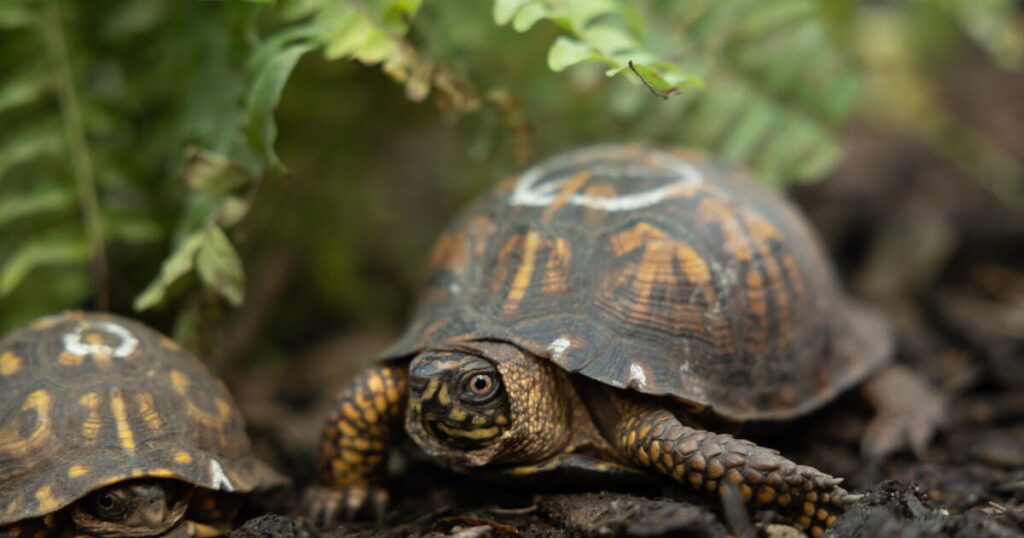
Turtles and tortoises are coming to Los Angeles from all over America, but it’s happening against their will. Smuggling these creatures for overseas sales, especially in Asia, began growing rapidly at the turn of this century, but there has been a dramatic increase in the last six or seven years, and LAX and the ports of Los Angeles and Long Beach are major exit points.
Eric Goode, founder of the Turtle Conservancyin Ojai, knows this issue all too well.
Founded in 2005, the 90-acre conservancy originally focused on helping create or maintain habitats around the world and serving as a research center, but these days much of its energy goes to caring for the displaced turtles and tortoises, most of which arrive starving and stressed. The conservancy, whose mission has expanded to deal with the growing tide of animals that need help, has taken in 810 turtles and tortoises saved by authorities since 2017. More than 400 of those have been in the last six months.
“We’re at a breaking point,” Goode says of the smuggling situation.
Goode, who made his fortune opening nightclubs, restaurants and hotels, has in recent years made animal-related docuseries: “Tiger King,” “Chimp Crazy” and this year’s “Monsters of God,” which is about reptile smuggling.
“Everyone wants American turtles because some are stunningly beautiful and some are among the rarest turtles in the world,” Goode says, pointing to the flattened musk turtles, which live in only one area of Alabama. “Some of these animals are on the brink of extinction. We made the documentary to show people what is happening.”
The conservancy built a 14,400-square-foot greenhouse habitat and a 6,000-square-foot hoop house cold frame to hold up to 500 turtles as a temporary quarantine for new arrivals. (It’s cold for turtles that are not local and need to hibernate in cold weather.) But law enforcement is constantly coming back with more.
“It’s not sustainable,” Goode says, adding that food, manpower, electricity and water make it extremely expensive to care for them. “We cannot take in another 300 turtles because we can’t mix them in with our general population.”
Manisa Kung, the U.S. Fish and Wildlife Service special agent in charge who oversees enforcement in the Los Angeles area, says social media is driving the demand for smuggled animals, including these reptiles. “Now you have large networks of bad guys collaborating together to organize the poaching. They’re more organized,” she says.
Although LAX and the ports of Los Angeles and Long Beach are hot spots, there are others too, including Miami, the Mexican border in California and Texas, and JFK Airport in New York, says Sara Walker, a senior advisor on trafficking for the Assn. of Zoos and Aquariums, an advocacy group.
No one knows exactly how many creatures are being smuggled out, but one of the current challenges is what to do with the ones that are seized by law enforcement. Three years ago, the Assn. of Zoos and Aquariums created the Wildlife Confiscations Network, which Walker heads. The network’s pilot program works with law enforcement to find the best possible homes for animals confiscated in Southern California. “We built a system that would be more efficient and accountable and coordinate everyone,” Walker says.
The group has placed more than 4,600 animals of all types across more than 135 cases. It turns to the San Diego Zoo,
the Los Angeles Zoo and the Santa Ana Zoo in addition to the conservancy. “Because the conservancy is turtle-specific and they have so much husbandry experience, they are one of our go-to facilities,” Walker says.
The reality of being a savior is bleak, however, Goode says, explaining that the vast majority of confiscated turtles die.
“They’re smuggled very cruelly,” Walker explains. “They’re stuffed into bags, shoved into tiny little crates. They’re dehydrated and malnourished. And when animals become stressed, they’re more susceptible to getting diseases, even ones [they] wouldn’t necessarily have in the wild.”
Jeremy McBride, Goode’s producing partner on “Monsters of God,” emphasizes that more resources are needed but says there’s a small step being taken in Congress: the Wildlife Confiscations Network Act. This bipartisan bill was introduced in the House of Representatives last year and would commit $5 million annually over five years from the federal government to support the confiscation management that’s being done in Southern California and take the program national. However, the bill is stuck in committees and has yet to be voted on.
Even if it passes, Goode argues, “that’s just a drop in the bucket.”
A major problem in stemming the tide, Kung and Walker say, is that smugglers typically get off with light sentences, so the criminals view arrests as “the cost of doing business,” a phrase both used. When two brothers tried smuggling 635 turtles valued at more than $1 million, one was sentenced to a year in prison and a $15,000 fine, and the other to two concurrent year-and-a-day sentences with a $10,000 fine. Kung says authorities often try to connect other illegal activity to these smugglers to seek significant prison time. Walker and Goode both advocate for stiffer sentences as a deterrent, but there doesn’t seem to be any political movement on that front.
Since the smuggling can’t be stopped or even slowed at this point, the main goal becomes saving as many animals as possible. Walker says another goal is getting confiscated turtles back to the wild, but as Kung notes, smugglers commingle different turtles, spreading diseases that must be kept out of wild populations. The conservancy and zoos all work to return reptiles to the wild when possible.
The conservancy is currently working to release a group of ploughshare tortoises bred there after the species was close to extinction because of poaching. Ploughshare tortoises, which exist in the wild only in Madagascar, had once reaped six figures on the black market. Previous attempts to breed them in captivity had failed, but Goode rescued a batch from Asian smugglers in 2010, and after 15 years of care, he got 25 hatchlings. He is now working with the Madagascar government to get them back in the wild there. “We’ve built a soft-release pen on 11 acres in their natural habitat, which will be monitored by guards, to show they can survive there. We also want to get more breeding groups around the world,” Goode says.
Although the conservancy can roughly estimate where to release its ploughshare tortoises, it’s difficult to know where a smuggled animal with wide home ranges, such as the eastern box turtle, should be returned. The smugglers are no help, Kung says, since the person arrested may be the third or fourth person to handle the creature and would have no idea of the point of origin. “It’s something we struggle with,” she says.
UCLA ecology professor Brad Shaffer is working to solve at least part of that problem. “A turtle that evolved for the cold winters and native plants of Connecticut would have a much lower chance of surviving if it’s released in Georgia,” the herpetologist says. He is using genomics to try to map the landscape and homes of turtles, working with the Turtle Conservancy and the Turtle Survival Alliance.
“If we can sequence the genomes of a large representative set of animals that we know where they came from, then we can use that as a reference set,” he says. “When an animal is confiscated, you can quickly sequence its genome and say, this turtle came from this part of Maryland or Texas.”
This would allow turtles to be returned more quickly and confidently to the right place and, Shaffer notes, it also means that law enforcement can track where the worst poaching spots are and clamp down there. (Even dead turtles would be helpful in that regard.) Shaffer expects to have one turtle species mapped as a test case within a year, and half a dozen species mapped within the next few years. That will allow for faster and safer repatriation of the turtles that survive.
But Goode says even with that information the process will remain too slow. He’s less interested in finding the precise location of the turtles’ origins than in finding ways to get healthy turtles generally back into the wild, saying there’s an argument to be made that the latter would be better in the long run. (More traditional advocates disagree with that approach, noting that releasing turtles where they technically may be invasive could do more harm than good in that habitat.)
Even with the genomic mapping there will be problems. “Every state has its own laws and bureaucracy,” Goode says. Rewilding pets may be prohibited, and doing it for confiscated turtles may require a state permit, with each state having its own rules for determining whether it will be safe to put the animals back. “It’s so easy to pluck an animal out of the wild, but when you want to put one back there’s more roadblocks. Can we find a happy medium? Because the best thing for these turtles is not to keep them in holding areas for too long.”
He recently began working with a South Carolina couple who expect to confidentially take 30 of his eastern box turtles later this month to release in an undisclosed location in the wild — it will be in the range of the species, although they won’t know for certain whether it’s where these specific creatures are from.
“This idea is being debated, but these people are less conservative about releasing animals,” Goode says. “We’re not reckless, but we think it’s better to be risk-tolerant than to watch these turtles flounder and slowly die in captivity.”
The post How L.A. became a turtle smuggling hot spot, pushing this rescue group to the brink appeared first on Los Angeles Times.