The war in Iran has rippled through the global economy in many ways, pushing up prices for oil, fertilizer and other products. It has also created challenges for America’s most popular fruit: bananas.
The banana business has long been an underappreciated feat of logistics. It involves transporting a fragile and finicky fruit thousands of miles from the tropics, only to be sold for less than a quarter each. And it’s a business that is even trickier of late as the war raises the costs of fuel and other materials banana producers need.
That has put even more financial pressure on banana producers, who operate with thin margins and have little ability to raise prices. Compounding the industry’s problems are the threat of disease, climate change, tariffs and an exceptionally severe El Niño this year.
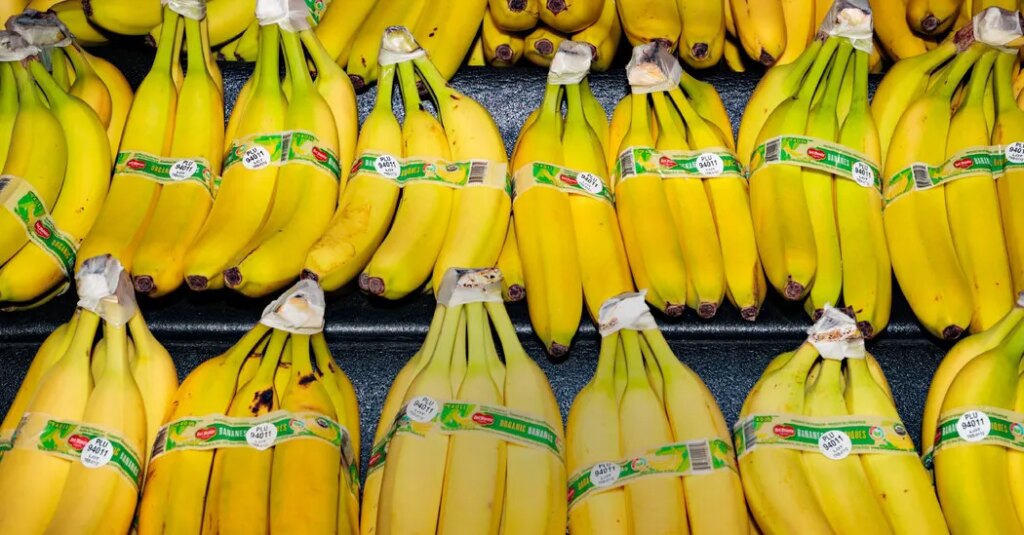
The banana might be America’s most unassuming fruit, a cheaply priced staple of smoothies and school cafeterias. It is the most consumed fruit in the United States, with Americans eating around 80 bananas a year, on average.
But bananas make little profit for grocery stores or the companies growing them. Instead, stores price them cheaply to draw shoppers in the door. The average price of bananas in the United States — about 65 cents a pound in August — has changed little over the last decade, despite rising costs.
“Everything is costing more money,” said Danny Dumas, a senior vice president at Del Monte North America. “If you ask me, it is a crisis.”
Even so, Del Monte, like the other major banana producers, Chiquita, Dole and Fyffes, continues to bring massive quantities of fruit to the United States.
In a port outside Philadelphia this summer, cranes and trucks busily unloaded hundreds of refrigerated containers from the Del Monte Spirit, a hulking ship that stretches two football fields long and had traveled more than 2,000 miles from Central America.
The ship, one of seven in Del Monte’s fleet, contained about 7 percent of the bananas that would be brought into the United States that week, supplying an area stretching from Iowa to North Carolina and Nova Scotia. The crew had just 40 hours to empty the ship’s cargo — millions of bananas from Guatemala and Costa Rica — before it would sail back for the next week’s pickup.
To understand the impact of the war, The New York Times traced the journey of a container of bananas from that ship over roughly 2,500 miles, from the plantation where it was grown to a Pennsylvania grocery store.
Some bananas on the Del Monte Spirit were grown in Tiquisate, a farm-dotted flood plain on the Pacific coast of Guatemala. Once carefully packed to avoid bruising, they were driven more than 250 miles in a refrigerated truck to Santo Tomás de Castilla, a port on Guatemala’s Caribbean coast.
The Spirit then carried them to Gloucester City, N.J., where Del Monte unloads up to 300,000 boxes of bananas a week. The company ships them directly to retailers or sends them to its own ripening facilities, which slowly increase the temperature and introduce ethylene gas so the bananas turn a perfect, unblemished yellow on your kitchen counter.
While many farmers and food sellers have seen costs increase because of the war, bananas have been hit harder because they are transported long distances and must be kept carefully refrigerated.
The price of diesel — needed to power Del Monte’s fleet of refrigerated trucks — has risen about 70 percent in the United States since the war started seven months ago, peaking at over $6 a gallon. Prices have also surged for the bunker fuel for Del Monte’s ships, and for the fuel for farmers’ irrigation systems in Central and South America.
The fertilizer that banana plantations depend on has also become more expensive, since much of it is made from natural gas coming from the Middle East. And the higher cost of shipping has spilled over into other products, like cardboard and plastic packaging and the chemicals that farmers spray on bananas to prevent disease.
Although the Trump administration has repeatedly pronounced the war with Iran over, the cease-fires have so far not held.
Transits out of the Persian Gulf through the Strait of Hormuz — which formerly helped to move about a third of the world’s fertilizer and a quarter of its seaborne oil — are still a small fraction of what they were. While more oil is flowing out of the Middle East than before, global oil prices have repeatedly breached $100 per barrel over the last seven months.
“Across the supply chain, everything depends on energy,” Mohammed Abbas, Del Monte’s president, said in an interview.
The threat of disease
Del Monte grows some of its own bananas and buys others from farmers. Banana companies worry that higher prices may cause farmers to forgo fertilizer and disease-treating chemicals, resulting in a smaller crop next year. Some Central American farmers are already switching to pineapples.
Rising costs could also sap the industry’s ability to invest in disease-resistant varieties. The banana as Americans know it — a genetically homogeneous strain called Cavendish — is at risk from fungi and viruses that are spreading through South America.
While there are hundreds of varieties of bananas, ranging from the silvery-blue Ice Cream banana to the purplish Red Dacca, many Americans encounter only the Cavendish. Until the 1950s, Americans ate a variety called Gros Michel, a plumper, sweeter banana with a thick skin suited for shipping, and a flavor profile that lives on in banana-flavored candy.
But a fungus called Panama disease decimated the Gros Michel by the 1960s. Farmers turned to the Cavendish, first cultivated by an English gardener in the 1800s. Virtually all bananas consumed in the United States descend from that single English plant.
As farmers adapted, so did fungus. Another strain of Panama disease now targets Cavendish bananas in Southeast Asia and South America. It can survive in soil for decades, permanently wiping out farms.
Companies are quietly researching genetic alternatives in case the global supply collapses, an effort requiring significant investment. Del Monte declined to comment on its program.
Miguel Angel Morales, a small producer in northern Peru, said Panama disease had wiped out one in three banana-growing valleys in his region, forcing him and others to relocate their farms. The region produced 12 containers of bananas five years ago, but farmers now fill only one.
Stress from the war in Iran has compounded those problems. Mr. Morales said that his costs had jumped 25 to 30 percent this year, and that there was little support from banks or the government.
He had not yet raised his prices because annual contracts locked them in. Eventually, he thought, consumers in wealthier regions should pay more.
“If production costs increase, it’s logical that banana prices should increase, right?” he asked.
Banana-nomics
Yet an undisputed truth — at least among banana executives — is that the effort they put into their product has little relation to its price.
For decades, grocery stores have approached bananas as they do other “loss leaders” — pricing the fruit cheaply to get customers in the door. The industry structure, in which several companies compete to sell a largely identical product, also leaves banana producers with little power to raise their prices.
Banana companies have also developed highly efficient supply chains that shaved internal costs from farm to store — a strategy brutally perfected by the United Fruit Company, which turned large parts of Central America into company-run territory in the early 1900s.
The result is that the banana, despite being fragile and shipped long distances, is typically sold for as little as 15 cents each.
Adjusted for inflation, the average price of a pound of bananas in the United States has fallen roughly by half in the last 40 years. In the second quarter, Del Monte’s margin on bananas was just 2.3 percent.
“I always used to say that we are a nonprofit business,” said Juan Alarcon, the chief executive of Fyffes North America.
Banana companies also struggled last year with costs from tariffs, until the Trump administration exempted some food that is not locally grown in November.
Companies have also contended with a shortage of truck drivers, in part because the Trump administration stripped more than 30,000 drivers of commercial licenses.
The price at which many producers sell bananas is fixed by long-term contracts, some of which expire in December. But it’s not clear how much grocery stores will allow prices to rise.
Tom Stenzel, managing director of the Banana Association of North America, said it was “almost a mythology” among retailers that they couldn’t raise the price of bananas, the way they could for produce grown much closer to stores.
“I don’t want to throw my apple brothers under the bus,” Mr. Stenzel said, but apples are more expensive and take less effort to grow and ship. The banana industry’s ability to absorb costs is “at a breaking point,” he added.
“What else can you buy in a grocery store for 25 cents?” he asked.
Mitra Taj contributed reporting from Peru, and Jody García from Guatemala.
The post America’s Favorite Fruit Is Being Bruised by the Iran War appeared first on New York Times.