For the explorers from ice-covered Greenland, it must have seemed a paradise. A genuinely green land of lush meadows irrigated by free-flowing rivers. Whales and caribou to hunt, nesting birds and wild salmon to catch, grapes and wheat to gather. A warmer climate with more daylight and milder winters.
These Norsemen and women, led by the Viking Leif Erikson, built a year-round outpost believed to be a station for ship repair and staging ground for voyages farther south. They fought and traded with Indigenous peoples. At least one woman gave birth.
They named it Vinland.
Today, it’s called Newfoundland, in eastern Canada. The Vikings arrived in the year 1000, give or take a decade — half a millennium before a certain other European explorer first landed in the Bahamas.
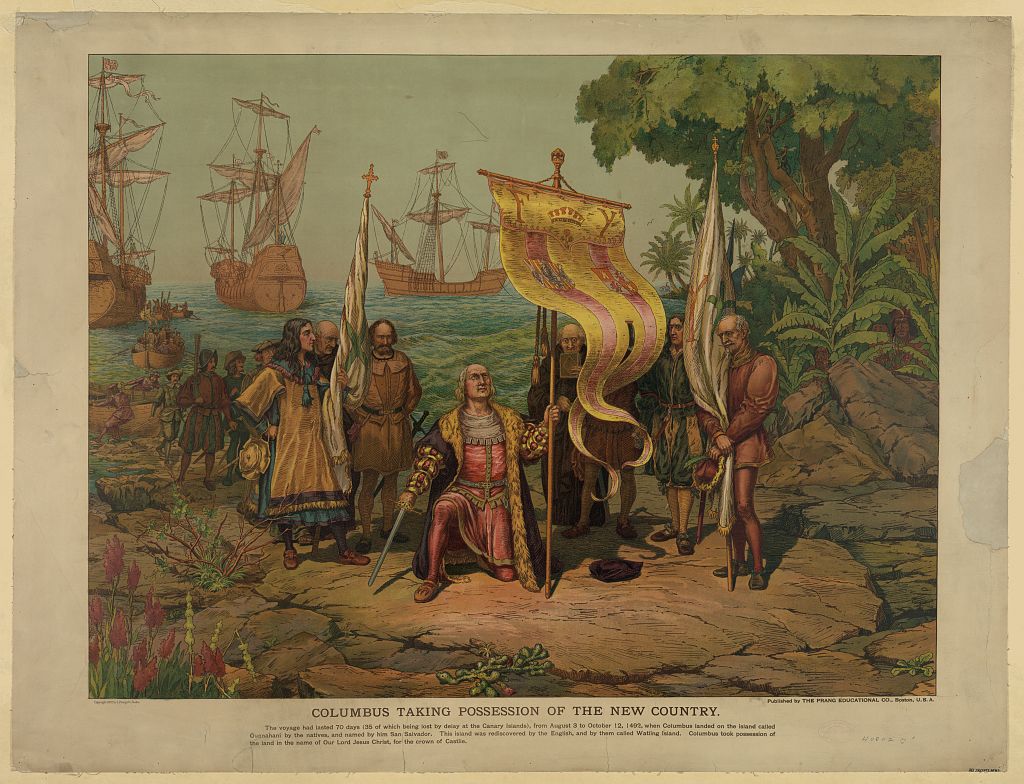
So why, on Monday, does the United States observe Columbus Day?
‘Columbus had better PR’
Christopher Columbus never set foot in North America. It wasn’t until after his death that Juan Ponce de León became the first European to reach what is now the United States.
“Columbus had better PR,” says John Steinberg, an archeologist at the University of Massachusetts Boston.
Much of what’s understood about the Norse presence in North America comes from the Vinland Sagas, a pair of 13th-century Icelandic works of genealogy, stories and navigational data that was uncorroborated until the discovery of Norse artifacts in Newfoundland in the 1960s.
Christopher Columbus’s voyage to the Americas in 1492, by contrast, was detailed by the contemporary writer Bartolomé de las Casas, a lawyer and Dominican friar working in part from Columbus’s own logs.
“The Vinland Sagas are stories told around a campfire,” Steinberg says. “We have legends and archeology but no real history. … With Columbus, someone writes the story from his point of view.”
An Italian American heritage day
The Genoan navigator also benefited from a strong Italian American lobby, during a period when Italian immigrants to the United States were subjected to sometimes violent discrimination.
Columbus Day is first known to have been celebrated in New York on Oct. 12, 1792, the 300th anniversary of his landfall. The first distinctly Italian American observance came in 1866.
In 1891, a mob in New Orleans lynched 11 Italian immigrants. Italy severed diplomatic relations with the United States. The following year, President Benjamin Harrison proclaimed Oct. 12 a national holiday. Lobbying by the Knights of Columbus, a Catholic fraternal order, and prominent Italian Americans eventually led to its proclamation as a federal holiday in 1937 by President Franklin D. Roosevelt.
In reaching the Americas, Columbus and those who followed him brought slavery, disease and death to the native population, and academics and activists in recent years have called for an end to the holiday.
In 1989, as the 500th anniversary of his first voyage approached, South Dakota, home to nine federally recognized tribes, replaced Columbus Day with Indigenous Peoples Day.
More than a dozen states and the District of Columbia have followed suit. Joe Biden in 2021 became the first president to proclaim Indigenous Peoples’ Day, alongside Columbus Day.
President Donald Trump, whose administration has pushed to scrub federal institutions of what it calls “corrosive ideology” — including policies or programs recognizing historical oppression and racism — last year signed a presidential proclamation to recognize Columbus as “the original American hero.”
Trump last year proclaimed that he was “bringing Columbus Day back from the ashes,” though many places had never stopped celebrating it.
Corroborating the sagas
For centuries, the Norse claim to have reached Americas rested on the Saga of the Greenlanders and the Saga of Erik the Red, sometimes contradictory works written some 250 years after the events they depict.
As history, the sagas can be problematic. Alongside plausible descriptions of Viking life on land and at sea, they recount, for example, the time that the recently deceased Thorstein Erikson sits up to speak to his widow. Also the mortal wounding of Thorvald Erikson by a one-legged creature, and the natives who elude Norse capture by vanishing. (Leif, Thorstein and Thorvald were all sons of the explorer Erik the Red.)
But navigational guides, historian Eleanor Barraclough says, the sagas are remarkably helpful. “Part of it is the stuff you need to know to survive out in the world, which is directions and how to get across seas,” says Barraclough, author of “Beyond the Northlands: Viking Voyages and the Old Norse Sagas.” “And so that material is really quite neatly mapped.”
It was the sagas that pointed the Norwegian husband-and-wife team of explorer Helge Ingstad and archaeologist Anne Stine Ingstad to L’Anse aux Meadows on the northern shore of Newfoundland, where in 1960 they discovered traces of a Norse settlement — the first evidence of European contact with the Americas before Columbus.
Found at the site were the remnants of eight sod-and-wood structures — three longhouses that could have housed scores of people, an iron forge and several workshops — identical to those the Vikings built in Iceland and Greenland, and artifacts including bone needles, iron nails, ship rivets and a bronze ring-headed cloak pin.
Researchers using carbon dating estimated the outpost to have been in use at some point between 990 and 1050. In 2021, scientists at the University of Groningen in the Netherlands used a new method — counting tree rings from the radiocarbon signature left by a solar disturbance known to have occurred in 993 — to date three pieces of wood hewn there to 1021.
L’Anse aux Meadows is now a Canadian National Historic Site with artifacts, replica buildings and historical interpreters, and a UNESCO World Heritage Site.
What were Vikings doing in Newfoundland?
We don’t know, precisely, but we can theorize. The Norse were known to have ranged as far south as the Mediterranean and as far east as Kievan Rus’, present-day Russia. To build ships, they needed lumber, a commodity scarce in Iceland and Greenland.
According to the Saga of the Greenlanders, the Icelandic merchant Bjarni Herjólfsson, blown off course while attempting to reach Erik the Red’s settlement in Greenland, was the first Norseman to sight Vinland. Leif Erikson, intrigued by Herjólfsson’s stories of a forested land, bought his ship and attempted to retrace his steps.
With a crew of 35, he found territory he called Helluland (Land of Flat Stones), believed to be present-day Baffin Island in the Canadian territory of Nunavut; Markland (Land of Forest), believed to be Labrador; and Vinland (Land of Wine).
The outpost at L’Anse aux Meadows might have been one in a network of sites used by the Norse throughout the year, as in Greenland and Iceland. “They would have summer dairy stations, fishing stations,” Steinberg says.
The relatively modest accommodations, lack of burial sites and comparatively shallow midden pile — waste dump — all suggest that it was not intended as a permanent settlement.
“It’s an outpost,” Barraclough says. “They’re using that place as a sort of springboard so they can spend their winters mending ships and then they can keep going further inland.”
Among the most compelling finds at the site are butternut shells. Butternut trees don’t grow naturally in Newfoundland. Their presence suggests that the Norse ventured farther south, perhaps to the Saint Lawrence River Valley or New Brunswick, or at least traded with people who did.
According to the sagas, the Norse had both friendly and violent encounters with Indigenous peoples.
A notable figure in the sagas is Gudrid Thorbjarnardóttir, the widow of Thorstein Erikson. She is said to have remarried and given birth to a son, Snorri, believed to be the first child of European descent born on the North American mainland; attempted a conversation with an Indigenous woman; and, after converting to Christianity, made a pilgrimage to Rome.
It’s unclear how long the Norse remained in contact with Vinland. Scientists conjecture sporadic visits over decades. Barraclough notes a 14th-century report of a ship blown off course from Markland — Labrador — turning up in Iceland.
“And so even in the 1300s,” she says, “it seems quite plausible that there are at least foraging expeditions, because Greenland doesn’t have an awful lot of wood, and the Norse really do need wood for the type of lifestyle that they’re trying to keep going.”
The campaign for Leif Erikson Day
As 19th-century Italian Americans began lobbying for Columbus Day, so Scandinavians sought recognition for Leif Erickson Day. The movement was fueled by the 1874 publication of “America Not Discovered by Columbus” by Rasmus B. Anderson, a professor of Scandinavian studies at the University of Wisconsin and later a U.S. ambassador to Denmark.
Though overbroad in its claims — Anderson writes of Leif Erikson’s travel to present-day New England, for which no evidence has been found — the work helped to popularize the idea of the Norse “discovery” of the Americas. In 1925, President Calvin Coolidge, speaking to a group of Norwegian Americans on the 100th anniversary of the arrival of Norwegian immigrants in New York Harbor, called Erikson the discoverer of America.
Soon, Wisconsin, Minnesota and the Canadian province of Saskatchewan, all home to substantial Scandinavian American populations, declared Leif Erikson days. President Lyndon Johnson followed with a national holiday in 1964, proclaimed by every president since. It’s celebrated today principally in the Upper Midwest.
As it was on Friday. It falls each Oct. 9 — not a date from Erikson’s life, but the anniversary of the arrival of those 1825 immigrants. And, conveniently, a few days before that other explorer’s day.
The post He reached the Americas centuries before Columbus. Why doesn’t he get more credit? appeared first on Washington Post.