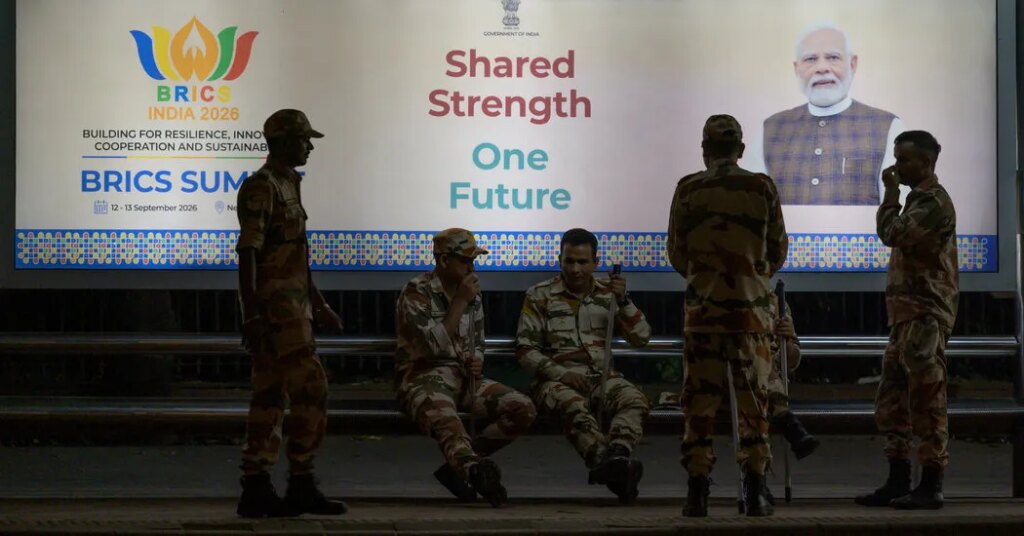
Prime Minister Narendra Modi has long cultivated an image abroad as the popular elected leader of the world’s largest democracy, a sober voice of peace in a world of violence.
He has balanced that role at home in India with another penchant, as a strongman whose lieutenants have wielded the arms of the state at dissenters, exploiting an increasingly pliant legal system and bureaucracy. These efforts have undercut and splintered the opposition, cowed independent media and jailed activists.
On Saturday, Mr. Modi’s balancing act broke down as violent scenes across the capital city were beamed to screens around the world, exposing the rough edges of his rule and the limits of his formula for maintaining power.
The police in New Delhi unleashed force at young protesters angry over what they say is Mr. Modi’s manipulation of the country’s voting system, bashing them and dragging them to detention by the thousands. Phones in hand, the youth have documented the harsh treatment, down to the dirty condition of the police stations they were held in. They found ways around an internet shutdown in central New Delhi to flood social media with content undermining the image of a democratic leader happily in control.
“The old playbook has become old, it’s tired, it doesn’t work,” said Gyan Prakash, a Princeton University historian who has written extensively about the Indian government’s descent into authoritarian rule in the 1970s. “And so what do they have now left? They have the police.”
Mr. Modi has remained characteristically mum on the protests. His official social media accounts instead posted birthday greetings and festival wishes, keeping with his practice of associating himself only with positive things.
But he still faces the challenge of how to deal with the mounting dissent, which analysts say is unlike anything he has faced so far. The once-battered opposition is feeling invigorated, trying to widen the crack opened by the young people through months of stubborn agitation.
Mr. Modi had long found ways to box in opponents, dismissing them as lightweight or demonizing some as terrorists and “anti-nationals.” The youth movement, however, increasingly draws on a cross-section of society that makes the protesters hard to target the same way. The government’s heavy-handed response has elicited rare objections from members of Mr. Modi’s camp, who usually maintain silence, including from a senior ideologist of his party and a cabinet minister.
Mr. Modi also faces a generational challenge. He and his Bharatiya Janata Party, which has long combined digital savvy with a Hindu nationalist ideology that espouses hierarchy and uniformity, seem stumped by a vocal Gen Z cohort that responds poorly to that kind of rigid authority.
The current wave of anger is over what the protesters see as a threat to the sanctity of voting in India, and it calls into question Mr. Modi’s image as an elected leader with a strong popular mandate. His party often cites his three victories in national elections — Mr. Modi has been prime minister for 12 years — and its success in local elections in dismissing criticism of his government’s conduct.
Over the past year, a nationwide revision of voter rolls has culled more than 130 million names. Mounting evidence of chaos in the revision process and allegations that millions of Indians were deliberately disenfranchised have fueled popular anger.
The protesters are demanding the resignation of Gyanesh Kumar, an election chief appointed through a process that Mr. Modi dominates. They accuse Mr. Kumar of doctoring the voter rolls to lock in the ruling party’s advantage for years to come. Mr. Modi’s party has rejected the allegation, saying the critics are sore losers who cannot successfully compete in elections.
At a news conference, Ravi Shankar Prasad, a senior lawmaker from Mr. Modi’s party, said, “We are not against protest, which is a natural part of democracy.”
Facing an earlier wave of youth protests over the summer, Mr. Modi made a rare concession with the resignation of his education minister amid mass agitation over scandals in college entry tests.
His party appears to have learned from that episode that giving in simply fuels demands for more, said Mr. Prakash, the historian. The resignation of the election chief could be particularly damaging, as the opposition could spin it as an admission that Mr. Modi’s electoral mandate was questionable.
“They are between the devil and the deep blue sea,” Mr. Prakash said.
Rajat Sethi, an analyst who formerly advised B.J.P. state governments, said that while the earlier protests against the education minister were nonpartisan, the current wave feels heavily influenced by the political opposition.
He said he feared that the opposition, in demanding the resignation of the election chief who holds a constitutional office, could bring about the kind of violent upheaval seen recently in neighboring Bangladesh and Nepal.
“My biggest question is: What is the endgame on this?” Mr. Sethi said. “Political parties are tasting blood on this, so they will be on the street because they have never be able to galvanize for the past 12 years.”
The government’s heavy-handed response has not quashed protests entirely. While it has erected vast numbers of barricades in central New Delhi and put thousands of security forces on the streets, protesters have kept popping up in different corners of the city, before police rush in to round them up.
Leaders of the youth movement promised more protests after being released from detention.
Mohak Gupta, a 22-year-old psychology student, was among the protesters who arrived early on Saturday, only to find barricades and columns of security. All day, he said he played cat and mouse with the police and shared his entire experience on Instagram.
He said what the ruling party doesn’t understand about members of his generation is that they will do exactly what they are told not to do. “They used force last time, too. They hit me with a baton,” he said, referring to the summer protests. “It doesn’t work with us. They made me more angry. How could they hit us?”
The post Crackdown Exposes Limits of Modi’s Playbook for Maintaining Power appeared first on New York Times.