In the cold open that began the Jan. 9, 1993, episode of “Saturday Night Live,” the actor George Wendt, portraying the fictional Chicago Bears superfan Bob Swerski, writes a letter to the team’s owner.
After decrying “one of the most monstrous acts of betrayal ever committed in the annals of man” — in real life, the team had just fired its revered coach, Mike Ditka — Wendt’s character reassures himself: “We do not fear for Ditka. We know Ditka will rise again. Ditka is like the sun, only smarter.”
In truth, when Ditka was let go, he hewed much closer to a fallen star. He may have led the Bears to a Super Bowl championship in 1985, but he had just overseen the team’s worst record, 5-11, since 1975.
Still, to those who watched “S.N.L.” in the 1990s or, really, were vulnerable in any way to popular culture, Ditka, who died last week at 86, was, now and forevermore, a giant — a mythical, infallible, indomitable leader of men. He was, as Wendt’s Swerski put it: “a man whose courage and good grooming set a standard for an entire city. His hairstyle was like the man himself — sharp, unmovable, water-resistant.”
In Midwestern Superfanese, Ditka was “Da Coach,” which translates to something like “Indisputably the Greatest Sports Legend of All Time.”
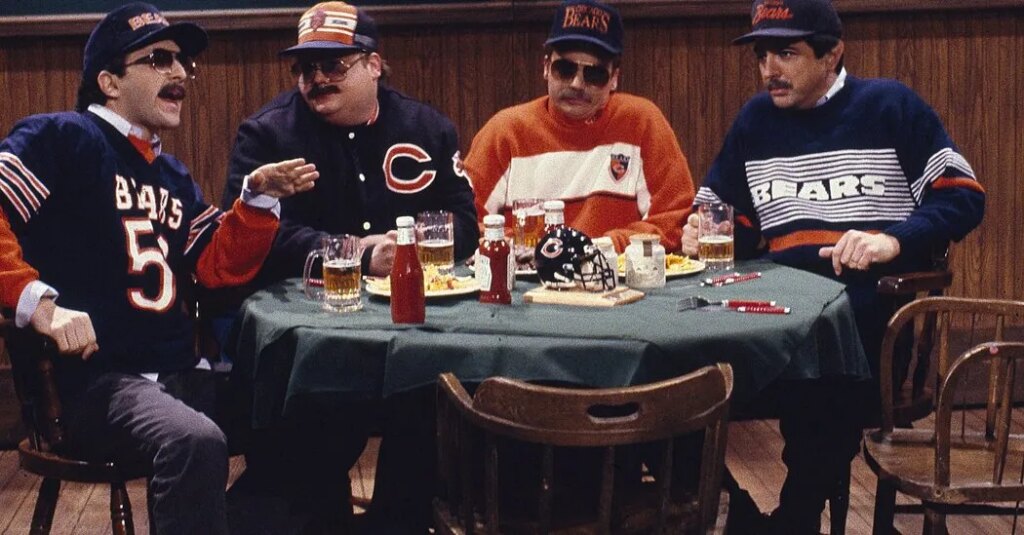
The skit debuted on “S.N.L.” in 1991. It’s four guys sitting around a table creaking under the weight of beer, brats and heavy Chicago accents, debating the fate of their beloved team and its luminous, if hard-bitten coach.
“Debating” is a stretch: Da Bears never lose. Will they beat the Giants in a playoff game? “Da Bears, 62-3,” a guy named Pat (played by Mike Myers) predicts. Chris Farley’s Todd agrees: “Bears, 79-zip.” But what if the Bears’ plane is delayed and only Ditka makes the game? “Ditka 17, Giants 14,” Myers’s character foretells. “He just barely gets by.”
“Bob Swerski’s Superfans” was created by the comedian and Illinois native Bob Odenkirk and the “S.N.L.” writer Robert Smigel, a New Yorker who, like Odenkirk, had honed his talents on the Chicago improv circuit. As it happened, Smigel found the kernel of the sketch at a Chicago White Sox baseball game.
“Almost every guy was wearing aviator shades and was overweight, and had the walrus mustache,” he once recalled. “It was like a badge of virility.” (Last year, when Robert Francis Prevost, a noted White Sox fan, was appointed the head of the Catholic Church as Leo XIV, Chicagoans christened him “Da Pope.”)
The skit was satire, of course, mocking a certain kind of hardheaded, volatile masculinity that Ditka seemed to embrace. But it was wrapped in love, tilting heavily toward envy — and not just for Chicago or football or cured meats.
“Da Bears” was far less about championships or dynasties (Ditka may have loved winning, but he took the Bears to just the one Super Bowl) and far more about what it means to be a fan — that is, a member of a community, where one can fall into the comfort of rituals and uniforms and unqualified friendship, even if the price is choking on a pork chop. Such tribes can be problematic but also beneficial.
That the sketch so quickly found its way into pop culture made it difficult to discern where the art ended and reality began. Were fans in Bears sweater vests and aviator sunglasses dressing up like Ditka or like Swerski? Or maybe Swerski was dressing up like the fans? Was Wendt even acting?
“He did not have to search for a commitment to the team by any means, nor to Mike Ditka, really,” Wendt’s wife, Bernadette Birkett, told The Chicago Tribune. “I mean, it was genuinely felt.”
“Bob Swerski’s Superfans” cemented Ditka as myth, arguably more than anything the coach ever did on the field. It led him to portray an exacting, no-nonsense version of himself in a host of TV commercials, hawking, for instance, fast food, insurance and erectile dysfunction medication. At Ditka’s restaurant, a fan could order, and maybe finish, the “Kick Ass” Paddle Steak (a 19-ounce bone-in rib-eye).
And when the “S.N.L.” alum Will Ferrell needed a proven winner to help him coach a youth soccer team in “Kicking and Screaming” (2005), he called Ditka. “Some of you are going to wish I was dead,” Ditka, of course wearing a Bears sweater vest, tells the kids at his first practice.
The result of all this was a gleeful delight in the myth of Ditka that extended far beyond Chicagoans, and even sports fans.
Or maybe it wasn’t mythmaking at all. After Ditka was fired by the Bears, he sounded a lot like Bob Swerski, abetted by his proclivity to speak in the third person.
“The Bears will come back,” he said. “Mike Ditka will survive.”
The post ‘Da Bears’ and the ‘S.N.L.’ Sketch That Immortalized Mike Ditka appeared first on New York Times.