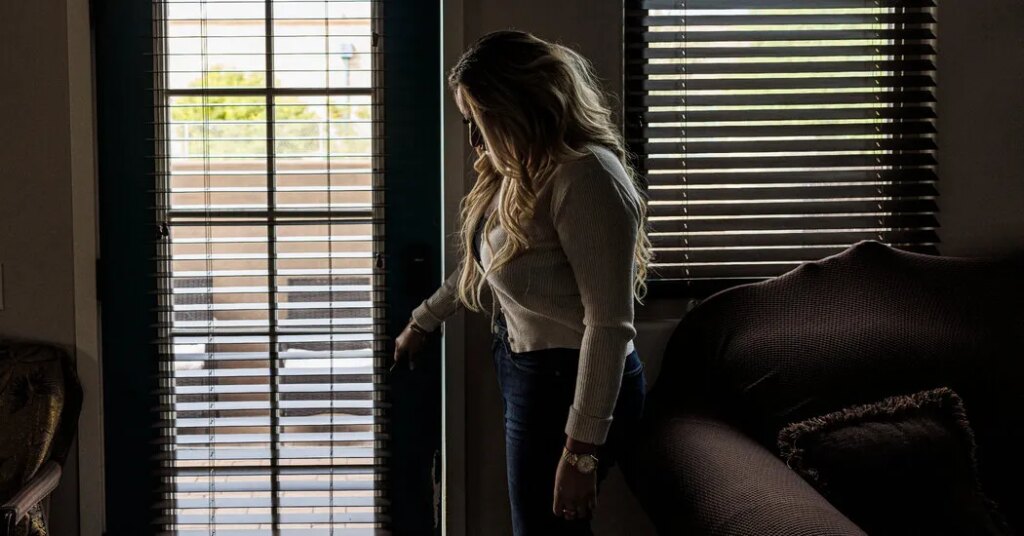
Alma Hernandez’s home used to feel like her sanctuary. Now it feels like a fortress.
In recent years she has installed cameras, alarms and a lock that opens with her fingerprint. She put iron bars on her windows and a blinding floodlight on her front porch. She cut down two trees in her yard after the police told her they could aid an intruder, and her brother moved in to protect her when the death threats intensified.
Ms. Hernandez, an Arizona state representative since 2019, did not know she was signing up for a dangerous job. But these days, serving in public office increasingly means looking over your shoulder.
“Politicians are no longer treated like we’re human,” she said.
Ms. Hernandez, a fourth-term Democratic lawmaker who is Mexican American and Jewish, has received threats from the far left and the far right. They have come in response to her outspoken support for Israel, her championing of vaccines and her first campaign, which drew attention from David Duke, a former leader of the Ku Klux Klan.
Violent threats have arrived via her social media feed, her email inbox and her office phones. Her home address has been circulated online, and her mother has received menacing calls. Last year, an aide’s car parked outside Ms. Hernandez’s house was struck by gunfire. This year, state police opened an investigation after someone sent her a social media message pledging to “find, torture and brutally murder” her and her friends, along with one of her two Chihuahuas.
So pervasive are the threats that they have altered not only Ms. Hernandez’s life, but also those of her family, friends and neighbors, who now keep a close eye on her home and warn her about suspicious activity. The intimidation has even influenced her approach to policymaking.
“I’ve asked myself, ‘Is it really worth it?’” said Ms. Hernandez, 33, who was the youngest woman ever to be elected to the Arizona Legislature. “I do wonder now, why would any 25-year-old want to do this with their life?”
Across America, threats of violence haunt the daily existence of elected officials, their staff members and their families. A New York Times investigation has found that the nation’s highest-profile politicians — including governors and members of Congress — face consistent violent harassment.
Studies show that violent threats are also rising against lower-level elected leaders, who number more than 500,000 and serve in state legislatures, city councils and school boards.
In a survey conducted this year by Princeton University and CivicPulse, nearly 20 percent of 460 local elected officials across the country reported receiving threats during the first three months of 2026. Just like at the federal level, the perilous climate is pushing some local public servants out of office early and causing others to forgo running altogether, the researchers said.
But unlike national political figures, most state and local officials have few resources to help keep them safe. Faced with violent threats, they are often left to fend for themselves. And after a Minnesota state lawmaker and her husband were assassinated last year, many say they feel more exposed than ever.
City and town officials are even more vulnerable, experts say, and they have been targeted repeatedly in Arizona in recent years. The Bridging Divides Initiative, a research center based in Princeton’s policy school, found 57 confirmed threats against Arizona county and municipal lawmakers since 2022, a figure researchers say is an undercount.
In Maricopa County, home to Phoenix, death threats toward local officials surged after the 2020 election as President Trump’s unfounded claims of voter fraud fueled a torrent of conspiracy theories. One county supervisor was diagnosed with post-traumatic stress disorder and decided not to seek re-election, while threats to two other officials resulted in a prison sentence.
At the state level, legislators from both parties have been targeted. In 2022, a former middle school music teacher emailed Senator Wendy Rogers, a Republican, and vowed to shoot her in the head. Last year, Arizona’s secretary of state, Adrian Fontes, a Democrat, allowed candidates for office to use campaign cash to pay for security, citing the dangerous political environment.
That decision helped Analise Ortiz, a Democratic state senator. Last year, her online posts alerting residents that immigration agents were near a school attracted a string of sinister threats, including several that said she would be hanged.
“Walk around with security cause I promise you three months,” one person wrote. Another said Ms. Ortiz’s “car and home and family are easy to find.”
Ms. Ortiz made a list of safe places and lived in undisclosed locations for two weeks as the threats rolled in, she said.
“It’s remarkable that in the United States of America in 2026, as a state senator, I had to fear for my life,” said Ms. Ortiz, whose district is west of Phoenix.
When she returned home, Ms. Ortiz, one of the statehouse’s leading progressives, installed a camera system and petitioned a court to conceal her address.
She also bought a gun and trained to use it.
“It’s horrible we have to think that way,” Ms. Ortiz said. “But ultimately, my home and loved ones need to be protected.”
Ms. Ortiz and Ms. Hernandez represent opposing factions of Arizona’s Democratic Party, but they agree that violent rhetoric has reshaped both of their lives.
“What she experienced and what I experienced are symptoms of the same problem,” Ms. Ortiz said.
Political violence has long shadowed the Hernandez family, three members of which have held elected office. Ms. Hernandez’s brother, Daniel, was an intern for Representative Gabrielle Giffords in 2011 when the Democratic congresswoman was shot outside a Safeway in Tucson.
Mr. Hernandez, then 20 years old, provided first aid to Ms. Giffords as an ambulance raced to the scene. Mr. Hernandez, suddenly in the national spotlight, received his first death threat three days later.
“I’ve seen people at their most unhinged, or I thought I had,” said Mr. Hernandez, who went on to serve as a state representative. “And then it keeps getting worse.”
He said he had been shocked by the amount of hate — especially the antisemitism — directed at Ms. Hernandez and their sister, Consuelo Hernandez, another Democratic state lawmaker. By late 2023, he had become so worried that he insisted on moving into Alma Hernandez’s Tucson house for extra protection. He still lives with her part-time.
Ms. Hernandez first received threats during her first term, when one of her bills so angered vaccine opponents that they flooded her social media and office with ominous messages. The bill, which would have limited vaccine exemptions, went nowhere, but the furor transformed her work: Ms. Hernandez, who has a master’s degree in public health, now says she will never again sponsor pro-vaccine legislation. The cause isn’t worth the harassment, she said.
After Hamas’s Oct. 7, 2023, attack on Israel, Ms. Hernandez said the number of threats increased. She said her vocal support for the Jewish state has drawn more violent messages in the last three years than any other time in her career.
Sam Segal, Ms. Hernandez’s boyfriend, has given her pepper spray and offered to teach her to use his firearms. They’ve also rehearsed chilling scenarios. If she’s attacked by a man, Mr. Segal has told her, “kick right in the middle and run.”
“You don’t know what’s legit and what’s not,” Mr. Segal said of the threats, many of which are anonymous. “There are extremists out there who will go the whole nine yards, and I can’t be with her 24/7.”
The threats have made the couple nervous about having children, they said.
“Would we be OK with bringing a family into this environment?” Ms. Hernandez said. “Quite frankly, the answer right now is no.”
A scary moment unfolded last year, just one day before Minnesota’s former House speaker was killed.
Mr. Hernandez, who was then running for Congress, was meeting with his campaign team at Ms. Hernandez’s house when a bullet shattered the window of his aide’s car, which was parked outside. The police never found the shooter, nor did they determine whether the gunfire was targeted. But the incident deeply rattled the family.
If Ms. Hernandez wins her election in November, she will serve a two-year term in the State Senate.
She said she had not thought much about her political future beyond that. But if she could go back in time, she said, she would choose a quieter, less stressful way to begin her career.
“I would tell Alma almost nine years ago, ‘Girl, wait. Go live your life,’” Ms. Hernandez said. “This has not been an easy time.”
Nick Corasaniti contributed reporting.
The post After Many Threats, an Arizona Lawmaker Asks: ‘Is It Really Worth It?’ appeared first on New York Times.