It was an enjoyable day of temple and factory visits organized by China Daily, the Communist Party’s English-language mouthpiece, but it ended on an uncomfortable note.
The group I was traveling with in the northern province of Shanxi — mostly foreign influencers hungry for followers and Chinese freebies — was told to line up behind a long banner and be filmed chanting: “Amazing China, Amazing Shanxi.”
I declined to join in, scowling in silence. But, back in my hotel room in the provincial capital of Taiyuan, I felt I had perhaps been too churlish: Getting a bunch of foreigners to chant on cue for the camera about China’s wonders was a transparent but harmless propaganda stunt.
And, to be honest, the 11th century temples we visited — and also the new highway that took us to them — were pretty amazing.
Then I received a message on WeChat, a Chinese messaging app, from an old friend in Beijing, a lawyer whose earnest decency and movie star looks always reminded me of the “good party cadre” characters in propaganda films. I had not seen him for more than 30 years and was planning to visit the following day.
Sadly, his message said, he would not be able to keep our appointment because state security officers, somehow apprised of our plans, had turned up at his door and ordered him to cancel.
China suddenly appeared not so much amazing as alarming.
After decades away from the country where I studied classical Chinese in 1980-81 and then worked as a journalist from 1987 until 1991, I returned in September last year for a six-month assignment. I marveled at how much had changed, sharing the amazement of first-time visitors awe-struck by China’s high-speed trains, dazzling modern cities and gung-ho embrace of the future.
My old friend’s message broke the reverie:
“Every bush and tree seems like an enemy soldier,” he warned, using a Chinese idiom to describe the paranoia of a security apparatus that has also changed dramatically. It has grown bigger, more intrusive and, thanks to high-tech marvels like WeChat and omnipresent surveillance cameras, much more capable of monitoring just about everyone.
China’s economic transformation over the last four decades has been extraordinary, and it infuriates Chinese officials that Western media outlets display what they see as “anti-China bias.” That is shorthand for reporting that dwells on anxiety about the economy, still growing but at a slower pace, and anything else that deviates from China’s undeniable achievements and charms.
Throughout my stay, I struggled to reconcile the reality of a country that has never been richer and seemingly full of promise with a parallel reality of brittle insecurity, in which every bush and tree hides a potential enemy.
Based in Shanghai, I often went on weekends with my wife to a park in the city’s northern Hongkou district, where groups of older Chinese gather to sing songs from their youth. Their favorite numbers are patriotic anthems but the singers, who often included a Uyghur man dressed and made up to look like Charlie Chaplin, were there of their own accord.
Their boisterous camaraderie and national pride seemed entirely genuine.
An official sign nearby, however, clouded the carefree mood: “Opposing Traitors and Guarding Against Spies Starts With Us,” it warned, with a phone number to “report espionage activity.”
The hunt for spies has escalated sharply since Xi Jinping took power in 2012 and began throttling the flow of information in and out of China, building up the Great Firewall to prevent Chinese from viewing many foreign websites.
There are seemingly no limits on what the state can see and hear, and ordinary Chinese have adapted accordingly — most noticeably with regard to the leader himself.
Mr. Xi is everywhere, on television, on billboards and on the front pages of newspapers and websites. But, throughout my stay in China, not one of the hundreds of Chinese I spoke to, mostly in private, ever uttered his name out loud. Even foreigners often avoided it, pointing at the ceiling when they wanted to refer to China’s president.
The Chinese people whom I met on my travels invariably skirted politics, except when I encountered a zealous patriot during a visit to Dazhai, a former Maoist model commune in a remote mountain area of Shanxi. “Which is better, China or America? Tell the truth!” he shouted, in between praise of China’s leadership and ridicule of the United States and Europe.
Nobody voiced open political dissent but many grumbled about the economy, particularly in places like Hainan Island where a runaway property boom has ground to a halt. A retiree from Shandong who had spent all his savings and borrowed money to buy a Hainan apartment that later lost more than a third of its value told me his much younger wife, his second, was threatening to leave him because he had fallen deeply into debt.
About the closest anyone came to openly challenging the authorities was in Shanghai when I met an out-of-town party member and his daughter outside a museum celebrating early revolutionaries.
Pushed and insulted by police officers when he started to video the entrance, which they said was forbidden, he frothed with anger, cursing them as “hooligans in uniform.” When I asked him what was wrong, he replied, using a Mao-era mantra, that the party and its servants “should serve the people but often forget that.”
His daughter, aware of the surveillance cameras planted on the narrow street, told him to shut up.
On the 150-yard walk from my Shanghai apartment in a gleaming new tower overlooking Suzhou Creek to the nearest subway, I counted more than 30 cameras trained on pedestrians. There is also a security check at the station, where guards, unfailingly polite, put all passengers’ bags through a scanner. Behind them was a cabinet stuffed with black batons, helmets and other riot control gear. Next to an ad for high-end dog food, a propaganda poster demanded vigilance against unspecified threats.
Vigilance against supposed spies in China has cursed foreign journalists looking for information, no matter how anodyne, for many decades.
When I worked there as a journalist in the 1980s, communism was crumbling next door in the Soviet Union and restlessness over corruption and one-party rule led to huge protests in Tiananmen Square. The party’s account of events after a bloody crackdown routinely accused foreign journalists of spreading “bourgeois liberalism” and stoking “counterrevolutionary turmoil.” Two American reporters were expelled for “obtaining state secrets through illegal means.”
John Burns, the veteran New York Times foreign correspondent, who died in March, was arrested in China in 1986 and charged with espionage after embarking on long motorcycle trip through the hinterland. The charges were later dropped and he was deported.
I was expelled from China in 1991 after obtaining Communist Party internal documents marked top secret and detailing a crackdown on groups accused of fomenting “splittist” sentiment — party code for cultural self-awareness — among ethnic Mongolians in the Chinese region of Inner Mongolia.
Back then, reporters were followed by furtive men who carried satchels fitted with cameras. The watchers are still there, now equipped with cellphone cameras and smart glasses.
In Dazhai, the former Maoist commune, a photographer and I were followed throughout on foot and by cars crammed with blank-faced men. In Hainan, a man followed us from the street to a sunny beach where we had decided to take a break. Pretending to talk into his cellphone, he kept its camera turned in our direction as we moved around. But the bulk of the surveillance these days is done by A.I.-powered systems that alert security agencies to communication involving people considered potential troublemakers — like foreign journalists.
WeChat and other apps available in China promise privacy, and most Chinese value the convenience they offer. But the apps are required by cybersecurity and other laws to share user data with the Chinese authorities. This facilitates snooping that, at least to many foreign journalists, smacks of digital dystopia.
Quickly realizing that any communication over WeChat risked putting old friends in the cross hairs of the security apparatus, I avoided contacting them. But one friend — the daughter of a former senior official, who was on a business trip back to China after years abroad — got in touch.
When we met for lunch in Shanghai, we reminisced about the 1980s and friends we had in common, nearly all of whom now live outside China. She raved about “Blossoms Shanghai,” a lush, 30-episode television series suffused with nostalgia for China’s roaring ’90s, a period of explosive economic growth and relative openness as the Communist Party relaxed the suffocating grip it imposed after the 1989 Tiananmen massacre.
We entirely avoided the political gossip that used to figure in our conversations. The food was excellent.
When I first went to China as a student, I lived in Jinan, an eastern center for state-owned heavy industry that reeked of coal. The city was still recovering from Mao’s Cultural Revolution, a decade of political turmoil that ended in 1976.
The economy was a wreck. Rice, cloth and even matches were in such short supply they could be bought only with ration coupons. The canteen at Shandong University, where I studied, served only greasy gruel with bits of mystery meat and steamed buns.
Time magazine had just named Deng Xiaoping, the supreme leader at the time, its “man of the year,” hailing his “visions of a new China.”
Deng was clear that the party would remain in control, but his path for China’s future was deliberately tentative. It was called “crossing the river by feeling the stones,” an admission of uncertainty that filled my university with excited debate about how to reach the ultimate goal — a China “rich and strong.”
Mr. Xi has embraced the same goal but has replaced Deng’s invitation to “feel for stones” with dogmatic certainty. The country is exhorted to show “unswerving loyalty” to Xi Jinping Thought, his blueprint for a “new era” with no room for debate.
The campus of Shandong University, open in my student days to the public, is now, like other college grounds in China, sealed off by security guards and studded with surveillance cameras.
One of the few buildings near the campus still standing from when I was a student is a huge, German-built Roman Catholic church, which had been converted into a storeroom and workshop. Lavishly renovated since, the church is now again used for religious services, though these are restricted to Christians willing to register and show their passports or ID cards.
When I first traveled by train to Jinan from Beijing, the journey took all night. It now takes under two hours. Jinan’s main railway station, a grand Art Nouveau building in the center of town built by Germans at the start of the 20th century, has been torn down, replaced by a hyper-modern structure on the outskirts.
I ran into a former classmate whom I remembered as having been something of a maverick. Now a businessman in Shanghai selling private planes, he reminisced about a time when everything was still open to discussion, except the authority of the Communist Party.
Having to constantly bite one’s tongue, he said, was a modest, if regrettable, price to pay for China’s many other changes for the better.
In Jinan, I visited the grave of the man I had often sought out as a student for his intimate knowledge of China’s now muffled past. I knew him as “Lao Wen” but his real name was James Veneris, a former American soldier who, after being taken prisoner by Chinese troops during the 1950-53 Korean War, had opted to stay with his captors and been given a job in Jinan.
Branded an American spy during the Cultural Revolution, he lost his factory job and had been assigned to haul a street cart. His Chinese wife at the time — the second of three — divorced him under duress.
When I got to know him in 1980, he had just been rehabilitated. He had a new wife and a new job teaching English at the university. Eager to avoid getting in trouble again, he plastered his campus apartment with portraits of Mao and Hua Guofeng, the new Communist Party chairman after Mao’s death.
He was alarmed when I told him that Hua’s portraits had suddenly disappeared from my lecture hall, a sure sign that he, too, had been purged.
“It’s all so damn confusing,” he groaned. Lao Wen died in Jinan in 2001.
His marble tombstone, paid for by his son, who moved to America, is in a serene new cemetery on the outskirts of Jinan. A gold inscription in English says he had not died, “just disappeared.” A Chinese inscription on the reverse side remembers him as an “American who loved peace, loved life and loved the people of China.”
His many travails are passed over in silence.
The silence that engulfs so much of China’s past reaches a sinister crescendo in Tiananmen Square, which I had last visited on the night of June 3-4, 1989, when soldiers seized it back from protesting students amid a hail of gunfire.
By the time I left Beijing in 1991, roads around Tiananmen had all been repaved to remove traces of tank tracks. The square had again become a public space filled with people flying kites and playing with their children.
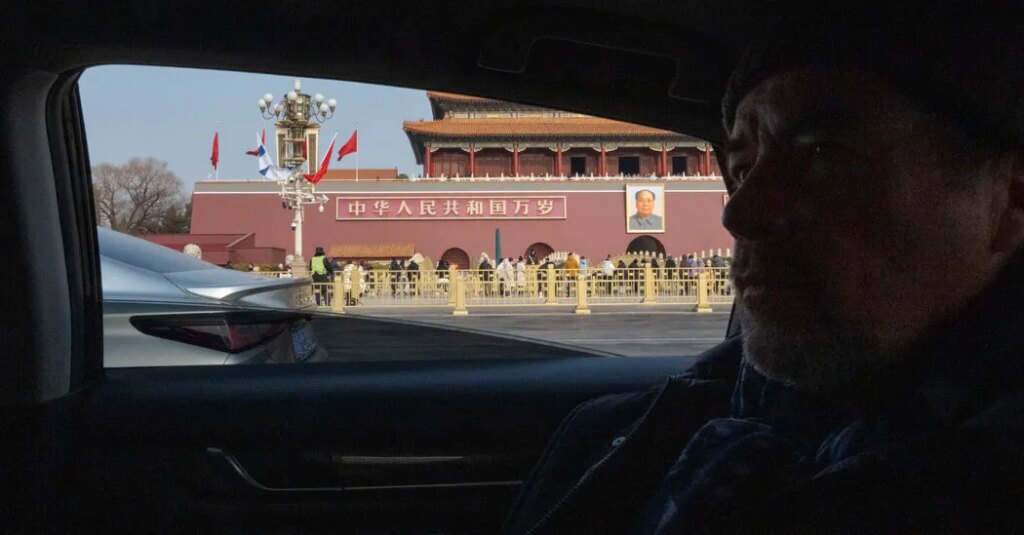
Today, the Chinese capital’s main public square is no longer a place to relax like Red Square in Moscow or Trafalgar Square in London, but a by-appointment-only dead zone. Kites are banned without a permit. All visitors, mostly Chinese from the provinces, are carefully screened.
Before my wife and I could visit in January, we had to apply for permission via WeChat. Once approved, we waited in line for two hours, showing our passports and computer-generated permission notification at three separate checkpoints with airport-style security.
At the final check, a guard pounced on a pen carried by my wife, insisting it contained red ink, which she said was prohibited. She did not say why, but during the 1989 student protests several people hurled red paint at a famous portrait of Mao that faces the square. A security supervisor finally let us through after writing with the pen on a piece of paper and seeing that it was brown, not red.
Now out of China, I often wonder: How can it be that a proud, nuclear-armed world power is scared of red ink?
The post Where Every Tree Hides ‘an Enemy’: How I Watched China’s Paranoia Grow appeared first on New York Times.