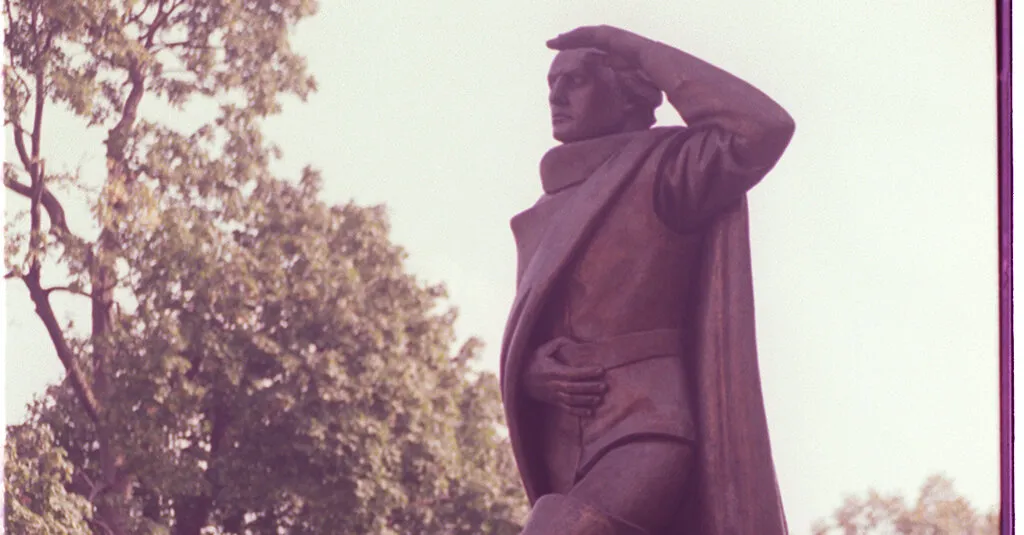
The Chambersburg neighborhood of Trenton, N.J., was once a thriving Italian American community, a Little Italy of square brick tenements and bungalows in the shadow of the giant smoke-belching Roebling steel plant.
Today, it’s still an immigrant enclave, although the recent arrivals are mostly from Central America. The plant shut down, and what remains of its 20th-century heyday is the Italian Peoples Bakery (“goes back to 1936”) and a curious stump of a platform where a statue once stood. A close inspection reveals that the stump is in the shape of a boat.
On a Sunday in October 1959, the whole neighborhood, including the future Supreme Court justice Samuel Alito and his family, stood alongside church leaders and diplomats to erect an image of their hero, Christopher Columbus, peering from the prow of a ship as he approaches the New World.
For the Alitos, this was a moment of pride. Trenton’s vibrant Italian American community was asserting its place in America. As Justice Alito would later put it in interviews, Italian immigrants who arrived in the United States in the early 20th century, including his relatives, were derided as foreigners. They embraced Columbus, who was born in Genoa and whose ships reached the New World more than a century before the Mayflower, because they were his countrymen. His story proved that they belonged.
The statue remained in Columbus Park for more than 60 years until Trenton’s mayor, Reed Gusciora, decided in 2020, after repeated acts of vandalism left the statue doused in red paint, to remove it, and the park was renamed Unity Square Park.
Most Italians had left Chambersburg by 2020. Many of the town’s residents, chiefly Black and Central American, decried Columbus as a symbol of slavery and genocide. “What we know about Columbus simply makes his image a poor fit for a city that is as diverse as Trenton,” the mayor said at the time.
But what the statue symbolized has not been forgotten. As it lay in pieces in a warehouse, a six-year saga ensued in which local Italian Americans, supported by a valuable ally — Justice Alito himself — feuded with the city to restore it. After years of patient advocacy, Italian Americans in Trenton have agreed to compromise. They are negotiating to acquire the statue and re-erect it outside a Knights of Columbus hall in neighboring Hamilton.
But despite optimism surrounding this year’s Columbus Day, the city has yet to approve the transfer.
Justice Alito was 9 years old when he attended the ceremony unveiling the statue. His father and his grandparents on both sides of his family had immigrated from southern Italy and settled in Chambersburg. In New Jersey, his parents struggled with poverty and discrimination while they worked their way through college and graduate school, his mother becoming a school principal and his father the longtime head of the New Jersey Office of Legislative Services. Their American journey has long been celebrated in speeches and interviews by Justice Alito, who felt personally affronted when he heard about the challenges to the statue.
Gilda Rorro, a longtime leader in the New Jersey Italian community, began lobbying to reinstate the statue in Chambersburg after discussing the matter with an upset Justice Alito in 2020. She said she read aloud a statement written by the justice to the Trenton City Council arguing that the statue does not symbolize Columbus’s deeds but rather the immigrants themselves.
“Poor Italian peasants made a long and difficult journey leaving everything they knew behind. And while many people in this country did not accept them, they wanted to claim that they had a rightful place here,” Dr. Rorro said, quoting Justice Alito’s message to the City Council in 2020. “That is what the statue symbolizes, and removing it is an insult to the Italian American community, tantamount to saying that their experience, all that they endured and contributed, accounts for nothing.”
A sitting Supreme Court justice lending his credibility to one side in a local dispute with painful racial and ethnic dimensions might raise a few eyebrows, but Justice Alito has a history of nudging the boundaries of judicial rectitude. That same year, he delivered a speech to the Federalist Society that denounced Covid-era restrictions that might have come before the court. Four years later, he declined to recuse himself from cases involving President Trump after his wife flew what appeared to be pro-Trump flags over their houses.
But his advocacy for the Columbus statue reflects something else: a personal project that reveals his views on immigration.
In the term that ended in June, Justice Alito was the author of opinions that drew sharp criticism from immigrant groups, marking him as the court’s most prolific defender of Mr. Trump’s crackdown on immigration. At the same time, as the Columbus dispute demonstrates, he has been an effusive defender of the immigrant experience of his fellow Italian Americans.
Justice Alito has never stinted in expressing his Italian pride. His undergraduate thesis at Princeton University was about Italy’s Constitution. He visits the country frequently in the summer. He paid tribute to the heroic Italian prosecutor Giovanni Falcone at the Supreme Court, and decried in a university talk the TV hit “The Sopranos” for furthering offensive stereotypes of Italians.
On the court, however, he seems to be notably unmoved by tales of hardship and sacrifice by other groups of immigrants. In 2018, he joined a 5-to-4 majority that rejected challenges to Mr. Trump’s so-called Muslim ban, finding that the president’s proclamation was based on nonreligious factors. In the 2024-25 term, Justice Alito showed deference to the second Trump administration when, for instance, he wrote a fiery dissent to an emergency order backed by seven of his colleagues that blocked Mr. Trump from deporting Venezuelans without a hearing.
In the last court term, Justice Alito’s immigration opinions stood out even further. He wrote for a 6-to-3 majority in overturning a lower-court order prohibiting U.S. border guards from intercepting migrants with potentially lawful claims to refugee status before they cross into the country. “A running back does not arrive in the end zone when he reaches the one-yard line,” Justice Alito argued, in ruling that the refugee statute doesn’t apply if an applicant is forcibly deterred even a few feet from the border.
Justice Alito wrote for the same majority in rejecting challenges to Mr. Trump’s removal of Temporary Protected Status for Haitians. Despite Mr. Trump’s having once called Haiti and Somalia “shithole countries” (and suggesting the United States should seek more immigrants from Norway and Sweden), Justice Alito rejected a bias claim based on the Constitution’s equal protection clause. Mr. Trump’s comments, he wrote, were not “overtly racial.”
Then, in the June 30 decision rejecting Mr. Trump’s order to deny birthright citizenship to children of undocumented immigrants, Justice Alito dissented. While the court’s majority, including two conservatives, cited the plain meaning of the 14th Amendment in granting citizenship to anyone born in the United States, Justice Alito insisted that the framers had not anticipated “birth tourists.” The court’s granting legal status to children of undocumented parents, he argued, would “degrade” American citizenship.
Earlier generations of Trentonians used similar terms in attacking Italian immigrants. News stories expressed concern over everything from “Many Foreign Names on Business Signs,” as a 1904 Trenton Sunday Advertiser headline put it, to excessive drinking and violence. A local newspaper, The Daily True American, put it bluntly in 1903: “Little Italy Must Keep Place Clean.”
Jeffrey Laurenti, a Chambersburg resident who knew the justice during their high school years and shares the goal of reinstating the Columbus statue, interpreted Justice Alito’s legal opinions as reflecting his “larger view of executive power” more than animus toward the immigrant plaintiffs.
But Justice Alito doesn’t always defend assertions of presidential power. In 2023, he alone supported the right of states to challenge President Joe Biden’s immigration priorities. And he has sometimes gone beyond legal theory to express the need for justice for individuals like a grieving father who was subjected to protesters at his son’s funeral and religious Christians who oppose same-sex marriage and thus risk being labeled “bigots.”
Justice Alito hasn’t expressed similar empathy for today’s Chambersburg residents. Susan Ryan, who produced a film on Chambersburg called “From the ’Burg to the Barrio,” has noted that the Central Americans whose foreign-sounding names are on the same storefronts where Italian names once appeared have much in common. The two generations of immigrants, she said, have similarities “in terms of their interests in family, food and work, and religion.”
The way Justice Alito talks about Italian immigrants often involves overcoming obstacles, not efforts to change their status before the law. In his telling, Italians seized on Columbus for practical reasons, since the great explorer was already celebrated by non-Italians.
“When Italian immigrants arrived here, they were often scorned,” Justice Alito told We the Italians, an online magazine. “Many thought they were hopelessly backward and could never fit in. Looking for a way to say that they did belong, Italian Americans, exercising a bit of furbezza, simply latched onto the Columbus symbol that the general population already knew and valued.”
That is the symbol that stood tall and proud over Chambersburg for 61 years, and the Italian Americans who wish to restore it have every right to invest their pride in its restoration.
“Furbezza,” more often spelled as “furbizia,” has a very useful meaning. According to the Cambridge Italian-English dictionary, it translates to “cunning, craftiness, shrewdness.” It is a vehicle for exercising your smarts.
It is a good way of taking care of yourself and your own.
Peter S. Canellos is a former editorial page editor of The Boston Globe and a former executive editor of Politico.
The Times is committed to publishing a diversity of letters to the editor. We’d like to hear what you think about this or any of our articles. Here are some tips. And here’s our email: [email protected].
Follow the New York Times Opinion section on Facebook, Instagram, TikTok, Bluesky, WhatsApp and Threads.
The post The Supreme Court Justice and the Columbus Statue appeared first on New York Times.