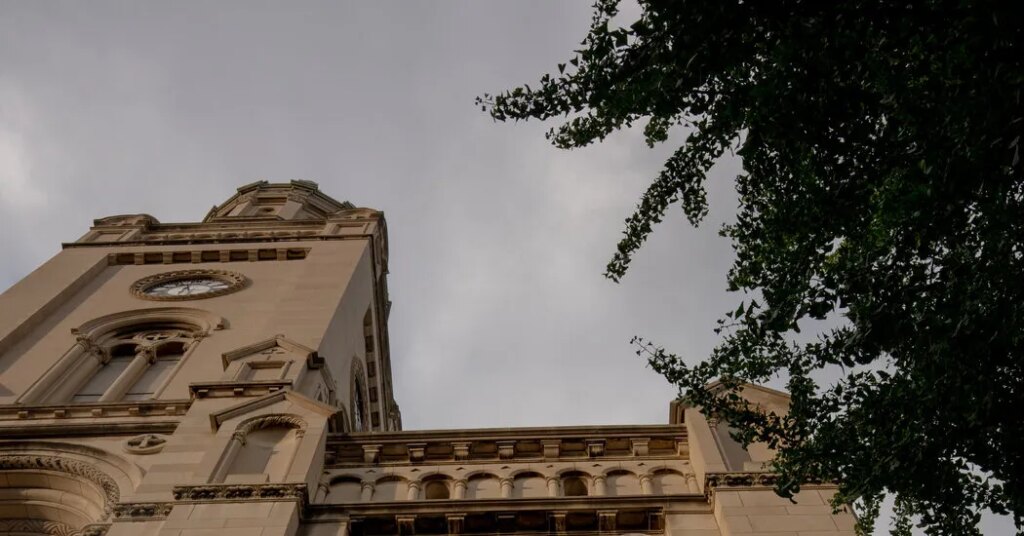
Since Most Holy Redeemer Catholic Church stopped holding weekly Mass over a year ago, some of its most devoted parishioners have continued to pray in front of its locked gates nearly every Sunday morning and Friday evening.
Between Hail Marys, the half a dozen faithful ask God to save both their souls and the 175-year-old church that many of them have belonged to for years and, in some cases, generations. Irene Sysak, who has attended services at the church for more than two decades and whose teenage nephew received his first communion there, called it “a second home.”
“Or really, the first home — our spiritual home,” she said.
But parishioners fear that home’s future could be dictated by economic forces reshaping neighborhoods around the city like the Lower East Side — forces that they fear could affect even institutions as enduring as the Roman Catholic church.
Most Holy Redeemer was closed last August, with little explanation from the Archdiocese of New York outside of a priest shortage and slight structural damage to its ceiling, parishioners and church leaders said. Its weekly Mass was cut to just two services each year to observe its feast day and consecration anniversary.
But in the past year, its members say the church has not opened for either of those two services, and its ceiling has not yet been fixed. Special programs like the church’s Spanish-language Mass and soup kitchen have ceased. And its doors — once open all day, every day to members and passers-by wishing to meditate and pray — have been largely closed. In fact, while the church tower’s bell still chimes every hour, the last time the church’s doors opened to the public was in January, for the funeral of a longtime member, according to several parishioners who attended the service.
Catholic churches, once a mainstay of neighborhoods like the Lower East Side, have become endangered: Many have closed to merge with other churches as part of a reorganization plan that the Archdiocese of New York put forth in 2014 to conserve resources. Others have been torn down and rebuilt as parking lots, college dormitories or, in one case, luxury condos attached to a Barnes & Noble.
This is why members and allies of Most Holy Redeemer have so feverishly fought its closure, fearful that their church home will soon become something else entirely. At the heart of their fight lie questions of identity in a changing New York neighborhood.
“If we just keep putting up all these luxury buildings, what do we have?” said Amy Sacks, who lives across the street from Most Holy Redeemer and has resided and worked in the Lower East Side for more than 20 years. “We have no integrity.”
Parishioners say they have repeatedly asked the archdiocese and parish leadership when repairs would be made so that services could restart but haven’t received satisfying answers. They have held protests, pursued local and national landmarks status and appealed to politicians. And one lawyer has filed a challenge with the Catholic church against the Archdiocese of New York, arguing the cessation of Mass violates canon law because the archdiocese has not issued a formal decree declaring the church or its parish closed.
Against the backdrop of a potential $800 million settlement between the Archdiocese of New York and victims of sexual abuse from its clergy and lay leaders, Most Holy Redeemer’s sudden closure and what parishioners view as the church leadership’s limited response stands to further damage an already strained relationship between the nation’s foremost Catholic archdiocese and its members.
“I think that the lack of an open line of communication is probably the most disturbing thing to the parishioners,” said Laura Sewell, the executive director of the East Village Community Coalition, which is helping lead the fight to reopen Most Holy Redeemer.
Joseph Zwilling, a spokesman for the archdiocese, said the church’s closure was unrelated to the archdiocese’s pending settlement. Construction on the church ceiling began last month and Mr. Zwilling said the Mass schedule will be determined after the repairs are completed. The frequency of Mass will depend on several factors, Mr. Zwilling added, including “the needs of the people, the availability of Mass elsewhere and the ability to provide priests to celebrate the Mass.”
And Mr. Zwilling disputed that the archdiocese was violating church law, saying that the status of the church itself has not changed and that it was closed only for safety reasons.
Representatives for the parish that includes Most Holy Redeemer did not respond to requests for comment.
The more than 150 parishioners who belong to Most Holy Redeemer said the church’s temporary closure has left them feeling spiritually homeless. They have now moved to smaller churches in the area, where they say space is tighter.
It has also underlined a disturbing trend in their neighborhood and many others in the city. Scores of houses of worship in Lower Manhattan have suspended regular services, closed or been demolished over the last two decades.
During an Aug. 31 rally at the church, held one year after its closure, local leaders and longtime parishioners spoke emphatically of their love for the church and its place in the community. In English and Spanish, over the roar of motorcycles and other passing traffic, they vowed to keep fighting to “save” the church as they noted how the changes in where they worship have hurt them.
“As much as people say, ‘You have your faith’ — yes, I do have my faith but I don’t have my home,” Gladys Cortez-Feliciano, who was born in the Lower East Side and is of Mexican heritage, told a crowd of more than 100 supporters at the rally. Her family once attended services at a nearby Catholic church that has now been made into a luxury building.
“I feel like I’ve been displaced,” she added.
Brody Hale, a lawyer and lifelong Catholic who has assisted dozens of churches that have closed, including Most Holy Redeemer, argued that the archdiocese benefits from parishioners’ ignorance of canon law.
“They take advantage of that lack of knowledge and use it against parishioners, to get away with things that they otherwise would have no ability to get away with,” he said of the New York Archdiocese.
In the weeks before the church closed its doors, sudden changes fueled anxiety in its congregants like the departure of its young, active priest who was moved to another parish in the Bronx. And in recent weeks, a break-in at the church has stirred tensions further.
The parishioners view Most Holy Redeemer as a symbol of the history and culture of its neighborhood. The church opened in 1851, built by German immigrants with the Redemptorist Order, which aimed to serve immigrants and the poor — some of its deceased founders remain buried in its crypt. When the church was first constructed, it was counted among the tallest towers in New York City.
“It’s certainly a touchstone,” said Andrew Berman, the executive director of Village Preservation, which is helping lead the effort to designate the church as a city landmark, thus shielding it from demolition. “It’s an element of continuity in a neighborhood that’s undergone an enormous amount of change.”
Today the church sits at the intersection of demographic shifts transforming both the Lower East Side and the Catholic church. Core members of Most Holy Redeemer skew older and have deep roots in the neighborhood; many of its most senior parishioners are Eastern European and Latino Catholics.
It is unclear whether the church will receive landmark designation, as landmarking efforts citywide have currently stalled. Mr. Berman said his coalition has been in touch with the city’s Landmarks Preservation Commission, and he has reached out to Mayor Zohran Mamdani’s office directly. Parishioners have rallied in front of the church and at St. Patrick’s Cathedral in Midtown.
Some members, like Phyllis Hinkson, saw those efforts as part of preserving a lifeline. Ms. Hinkson, 82, said she has attended the church since her family moved to the Lower East Side from Barbados in 1950. She, her siblings and her children were baptized, christened and received their first communions there. She worked in the church as an usher, lector and food pantry volunteer.
When the church closed, she was “at a loss.”
“Devastated. Devastated,” she said, adding, “It took a part of my life away.”
She pointed to an apartment building down the block and said she often looked out her window there to see and pray for the church. The apartment where she lives now — a rent-controlled building — has come under threat from real estate developers who have tried to buy it out, she said. To her, all of it is part of an alarming trend.
“The neighborhood has changed,” she said. “And the community has changed.”
Masha Hamilton contributed reporting.
The post Lower East Side Parishioners Mourn Loss of ‘Spiritual Home’ appeared first on New York Times.