When you sit for hours, your entire body takes a hit — from your neck to your glutes.
Our bodies crave movement variety, said David Jou, a physical therapist in New York City. But when you spend all day at a desk, your body starts to conform to the position it knows best, a process he calls “creep.”
“Once your tissues start to assume a shape, it becomes really hard to get out of,” he said. Eventually, an overly sedentary lifestyle can lead to muscle imbalances, joint issues and chronic pain.
It’s important to counteract long periods of sitting with exercises that take your body out of that hunched position, said Katie Hillery, a physical therapist and strength and conditioning coach in Chappaqua, N.Y. That means opening up areas along the front of your body, including your chest and hip flexors, while engaging and strengthening muscles along the back of your body — called the posterior chain — including your upper back and glutes.
This 20-minute routine, designed with Mr. Jou and Ms. Hillery, combines mobility and strengthening exercises to move your neck, back and hips through ranges of motion you don’t experience at a desk. Work through the entire routine during a break or in the evening, or pick a few movements to sprinkle throughout your workday.
Overview
Time: 20 to 25 minutes
Intensity: Light
What You’ll Need
-
Chair or bench
-
A mat
-
A long resistance band and a short resistance band
-
Light to moderate dumbbell (optional)
-
Foam roller (optional)
Chin Tucks
Repetitions: Two sets of 10 reps
Targets: Activates the deep neck muscles
Start seated with your shoulders relaxed and spine upright. Look straight ahead and gently draw your head straight back, as if you were trying to make a double chin. Keep your gaze level rather than dropping your chin toward your chest. Hold for three seconds, then relax.
Neck Rolls
Repetitions: One minute, each direction
Targets: Stretches the muscles along the front, side and back of the neck
Start sitting or standing with your spine straight and shoulders relaxed. Slowly lower your chin toward your chest. Roll one ear toward your shoulder, and continue in a circle, tilting your head back before bringing your other ear toward your shoulder and returning your chin toward your chest. You should feel a stretch but no pain — only go as far as feels comfortable. If any spots feel particularly tight, hold the stretch and take a deep breath. Repeat in the opposite direction.
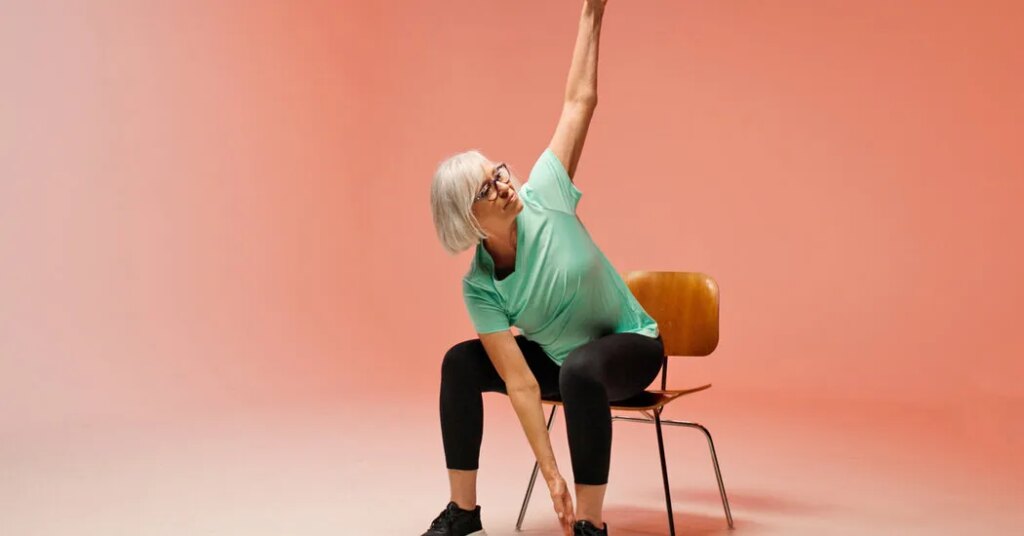
Seated Thoracic Windmills
Repetitions: Two sets of eight repetitions per side
Targets: Stretches the chest and mobilizes the mid-back
Sit on a chair or a bench. Reach down with your left arm and grab your right leg as far down as is comfortable. Rotate your torso to the right as you reach your right hand toward the ceiling, opening your chest. Aim to stack your shoulders, but go only as far as your mobility allows. Return to the starting position and repeat. Switch sides.
Thoracic Extension on Foam Roller
Repetitions: Three sets of eight repetitions
Targets: Stretches the chest and mobilizes the mid-back
Lie on your mat and position the foam roller horizontally beneath your shoulder blades. Place your hands behind your head, keeping your elbows wide. Slowly extend your upper back over the foam roller, allowing your chest to open. Keep your hips on the floor and avoid arching excessively through your lower back. If you need to release pressure, keep more weight on your feet. Hold for five seconds, and then return to the starting position.
Seated Row
Repetitions: Three sets of 15 repetitions
Targets: Strengthens the upper back muscles
Sit on the mat with your legs extended in front of you, keeping a slight bend in your knees. Loop a light to medium resistance band around the soles of your feet and hold one end in each hand. Engage your core and sit tall. Pull the ends of the band toward your hip bones, drawing your shoulder blades back and together. Avoid shrugging your shoulders to your ears. Slowly extend your arms and control the movement back to the starting position.
Half-Kneeling Hip Flexor Stretch
Repetitions: Two sets of 30 seconds per side
Targets: Stretches the hip flexors
Kneel on the mat with one knee on the ground and the opposite foot planted in front of you. (Place a pillow or cushion beneath your knee if needed.) Put your hands on your hips or on top of your knee, tuck your pelvis and tighten the glute on your kneeling side. Keeping that position, shift your hips forward until you feel a stretch in the front of the hip on the kneeling side. Rock in and out of the stretch for the allotted time. Switch sides.
Banded Hip Flexor March
Repetitions: Two sets of 20 repetitions (10 per side)
Targets: Strengthens the hip flexors and engages the core
Stand tall with your feet hip-width apart and loop a short resistance band around both feet. Keeping your torso upright, raise one knee until your thigh is parallel to the floor. Keep your foot flexed and avoid leaning back. Lower your foot with control and repeat on the other side. You can keep your hands on your hips or swing the opposite arm as you march.
Seated Good Mornings
Repetitions: Three sets of eight repetitions
Targets: Strengthens and stretches the hips
Sit on a bench or chair with your feet wider than your hips and your toes out in front of your knees. Slightly angle your feet outward. Hold a light to medium dumbbell in both hands between your legs. Keeping your back flat, hinge forward from your hips and lower as far as you comfortably can, until you feel a stretch through your glutes and hamstrings. Press through your feet and squeeze your glutes to return to sitting.
Sit-to-Stand Squat
Repetitions: Three sets of eight repetitions
Targets: Strengthens the glutes and thighs
Stand in front of a bench or sturdy chair with your feet hips-width apart. Bend your knees and lower into a squat until you tap the chair. Press into your feet to stand back up and squeeze your glutes at the top, being mindful not to arch through your lower back. To make this movement more challenging, you can hold a dumbbell at your chest.
On-set trainer: Cadence Dubus
The post Sitting All Day? This Mobility Routine Can Help You Loosen Up. appeared first on New York Times.