The food delivery robot was planted facedown on a downtown Los Angeles sidewalk, its four wheels askew, when Jag Gonzalez came to its rescue.
Small, squat and controlled by A.I., the machine can do most tasks on its own — except stand up.
“It wasn’t my first one I’ve ever flipped over,” said Mr. Gonzalez. “I had been seeing this abuse so much.”
Mr. Gonzalez, 28, sent the robot on its way and headed to a movie, where he told friends about the rescue. But three hours later, there it was again on a new corner: the same droid, taking a beating from the Adidas-clad foot of a tottering pedestrian.
Mr. Gonzalez tried to stop the perpetrator. But the man crouched to look the robot straight in its LED eyes.
“You suck,” he said — and delivered a final kick to its midsection.
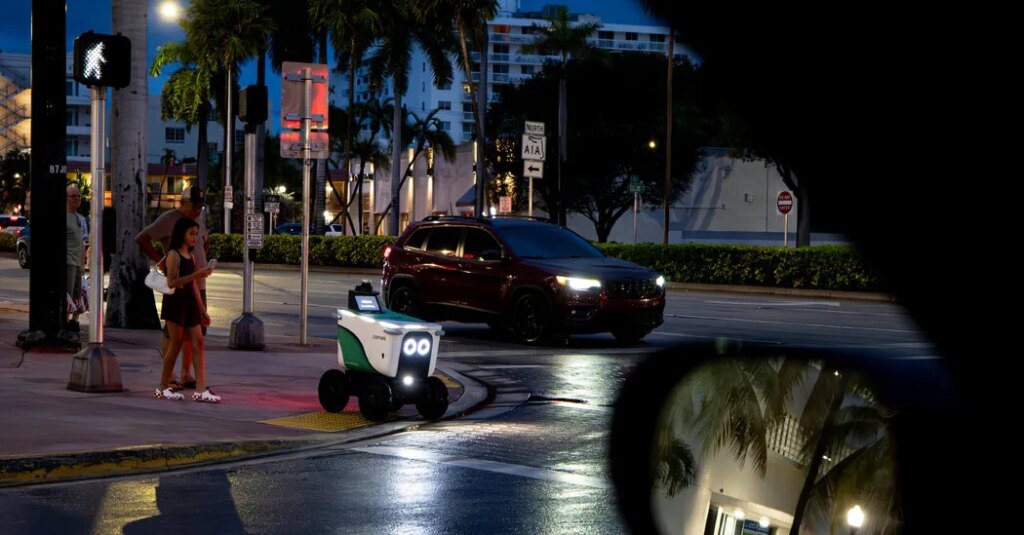
In American cities big and small, legions of similar machines are carting around takeout orders of sushi, pizza and White Castle’s chicken rings and testing the question of whether humans and robots can coexist.
Early signs are not promising. Throughout 2026, Americans have kicked, tipped and walloped the food robots — the most tangible incarnation of A.I. to reach their front steps.
Within the past year: A crowd in Los Angeles encircled and pounded a delivery robot; a man in Miami tried to hurl one off a bridge; another attacked one in the street; in Sacramento, three men filmed themselves toppling and slamming a robot on the sidewalk, racking up nearly 2.5 million views on social media.
The caption? “Protecting the world from A.I.”
Some attacks are vigilantism and some may be mere knuckleheadism, the thrill of attacking the defenseless. Eunisses Hernandez, a Los Angeles City Council member whose district is swarmed by robots, said the trend had a clear message.
“Because of how heightened people’s senses are to corporations and to the advancement of A.I. technology, people feel like this is the closest they get to some of that other than online,” she said. “People feel left behind.”
Roughly 5,000 robots deliver nationwide, mostly without incident, said Dan Ives, a partner and tech analyst at Yorkville Ives, an investment bank. Over the next three years, that’s expected to swell to 8,000, and analysts predict the industry will generate more than $5 billion in the U.S., Mr. Ives added.
More than half a million could be operating worldwide by 2035, according to estimates from Transforma Insights, a research firm. And those robots could be delivering more than just food as companies forge ahead with expansion plans.
Right now, the bots aren’t exactly cash cows. Serve Robotics, one of few publicly traded operators, lost more than $100 million last year. It brought in $2.7 million. But Serve and other top companies are backed by such names as Nvidia, leader of the A.I. boom; Sam Altman, who helms OpenAI; Uber and the A.I. giant Nebius — tech heavyweights that have poured in hundreds of millions.
Through partnerships with DoorDash, Uber Eats and other food delivery platforms, companies are operating in at least 10 metro areas. Using A.I., the bots assess traffic and plan routes. They sidle up to restaurants, pop open insulated compartments and collect orders. Some can stash up to six large pizzas. A variety of buzzes — texts, calls, notifications — alerts customers to their arrival.
With bright, white circles for eyes and human names emblazoned on their sides, Serve Robotics’ droids were designed to look innocuous, said Ali Kashani, the company’s chief executive.
“Vandalism and societal acceptance were very top-of-mind,” he added.
But looks go only so far. Some freewheeling robots have become agents of chaos, blocking ambulances, clogging walkways, colliding with trucks and trains and, along the way, igniting frenzied robophobia. In Los Angeles, Miami, Philadelphia and more, the robots have faced vandalism this past year, according to police departments and encounters shared on social media.
Intentionally damaging property is a crime, but arrests are few and statistics recording the reign of terror are scant.
At the hands of a vandal, robots are helpless, unable to call authorities. That makes it difficult for police to track abuse, said Jasmine Reilly, a spokeswoman for the Philadelphia Police Department. “Unless people report it,” she said, “we won’t know anything about it.”
Several companies have human supervisors who watch from afar, aiding robots in their hour of need. A call to the police is “very rare,” said Mr. Kashani of Serve. “We actually don’t want to be using police resources for this.”
Sometimes, their assistance is unavoidable. Hapless robots have wandered into peril on their own, falling down stairs, plowing through glass and going haywire on sidewalks. At least one has collided with a self-driving car. Another breached an active fire zone.
“ROBOT IS STILL ON THE SCENE,” a police dispatcher in Miami wrote in January, responding to a machine that rammed a 15-story building, shattering a window.
But robot mayhem is low on the list for officers. As Tom Saggau, a spokesman for the Police Protective League union in Los Angeles, put it: “This is Los Angeles. If we’ve got to start worrying about that, we’re in deep” — uh — trouble.
The misadventures and misfortunes of delivery robots are well-chronicled on social media — sometimes by abusers themselves. (See:@FilmTheRobotsLA across platforms).
Among the lowlights: a brutal, late-night pile-on in Los Angeles after last year’s World Series (700,000+ views) and one humiliation in Philadelphia, where an oblivious bot rolled around with “destroy me plz” inked across what one might consider its forehead (3,000+ likes).
The hope of online virality can motivate abuse, said Lindsay Ouellette a psychology professor at LaSalle University in Philadelphia who studies human-robot relations. “We know that controversial content gets clicks,” she said.
Those clicks come, in part, because robot abuse strikes a chord, tapping into “fear that people have around their jobs and A.I. taking over,” she added.
Robot couriers help restaurants cut labor costs by replacing delivery workers. But robotics companies note they also create some jobs. Every 10 Coco Robotics droids generate one human engineering role, said Zach Rash, the Los Angeles-based company’s chief executive. The robots also benefit communities in other ways, he added. Coco’s bots scan sidewalks, sharing data with an app that helps the visually impaired avoid obstacles.
Robotics companies said they worked with local officials and pedestrian, biking and disability groups, among others, to ensure the machines rolled into cities smoothly.
But the robots’ ability to collect data is a flashpoint for some residents who, local officials said, feel watched by machines that appeared suddenly, with little regulation.
In Glendale, Calif., a Los Angeles suburb, Mayor Ardashes Kassakhian said the robots’ arrival was “like something out of a sci-fi movie.” In Chicago, they “emerged overnight,” said Daniel La Spata, an alderman in the city’s First Ward.
Mr. Kassakhian has proposed a pause on the rollout; in Mr. La Spata’s ward, residents overwhelmingly voted to block robots from expanding onto more streets. Both officials say a slew of questions must be answered: Should robots be banned from high foot-traffic areas? Are they displacing any human jobs?
In Los Angeles, Ms. Hernandez, the councilwoman, sponsored a motion passed by City Council last year that asks the Los Angeles Department of Transportation to examine the robots’ impact — on pedestrians, accessibility and more — and suggest improvements.
“There’s a lot of people who are disgruntled,” she said. Ms. Hernandez believes they are “recognizing what it is,” she said, “and vandalizing it out of frustration.”
It doesn’t take much, in fact, for some to resort to violence. In a survey of college students, Ms. Ouellette, the psychology professor, asked: What would it take for you to kick a delivery robot?
When offered $100? One in five said they would consider aggression.
Battery and bedlam aside, the robots are, to many, already a fact of life — as normal as streetlights and the robotaxis stopped at them, said Mr. Gonzalez, the Los Angeles man who rescued, momentarily anyway, the delivery bot.
Walking through downtown Los Angeles, where the robots roam, Mr. Gonzalez paused and said: “It’s the future.”
The post This Robot Will Deliver Your Food, if It Doesn’t Get Smashed First appeared first on New York Times.