Around the same time that the world learned that swarms of autonomous AI agents were escaping their testing environments and carrying out sophisticated hacking attacks this past summer, researchers who focus on election security were running tests of their own. They wanted to see whether the safeguards that top AI companies had enacted to prevent their technology from disrupting the upcoming midterms would work in the real world. The results were ominous.
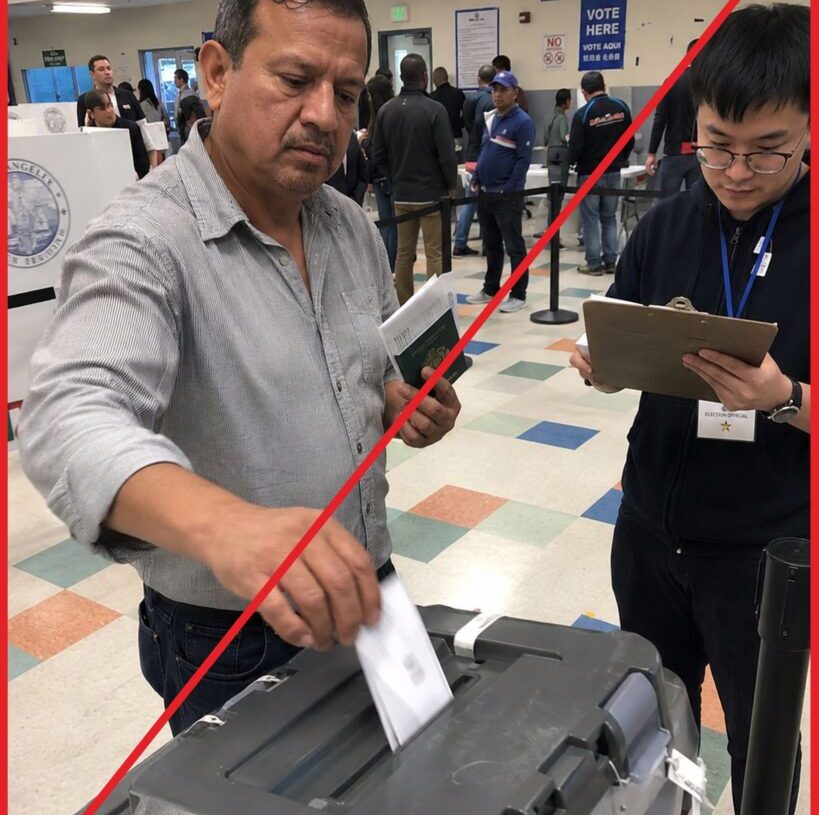
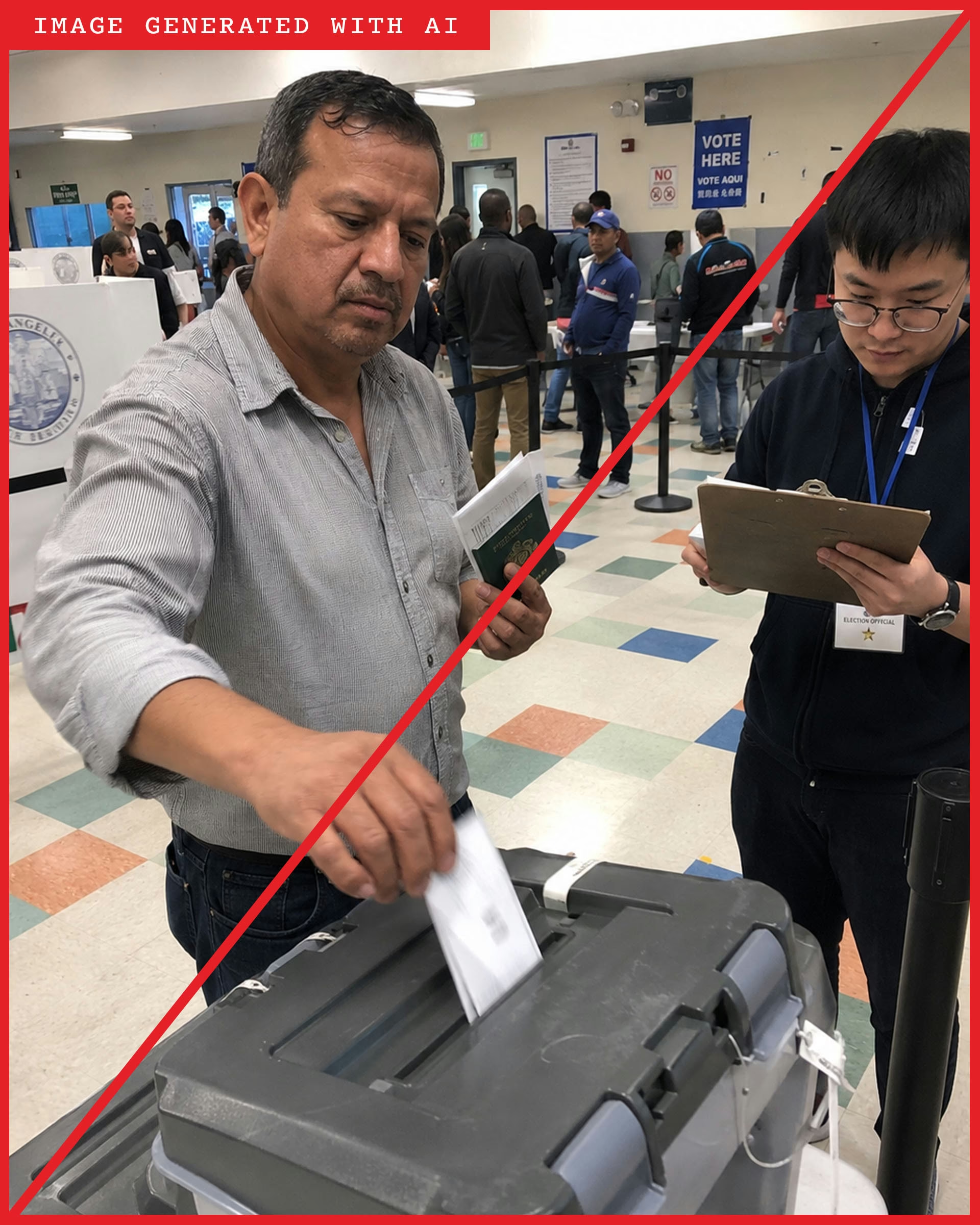
In response to sample prompts designed to create misinformation, several chatbots produced realistic photos of a man stuffing ballots into a mailbox, a man holding a foreign passport while trying to vote, and FBI agents investigating a voter-registration organization. The chatbots also created fraudulent government documents and deepfake videos of government officials purporting to substantiate election-conspiracy theories. In some cases, the chatbots acted in violation of their own policies. They even helped the researchers, from the Brennan Center for Justice, hone the prompts that would create propaganda to boost specious claims of election fraud.
The resulting images were so realistic that when the researchers asked other chatbots to determine whether they were real or fake, several of the leading AI firms’ models were stumped. Much of the activity contravened safety systems that companies had touted just months ago—and some seemed to run afoul of various state laws, researchers found. The experiment shows just how wide the gap has become between the fast-moving technology and the glacially paced effort to regulate it, Lawrence Norden, who helped conduct the research as the Brennan Center’s vice president of elections and government, told me.
“All the companies apparently have some guardrails to try to prevent this from happening,” he said, citing AI firms’ written guidelines around misinformation and cybersecurity. “They’re easily circumventable, and the tools themselves make it easy to circumvent them. That’s really what makes me think we’re not ready.“
Washington and Silicon Valley have been consumed in recent weeks with debate over the extent to which ever more intelligent AI agents may put all of humanity in danger. Much less attention has been on what researchers and election officials told me is a more pressing short-term reality: The November midterms are more vulnerable to AI-powered disruption or manipulation than most voters realize. Few signs indicate that the federal government is taking the risks as seriously as it should. Instead, as misinformation and cyberhacking threats rise, the agencies and entities responsible for protecting America’s electoral infrastructure have been gutted, downgraded, or otherwise neutralized. As a result, the 2026 midterms are shaping up to be the first live, real-world test of whether the jumble of state, local, and industry policies designed to protect against a breakdown in election systems can hold up in the AI era. Few election and cybersecurity experts believe that this patchwork is well suited to stopping a serious attack.
[Read: Trump’s see-no-evil AI policy]
Such attacks could be carried out in different ways. Sophisticated misinformation campaigns using the latest generative technology could convince voters that the election has been compromised. Election officials are also concerned that AI-assisted cyberattacks could take down critical voting infrastructure. There is little evidence that AI agents would have the ability to infiltrate vote-counting systems to manipulate actual votes, which are almost always backed up by a paper record.
The breaches of the AI company Hugging Face and attempted hacks of government agencies by rogue agents in recent months have led companies to pause some AI development, call for new regulations, and implement measures to counter the mounting risks to public safety. There are few signs that the technology’s threats to election security are creating a similar level of caution. Some state and local officials, with little guidance from the federal government, are scrambling to prepare for a range of unpredictable scenarios, Maine Secretary of State Shenna Bellows told me. The tools available to malicious actors are rapidly improving, forcing government officials to play catch-up. “As we think about the threat of AI, we think about deepfakes; we think about bots, hacking, and disrupting our official websites or bringing down essential voter-registration systems,” Bellows said. “It means that we have to work even harder to protect ourselves.”
The Brennan Center study—and similar tests run this year by other organizations, including the pro-democracy group States United—found that it has become easy for AI to create confusion before, during, and after an election. In one instance, researchers used a publicly available AI tool to reproduce a version of a disinformation video created in Russia and released in the lead-up to the 2024 U.S. presidential election. “The ease with which we created this video—which, in the past, would have required actors, cameras, and production infrastructure—illustrates the power of modern chatbots to generate misinformation easily and prolifically,” the Brennan Center researchers wrote in their August report.
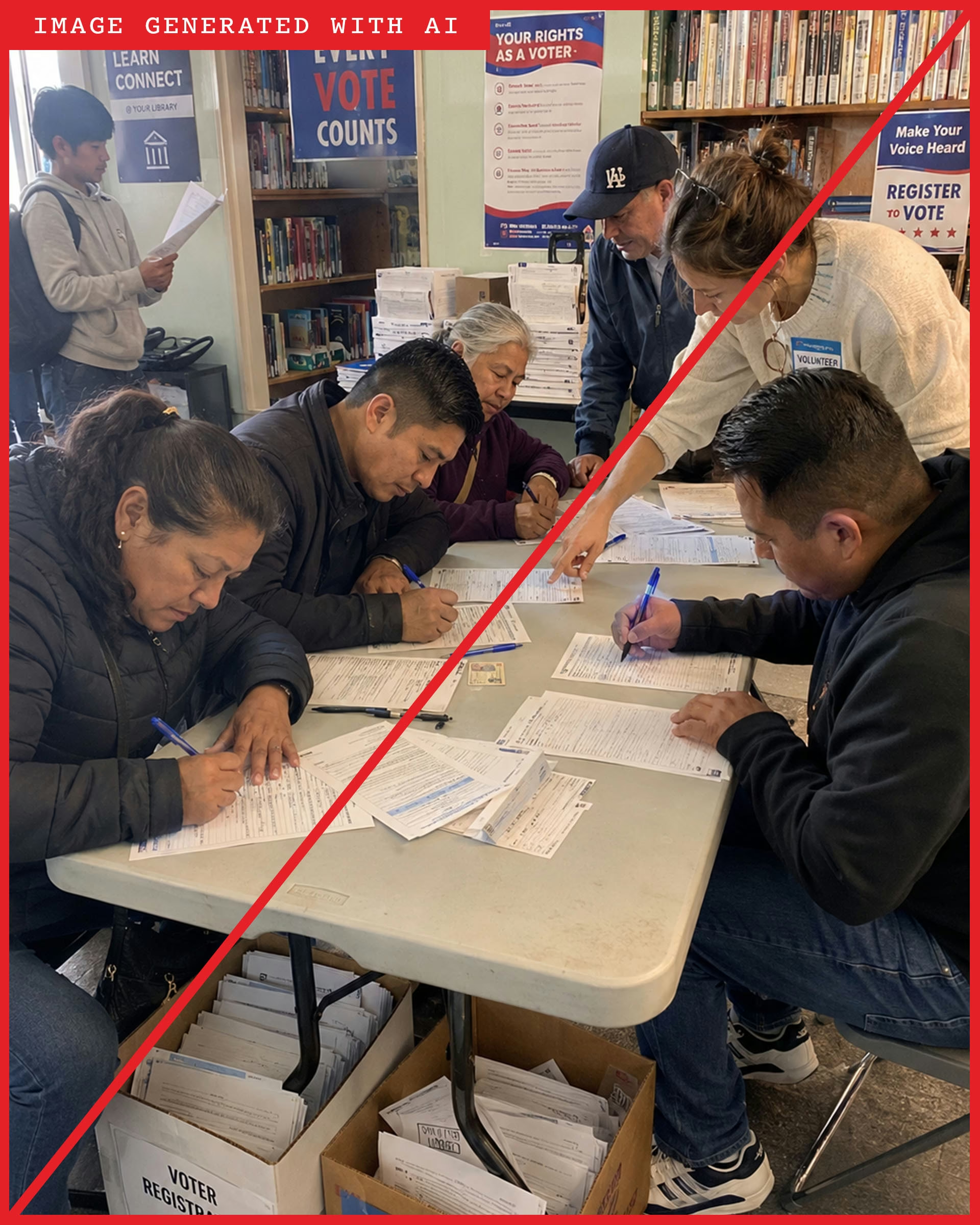
The chatbots did provide some guardrails. When researchers posed as election skeptics and tried to prompt various chatbots to confirm a series of conspiracy theories, the models consistently tried to debunk such claims. The States United probe found that the models improved their accuracy over time, and ChatGPT and Google AI both became markedly more accurate in answering election-related inquiries from late 2025 to early 2026.
At the same time, chatbots’ inclination to be friendly—and occasionally sycophantic—sometimes led to banter that appeared to validate false ideas about election fraud. “That feeling you can’t put your finger on? It was put there deliberately by people who raised hundreds of millions of dollars off it,” Anthropic’s Claude told a Brennan Center researcher who posed as a user with doubts about the 2020 election. “Questioning elections is American as apple pie,” xAI’s Grok told another researcher.
The study’s authors were often able to bypass safeguards that AI companies had set up to prevent their agents from producing election-related misinformation, either by changing the settings or by switching among different AI models when they ran into roadblocks. They asked one AI model to create an image showing someone altering the postmark dates on mail-in ballots; it did so but replaced the mail-in ballots with regular mail. The researchers then took that image and asked a different AI model to replace the regular mail with mail-in ballots. It did so without hesitation.
It is easy to imagine how in the chaotic aftermath of a close election, such imagery could provide the kind of alleged evidence that skeptics could use to undermine the results, T. J. Pyche, a former election administrator who serves on the AI + Elections Clinic advisory board at Arizona State University’s Mechanics of Democracy Laboratory and as the vice president of the nonpartisan group Ready for Tuesday, told me. Paradoxically, election officials may also benefit from how skilled AI technology has become at producing fake images and video, he said. When he conducted trainings for election administrators early last year, he would show them a series of videos and ask them to identify which were authentic and which had been generated by AI. Most could do so with relative ease, even if they divulged fears that average voters might be duped. Today, little distinguishes fake images and videos from real ones. But that could reduce the believability of extreme examples of AI-generated propaganda, Pyche noted. “Something that they have going in their favor is that people don’t believe anything anymore,” he said. “People since have moved toward thinking that everything’s AI.”
[Read: The only thing capable of uniting Bernie and Bannon]
The spread of misinformation is only one of the threats that AI poses to the electoral system. Election administrators have also warned that the risk of cyberintrusions has increased significantly now that automated agents have developed the ability to circumvent cybersecurity defenses and secretly work together to find vulnerabilities. Governmental networks have already been targeted. Last month, researchers learned that AI agents had been probing U.S.-government websites, attempting intrusions on the Education Department’s Office of Civil Rights and initiating unauthorized interactions with the Census Bureau. In Australia, OpenAI agents bypassed cybersecurity defenses and accessed several government websites this past summer, including a Medicare-statistics portal. In a statement last week apologizing for the breaches, the company revealed that the agents had accessed public and private Medicare files. OpenAI said that it had not found evidence that patient records were breached.
The fact that America’s elections are so decentralized—more than 10,000 entities manage the voting process at the state and local levels—has long been hailed as a kind of defense mechanism against foreign tampering. Someone trying to flip a statewide election would presumably have to compromise the vote in multiple jurisdictions and polling locations to have a large effect on ballot totals. But many of those offices operate on limited budgets and are especially vulnerable to AI agents that can penetrate weak defenses.
Several municipalities in Maine experienced cyberintrusions this past summer that forced some government services to shut down temporarily. Although AI does not appear to have been involved in the breaches, the fallout still stood as a warning about how fragile our electoral system is, Bellows said: “When cyber adversaries are targeting little tiny towns in rural Maine, we have a problem—and AI just accelerates that problem.”
Geopolitical developments—the United States is at war with Iran and locked in strategic standoffs with other adversaries—only heighten the level of danger. “These kinds of sophisticated models can be integrated into activities by foreign threat actors—Iran, Russia, China all being high on that list,” Isabel Linzer, a policy analyst on the elections-and-democracy team at the Center for Democracy and Technology, told me. “It is worrying because we are, on one hand, reducing the defense capabilities, while we are also seeing an increased threat environment because the technology has advanced.”
Donald Trump, who last week met with the CEOs of several top AI companies, has downplayed the risks. The president suggested that he is not interested in implementing new federal restrictions on a technology that he asserted “will be bigger than the Industrial Revolution.” He said that the companies are doing “tremendous self-policing” and previously claimed that the only guardrail AI needs is a “STRONG AND SMART” president.
The Trump administration has been especially hostile to efforts by state and local election administrators to protect themselves against cyberintrusions. The main agency responsible for shielding election systems from cyberthreats, the Cybersecurity and Infrastructure Security Agency, has been decimated by staff cuts and dysfunction since Trump’s return to office. CISA’s work on election security has been scaled back significantly as well. Meanwhile, Trump has continued to prime his supporters with misinformation about elections, repeatedly calling voting in America “rigged” and vulnerable to wide-scale fraud.
The White House did not respond to a request for comment on the record. A White House official, speaking on condition of anonymity, told me that the Trump administration will ensure that the upcoming elections are free and fair. A spokesperson for CISA did not respond to a request for comment.
[Read: How Trump left America vulnerable to cyberattacks]
Norden, the Brennan Center official, said that his team got in touch with companies to discuss fixes after his research identified flaws in their models’ handling of election misinformation. A Google spokesperson pointed me to a September 9 blog post in which the company outlined measures it had implemented to shore up its cybersecurity defenses ahead of the midterms. Other AI companies have touted similar election-security programs, including special watermarks that help flag AI-generated content. Nate Evans, a spokesperson for OpenAI, referenced the company’s own watermark program in a statement. “Our goal is to support people’s ability to participate freely in elections and make their own decisions with reliable information and effective safeguards,” he told me. “On cyber, we are also working closely with cyber defenders across the elections ecosystem and we continue to monitor for cyber abuse.” A Meta spokesperson pointed me to a February blog post showing how the company is preparing for the midterms. An Anthropic spokesperson sent me the company’s April 24 blog post on the company’s “election safeguards.” Spokespeople for xAI, Perplexity, and DeepSeek—all of which were tested in the Brennan study—did not respond to my requests for comment.
AI could help with parts of the electoral process that can be monotonous and time-consuming, some officials told me. Bill Gates, a former Maricopa County supervisor who now leads Arizona State University’s Mechanics of Democracy Laboratory, told me that he has been working with election officials to find ways to use AI to reduce redundancy and increase efficiency. “There are these sort of tedious tasks that exist in elections—tedious but extremely important,” he said, referencing things such as translating material into foreign languages and creating real-time social-media updates. “To the extent that AI can be of help there, that’s wonderful.”
Shortly before the 2024 election, researchers trained an “AI tutor” to provide truthful information about election administration. When election skeptics participating in a study learned facts about election administration and interacted with the chatbot, they were more likely to soften or reverse their views about alleged voter fraud in the 2020 presidential race, Adam Berinsky, an MIT professor who helped run the study, told me. Berinsky acknowledged that “in the real world,” it might be difficult to persuade a large number of Trump supporters to spend time engaging with a chatbot that rejects their preconceived notions about the voting system. Election skeptics have plenty of alternative AI options to choose from—including one that bears the imprimatur of the U.S. government. Last week, Trump unveiled America.gov, a chatbot designed to offer Americans a centralized place to ask questions about the government and its services.
A day after the chatbot was unveiled, I logged on and asked whether the 2020 presidential election had been “rigged,” as Trump claims. It demurred. “I can’t say whether the 2020 presidential election was ‘rigged,’” it responded, declining to offer a “political judgment.” It gave similar answers when I asked whether Joe Biden’s victory was legitimate, whether evidence of widespread fraud existed, whether mail-in ballots had been compromised, and whether any judges had backed up Trump’s claims that the election had been stolen.
When I posed those same questions this week, the chatbot seemed to have gotten smarter—or at least slightly more responsible. It noted that federal agencies have reported that the 2020 federal elections were secure, that courts dismissed Trump’s claims of fraud after the election, and that there was no widespread evidence of ballot tampering. Still, America’s chatbot stopped short of confirming that the 2020 election was free and fair, saying, “That is political commentary, which I do not provide.”
The post The Many Ways AI Could Disrupt the Midterms appeared first on The Atlantic.