Mayor Zohran Mamdani on Thursday voiced no regrets about his handling of the third anniversary of the Oct. 7 attacks, after his efforts to mark the day were transformed into one of the most wrenching moments in his brief tenure leading New York City.
Instead, he reaffirmed his confidence in an approach to the Israeli-Palestinian conflict that had caused some Jewish New Yorkers and pro-Palestinian activists to assail his leadership.
Asked about Wednesday’s events at an unrelated news conference in Brooklyn, Mr. Mamdani expressed no regrets about the statement he had released to mark the anniversary. His statement inflamed tensions with many Jewish leaders, who said it had focused too much on Israel’s war in Gaza, and not enough on the people who had been killed or taken hostage in Israel that day.
“It is critically important to be able to mourn for all of those who were killed and have been killed since, especially given that we know this is ongoing,” the mayor said on Thursday. His intention, he said, had been to reckon with “a horror that devastated the lives of New Yorkers three years ago and it also continues to devastate New Yorkers today.”
Mr. Mamdani said on Thursday that he had been clear, and would remain so, that he believed Hamas had committed war crimes in its attacks on Israel on Oct. 7, 2023, in which about 1,200 people were killed and 251 hostages abducted. He also said Israel had used that carnage to justify a prolonged assault on Gaza that had led to the deaths of more than 74,000 Palestinians, actions that he believed amount to genocide.
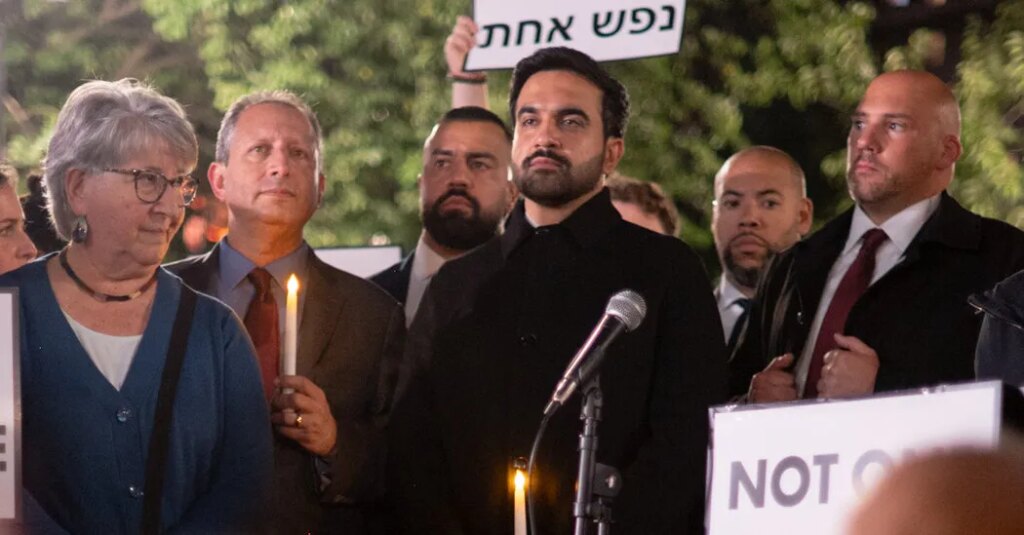
He evinced no doubts about his decision to attend a vigil on Wednesday evening organized by Israelis for Peace to honor those killed in both Israel and Gaza — an event he also attended last year before his election. He did not address the tense scene that developed when a group of pro-Palestinian activists disrupted the gathering, heckled him and called him a “traitor.”
While opposition to the mayor from pro-Israel Jewish leaders has become frequent, he is less accustomed to being publicly jeered by fellow critics of Israel for acknowledging the grief of Israelis and Jews.
But he said on Thursday that New Yorkers would find a way to come together, despite accusations from Jewish leaders that his focus on Israel has threatened the safety of his Jewish constituents amid heightened fears about antisemitism and violence.
There is a political logic to the consistency of his message.
“As a communications consultant and strategist, you would never tell your client to flip-flop,” said Lupe Todd-Medina, a Democratic political consultant. “You’ve got to own your position and stay there.”
But that consistency did little to resolve the predicament facing Mr. Mamdani, who is navigating a fraught relationship with Jewish leaders and growing skepticism from some of his allies on the left.
The Israeli-Palestinian conflict has dogged Mr. Mamdani since he took office in January as New York City’s first Muslim mayor, a dyed-in-the-wool pro-Palestinian activist and critic of Israel in a city that has a growing Muslim population and remains 12 percent Jewish. As a mayoral candidate, he promised to arrest the Israeli prime minister, Benjamin Netanyahu, if he set foot in the city.
His unabashed stance on the issue, in a city where politicians have long been almost reflexively pro-Israel, excited Muslims and young activists who enthusiastically joined his coalition.
But governing is different from campaigning.
It turned out that he had no authority to arrest Mr. Netanyahu, which his team had told him for months but which he only publicly acknowledged in a video in July. That video rattled Jewish leaders, who saw his sharp denunciations of Israel and its leader as a move to reassure his base while distracting from his abandonment of a campaign promise.
In August, during a meeting at City Hall, rabbis beseeched the mayor to lower the temperature and to more carefully consider how his words affected Jewish New Yorkers. And for a time, he seemed to retreat from talking about the Middle East as often.
Tensions resurfaced soon after when, amid the Jewish High Holiday season, the mayor’s office released a report on its efforts to combat antisemitism, which had risen across the United States after the Oct. 7 attacks.
The report steered clear of the thorny issue of Israel, but it nevertheless angered some of Mr. Mamdani’s supporters, who flooded social media with accusations that he was bowing to a Zionist agenda by highlighting hate crimes against Jews, interpreting the notion of hate crimes too broadly, and providing funding to a Jewish community group that supports Israel.
The post Mamdani Stands By His Handling of Oct. 7 Anniversary After Emotional Day appeared first on New York Times.