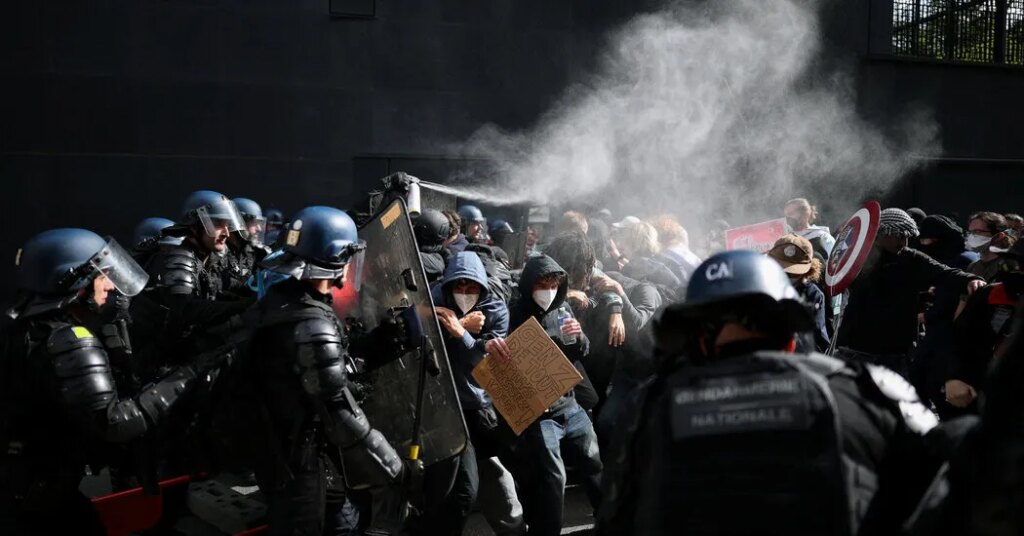
Chanting, marching and clashing at times with the police, French students protested for the second day this week on Thursday as officials looked for ways to ease a crisis that has threatened to swell into a nationwide wave of grievance.
Although officials estimated that the protests were smaller than the ones on Tuesday, they were still large and boisterous, as thousands of young people railed against overcrowded classrooms, a shortage of teachers and decrepit facilities. The mass demonstrations, sometimes joined by labor unions, parents and teachers, began more than two weeks ago, forcing hundreds of schools to close, and more are scheduled for next week.
Thomas Droit, a 22-year-old law student, said that in his five years of study at CY Cergy Paris University, he had “never seen a protest of this magnitude.”
The protest, he said, was about a “convergence of struggles” — a phrase that has gained traction in the protests — from all parts of society. He cited his own concerns about the government’s plan to freeze housing benefits for students and to make foreign students pay higher university fees.
“And personally what angers me is that high school students have been severely repressed,” he said.
Many protesters said they were outraged by videos they had seen online of police violence against high schoolers, some of whom had thrown debris and launched fireworks at officers.
“We are used to seeing police in France beat people, but they are normally adults. These are kids,” said Kerra Underwood, 20, a psychology student who was among the protesters who flooded into the Place de la Bastille, a main square in Paris. The crowds chanted “justice nowhere, police everywhere,” and a demand of the current president: “Macron, resign.”
The police scuffled in the square with protesters who threw plants, chairs and benches toward officers. Officers with riot shields charged toward some of the protesters and fired tear gas, sending people running.
Orian Loupescande, 20, a business student, who was crying from tear gas, blasted the police response, saying that students had come to demonstrate peacefully. “It’s shocking because it means we don’t have the right to protest,” he said.
The demonstrations have come at a fraught moment for France. The country will hold a presidential election in April, and polls indicate a far-right candidate, Marine Le Pen, has a plausible path to victory to succeed the current president, Emmanuel Macron.
In front of the Lycée Turgot, a public high school in Paris, Zoé Baby-Coutousis and May Souai, both 15, said they were protesting in solidarity with their peers in the suburbs where there are higher levels of unemployment, poverty, immigration and teacher absenteeism.
“We’re all supposed to have the opportunities,” May said. Their school had problems, too, they said. The days were too long, teachers were absent in some classes and the building was not equipped to deal with climate change, they said.
French officials said were listening to the students’ concerns. The education minister, Édouard Geffray, met with representatives of three major student groups on Thursday. After the meeting, Mr. Geffray said that they had discussed the state of school buildings across the country, the unfairness of the university application system, absent teachers and the importance of dialogue and democracy in schools.
Mr. Geffray has also pledged that there will be no job cuts in schools, in an effort to address student complaints about a shortage of teachers. But the government won’t unveil its new education budget until Nov. 12, which has left many students frustrated.
The French government, in the throes of a financial crisis, has offered students little remedy beyond suspending classes so they can voice their complaints.
The demonstrations could grow in size next week, when one of France’s main teachers’ unions has called on high school teachers and university professors to take part in a third day of nationwide protests. On Tuesday, when union activists joined the students protesters, the demonstrations drew an estimated 266,000 people across the country, and 71,500 in Paris, according to the Interior Ministry. The unions estimated the crowds were more than twice that large.
Just over 150 high schools were closed across France on Thursday, compared to 900 on Tuesday, according the education ministry. Students have barricaded some of them, and a handful have been set on fire. The police have made thousands of arrests since the protests began.
Some students have compared the mood to May 1968, when mass demonstrations, street battles and nationwide strikes transformed France. But so far, the protests have been more tightly focused, and not as ideologically potent, said Julian Bourg, a history professor at Boston College.
“That said, each major French protest movement does raise the possibility that the demands of a specific cohort may lead to more generalized protest and a broader political crisis,” he said. “That is the echo of 1968.”
In a speech to the nation on Wednesday, the French prime minister, Sébastien Lecornu, sought to assuage student anger. He pledged to fill vacant teaching positions and to identify urgent problems in school buildings, among other priorities. He also called on students and teachers to hold discussions in schools about how to improve the state of education.
“Young people’s anger doesn’t come out of nowhere,” Mr. Lecornu said, as he urged students to “choose their path and look to the future with confidence.”
On Thursday, some of the student protesters dismissed Mr. Lecornu’s remarks as a delay tactic.
“His speech motivated us to keep blocking our school until the government stops refusing to listen to us and responds to our demands,” said Augustin Lassaab, 17, who was protesting in the Place de la Bastille. “We will not stop.”
Giulia Imbert, Zane Irwin, Aurelien Breeden and Michael Levenson contributed reporting.
The post French Students Take to the Streets as Government Seeks Way Out of Crisis appeared first on New York Times.