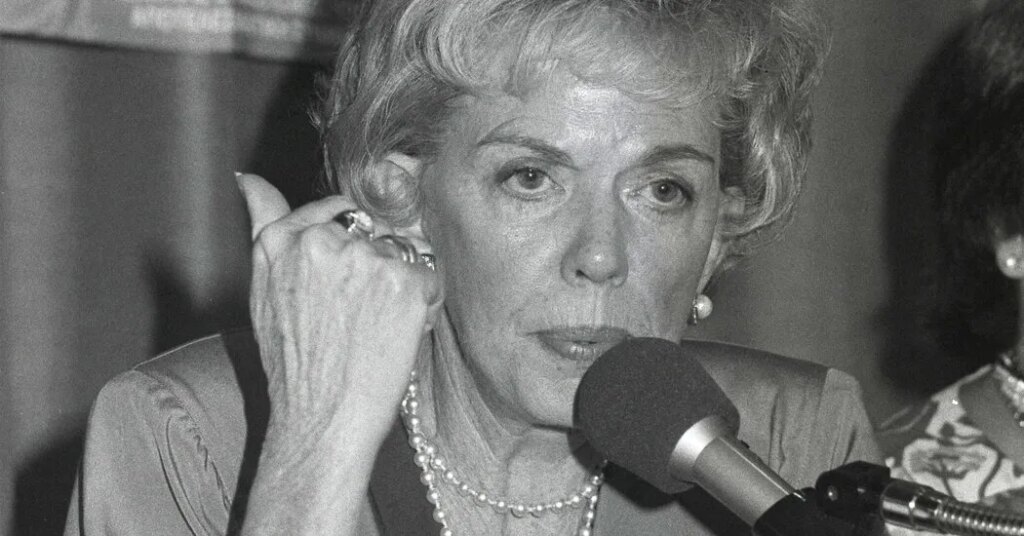
Margaret Papandreou, who helped transform legal and social rights for Greek women in the 1980s as the American-born wife of Prime Minister Andreas Papandreou and who later supported feminist and socialist movements around the world, died on Sept. 18 at her home in Palaio Faliro, a seaside suburb of Athens. She was 102.
Her family announced the death.
Ms. Papandreou’s tireless organizing and her direct pipeline to power were credited with spurring fundamental shifts in Greece that included legalizing abortion and removing antiquated social codes, such as requiring a husband’s permission for a woman to start a business or travel abroad with their children.
“The women’s movement is a political movement,” she said at a United Nations conference on women in Nairobi, Kenya, in 1985. “It is a social revolution. It is about changes in society, changes that are global.”
After a bitter public divorce in 1989, she expanded her role in international efforts to promote women in politics and retained prominence in Greece as matriarch of the third generation in a left-leaning political dynasty. Her son George A. Papandreou (pronounced Pap-an-DREY-oo) served as prime minister from 2009 to 2011.
With an easy smile and Midwestern openness that confused and charmed Greeks, Ms. Papandreou set the foundation for her influence in women’s issues during the heady era after the collapse of a seven-year military junta in 1974.
The Papandreous had fled from the junta’s crackdowns on dissent and were back from a self-exile in northern Europe and Canada, where Ms. Papandreou wrote a memoir, “Nightmare in Athens” (1970), recounting the events as dictatorship began in 1967. With the return of democracy, her husband’s Panhellenic Socialist Movement, or Pasok, was surging in strength.
Ms. Papandreou, who was known as Margarita in Greece, borrowed from the party’s populist-style tactics. She traveled across cities and rural areas to meet with women to discuss their aspirations and concerns, which at the time included the age-old system of the bride’s family providing a dowry before marriage. (It wasn’t until 1952 that Greek women could vote in national elections.)
Her efforts coalesced around the Women’s Union of Greece, a group she founded in 1975 and led for eight years. Opposition came from many directions. The Greek Orthodox Church claimed that Ms. Papandreou was undermining cultural traditions. Right-wing newspapers painted her as an interloper and made note of her American-accented Greek.
But national elections in 1981 gave Pasok a landslide victory and made her husband prime minister. “We’ve had enough of being second-class citizens, always pushed to the margin,” Ms. Papandreou said to a crowd of female voters at a pre-election rally for the Greek actress, singer and political activist Melina Mercouri, who was her husband’s ally. Ms. Mercouri won a seat in Parliament and was named culture minister.
Using the clout of her first lady status, Ms. Papandreou lobbied Pasok members in Parliament to act quickly on legislation to dismantle the restrictions on women.
Her crowning moment came in 1983 with the passage of a sweeping law that effectively gave women equal status on domestic issues and ended any lingering male-permission rules. The reforms also abolished dowries, created divorce by mutual consent and made single mothers the legal guardians of their children. In another first, women no longer had to change their names after marriage.
In 1986, Greece legalized abortion, making it one of the last Western European countries to end widespread restrictions — although some countries, including Poland and Malta, still maintain strict abortion regulations.
In a statement from President Constantine Tassoulas of Greece after Ms. Papandreou’s death, he described her as a cornerstone for “the reform of family law, the breakthrough in social and political rights, and the modernization of women’s status in Greek society.”
Apart from her political achievements, Ms. Papandreou’s legacy was also intertwined with modern Greece’s most watched breakup drama.
In a spectacle that played out in the press, she endured humiliation and responded with scorn after her husband of nearly 40 years and father of her four adult children started a relationship with Dimitra Liani, an Olympic Airways flight attendant who was half his age.
By the late 1980s, Ms. Liani had become the de facto first lady. She appeared with the prime minister during visits by dignitaries and at international events. In 1988, Ms. Liani and the prime minister were photographed walking hand in hand on the grounds of Harefield Hospital outside London, where he underwent heart surgery. Ms. Papandreou refused to visit him.
At first, Ms. Papandreou said she would not agree to a divorce, but she signed the papers in June 1989. The next month, just after finishing his second term, Mr. Papandreou, then 70, and Ms. Liani married. He was back in office from 1993 to 1996, resigning months before his death.
During Ms. Papandreou’s marital ordeal, public sympathy largely flowed to her because of how the prime minister flaunted his extramarital relationship in public.
“I refuse to be the victim,” Ms. Papandreou told The New York Times in 1989. “I believe I will come out of this very strong. Maybe I’ll come out of it the stronger of the two.”
Margaret Esther Chant, the oldest of five sisters, was born in Oak Park, Ill., on Sept. 30, 1923, and raised in nearby Elmhurst, west of Chicago. Her mother, Hulda (Pfund) Chant, was a homemaker, and her father, Douglas Chant, was a car mechanic who lost his job during the Great Depression.
The family’s financial struggles left a deep imprint on Margaret’s views on social justice.
“It seemed to me that there was something very unjust about people having a lot of money while others had none,” she later told The Washington Post. “The principles of socialism appealed to me. They were human goals, health, education, a right to work.”
At the University of Minnesota, she received a bachelor’s degree in journalism in 1946 and a master’s degree in public health in 1950. During her postgraduate studies, she started a small public relations firm in Minneapolis and struck a side deal to help a local dentist write his autobiography in exchange for free dental care.
While in the waiting room at the dentist’s office in 1948, she met Andreas Papandreou, an associate professor of economics at her alma mater and the son of a former Greek prime minister, George Papandreou, one of the pro-Western power brokers as Greece descended into factional fighting after World War II.
“By the end of that evening, I was in love with him,” she recalled to The Minneapolis Star Tribune in 1996. He was married at the time, and she was later briefly married to Robert L. Hall, a doctoral student in sociology. After their divorces, they wed each other in 1951.
Mr. Papandreou became chairman of the economics department at the University of California, Berkeley, in 1955, but he harbored ambitions as political heir to his father, and the couple relocated to Athens in 1961.
Mr. Papandreou’s political rise was soon underway after his father regained the prime minister post in the mid-1960s, a period of political upheavals when military commanders began plotting the coup. Ms. Papandreou came to wider notice to the Greek public in the coup’s aftermath as the junta rounded up left-leaning political leaders, students, intellectuals and others, including her husband.
She aggressively campaigned for his release, enlisting prominent friends like the economist and former U.S. diplomat John Kenneth Galbraith. After Mr. Papandreou was freed in 1968, the family left the country and eventually settled in Canada.
From their self-exile, Ms. Papandreou and her husband were increasingly dismayed by U.S. aid to the junta, which was seen by Washington as an anti-communist bulwark despite the regime’s repression and human rights violations.
For decades after, Ms. Papandreou and her husband remained sharp critics of U.S. policies, calling for the removal of military bases in Greece and describing unfettered capitalism as “anti-feminist.”
“I don’t hate the people there, or even the government,” she told The Globe and Mail of Toronto in 1983. “I just think it’s on the wrong track, that it neglects the interests of poor and oppressed people. But it would be nonsense to deny my past, my culture.”
In addition to her son George A. Papandreou, survivors include two other sons, Andreas Papandreou and Nikos Papandreou, a member of the European Parliament; a daughter, Sofia Papandreou; six grandchildren; and a great-granddaughter.
In 2015, Ms. Papandreou published a second memoir, “Love and Power: A Midwestern First Lady.” In speeches and interviews, she recounted being asked whether she ever dreamed she would become the wife of Greece’s prime minister.
“No,” she liked to say. “I dreamed I would grow up to be the prime minister of Greece.”
The post Margaret Papandreou, American-Born First Lady of Greece, Dies at 102 appeared first on New York Times.