The Trump administration argues that its proposed multibillion-dollar Russian oil deal would advance American foreign policy interests and lower energy prices.
But most of the ownership in the deal would go to a group of Middle Eastern investors, including some with business ties to key U.S. officials involved in the negotiations, according to people familiar with the talks.
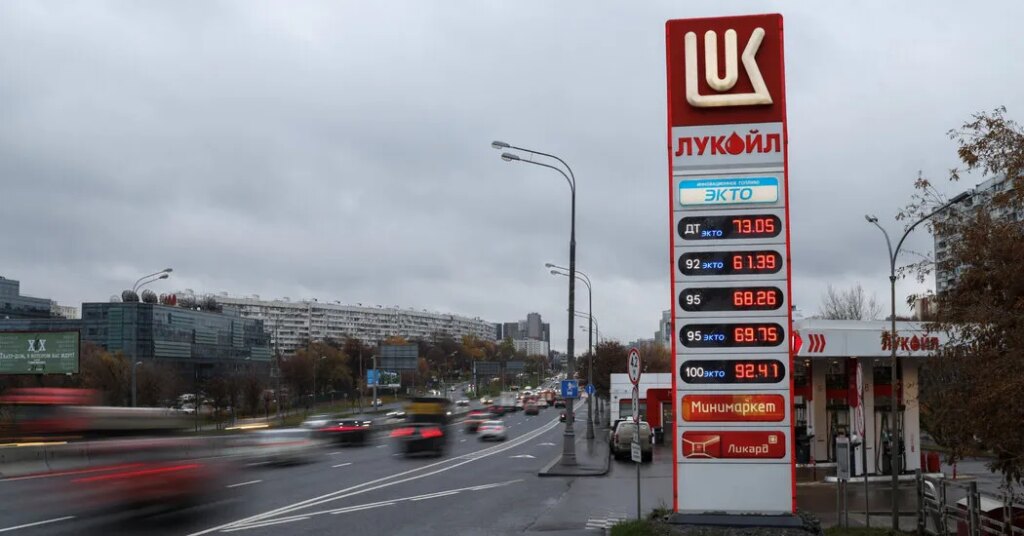
The deal, for a worldwide portfolio of oil fields, refineries and gas stations now owned by the sanctioned Russian energy giant Lukoil, has become intertwined with the U.S. talks with Russia over ending the war in Ukraine, The New York Times reported last week.
The United States government, through the U.S. International Development Finance Corporation, would get a stake of about 15 percent in the deal, without investing any cash up front, the people said.
The leader of the investor group, Todd Boehly, an American billionaire who has donated $2 million to pro-Trump causes in the last two years, would get a smaller minority stake.
But more than half of the equity will be cumulatively held by investors in the Middle East, according to three participants in the negotiations. The investors include entities tied to the royal family in Abu Dhabi and to two billionaire Syrian-born Qatari brothers, who are business partners with Jared Kushner, the president’s son-in-law, and Ivanka Trump, the president’s daughter.
The deal is structured in such a way that the United States — through Mr. Boehly and the government — would control a majority of the board of the resulting entity, some of the people close to the deal said. A senior administration official said the deal included a “substantial upfront payment and profits interest for the United States,” would enhance American “energy dominance” and outlast the current administration.
The Boehly group would acquire Lukoil stock with a face value of about $10 billion from non-Russian owners, although these purchases would be made at a significant discount, according to participants in the negotiations.
Once the purchase agreement is complete and approved by the Treasury Department, the assets would no longer be affected by U.S. sanctions on Lukoil, instantly driving up their value.
This deal is still in flux and could fall apart, but one of the previous bidders — the private equity fund Carlyle, based in Washington — is no longer actively pursuing the deal, after the U.S. government failed for months to sign off on Carlyle’s bid, according to parties involved in the deal talks.
The foreign-majority ownership raises new questions about who stands to most benefit from this complex transaction, which has involved negotiations with officials from the White House and the Kremlin, as well as a still-opaque list of investors from across the world.
President Vladimir V. Putin of Russia brought up the deal when he met at the Kremlin last month with Mr. Kushner and Steve Witkoff, a real estate developer, who both serve as Mr. Trump’s special envoys on the war in Ukraine. In Moscow, Mr. Putin is widely seen as having final say on the deal, even though Lukoil is a private company; in Washington, the Trump administration will need to approve it because of last year’s U.S. sanctions on Lukoil.
Whether or not the deal goes through, the behind-the-scenes negotiations over Lukoil show how Mr. Witkoff and Mr. Kushner have mixed their high-stakes diplomacy with talks that could provide a windfall to their business allies.
There is no indication that Mr. Kushner and Mr. Witkoff themselves stand to profit. The senior administration official said that the only interest guiding Mr. Kushner and Mr. Witkoff was “what is in the best interest of the American people.”
The deal’s proponents argue it would also be a windfall to U.S. taxpayers and a boon for U.S. interests because of the strategic assets in the deal, including key refineries in Eastern Europe. And the Trump administration has argued that showing Mr. Putin that the United States is prepared to do more business with Russia could help persuade him to compromise and end his war in Ukraine.
But for Mr. Putin, analysts say, the Lukoil sale has presented a chance to follow through on a strategy he has pursued ever since Mr. Trump returned to office: to use the promise of U.S.-Russia business deals to dissuade the White House from putting more pressure on Moscow over Ukraine.
Even better, from the Kremlin’s perspective, is that Mr. Kushner and Mr. Witkoff have business ties to two of the Middle Eastern investors involved in the deal, analysts say.
“The national security interests of the U.S. and U.S. allies, and private interests, are just so conflated,” Alexander Gabuev, director of the Carnegie Russia Eurasia Center, said. “That’s exactly the muddy waters that Putin and his K.G.B. negotiating school are thriving in.”
As Mr. Putin escalates his bombardment of Ukraine, Mr. Gabuev went on, “Lukoil just helps him to buy time.”
In the United Arab Emirates, one of the major investors is led by Sheikh Tahnoon bin Zayed Al Nahyan. He is a powerful member of the Abu Dhabi royal family whose business ventures have also invested in Mr. Kushner’s private equity fund and in World Liberty Financial, the cryptocurrency company co-founded in 2024 by Mr. Witkoff, as well as his and Mr. Trump’s sons. The White House has said that Mr. Witkoff has divested his position in the company.
In Qatar, the deal’s investors are the billionaire Syrian-born brothers Ramez and Moutaz Al-Khayyat, who are partners of Mr. Kushner and his wife, Ivanka Trump, in a proposed multibillion-dollar luxury Mediterranean coast resort in Albania.
The Khayyats and their Doha-based conglomerate have moved rapidly over the last year to expand business deals in the energy sector, including the oil industry, with investments now in Syria, Iraq, Libya and most recently in Venezuela.
The family has close ties to the royal family of Qatar dating back more than a decade, including with Sheikh Suhaim Bin AbdulAziz Al Thani, who serves on the boards of two of the Khayyats’ ventures.
Carlyle in January separately secured a “nonexclusive” purchase agreement, with a plan to put the payment at least temporarily into a locked up U.S. bank account, to avoid bringing profits to Russian investors who own Lukoil. But it then did not get the sign off it needed to complete the deal.
Some of the people close to the deal said the Carlyle deal was a nonstarter for the Russians, since they did not expect that the United States would ever release the money kept in a U.S. account.
These talks among possible buyers including Carlyle and Mr. Boehly started late last year after the Trump administration imposed sanctions on Lukoil, in an effort to force the end of the war in Ukraine. Lukoil’s international assets are spread across Europe, Africa, Mexico and the Middle East, and also include about 200 gas stations along the Mid-Atlantic coast of the United States.
The deal would need approval from the Treasury’s Office of Foreign Assets Control, which has set as a precondition for lifting the sanctions that any transfer of the assets “not provide a windfall to Lukoil,” since the United States does not want to deliver profits back to Russia.
The move by the United States government to impose sanctions on a foreign company and then play a direct role in moving to buy these sanctioned assets is extremely unusual, according to two former federal officials involved in sanctions efforts.
“I cannot recall any remotely similar arrangement in the 20 years I’ve focused on sanctions,” said Jeremy Paner, a former Treasury Department sanctions lawyer who now handles corporate sanctions compliance efforts.
In a statement, an official with the U.S. International Development Finance Corporation said the proposed deal was good for the United States, as it “would advance the Trump administration’s commitment to strengthen U.S. economic security, advance U.S. foreign policy and lower energy prices for everyday Americans.”
The Trump administration, at least initially, would not put money into the deal, people familiar with the deal said, but the United States will still be in line to secure profits.
Once the sale of the Lukoil international assets are complete, the buyers plan to spend hundreds of millions of dollars to expand and retrofit different parts of these operations.
The negotiations are delicate, the people said, because Mr. Putin could still reject it if he sees it as unduly benefiting the United States. That is why, they said, the participation of Middle Eastern investors is important, since the Kremlin sees Qatar and the Emirates as friendly countries.
“Look at what’s happening to Lukoil,” Mr. Putin said at a conference last week, accusing the West of “the theft of our companies.”
The Treasury Department has set an Oct. 22 deadline for the negotiations over the sale. That deadline might be extended again, but on Wednesday two U.S. senators sent a letter to Secretary of State Marco Rubio and Treasury Secretary Scott Bessent insisting that they ensure no financial benefits go to Russian players if the Lukoil sale is approved.
“Every day that passes without maximum economic pressure allows Moscow to sustain this military escalation,” read the letter from Senator Roger Wicker, Republican of Mississippi, the chairman of the Senate Armed Services Committee, and Senator Jeanne Shaheen of New Hampshire, the top Democrat on the Senate Foreign Relations Committee.
Dmitri S. Peskov, Mr. Putin’s spokesman, declined to comment on the Lukoil sale process when asked about it in his daily conference call with reporters on Monday.
“I will only say that, indeed, the topic of interacting and cooperating in the energy sector is indeed being raised in conversations with American counterparts,” Mr. Peskov said.
Ana Swanson, Tyler Pager, Ivan Nechepurenko and Andrew E. Kramer contributed reporting.
The post In Trump’s Russian Oil Deal, Middle East Funds Are the Biggest Owners appeared first on New York Times.