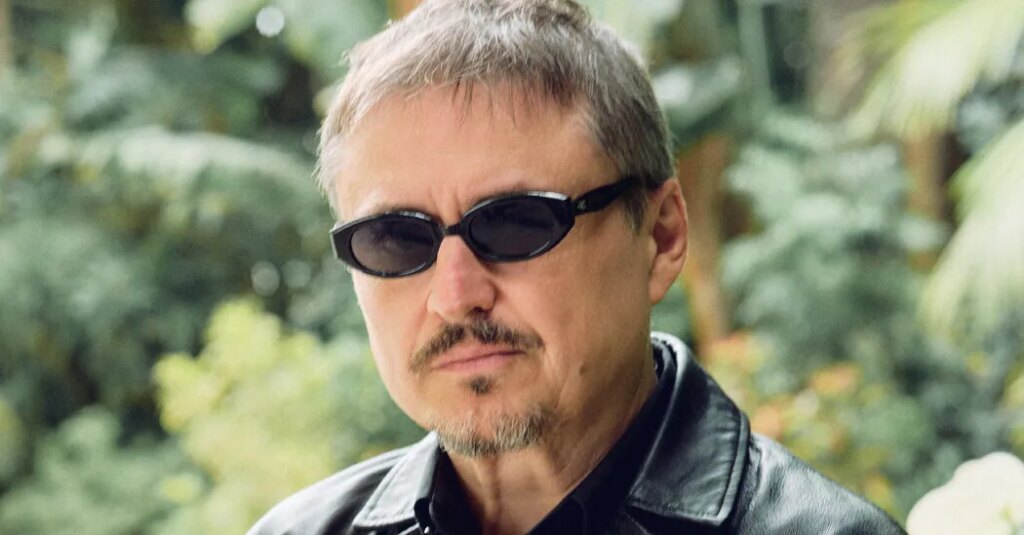
The most devastating scene in “Fjord,” a new movie by the Romanian director Cristian Mungiu, comes about a third of the way through. In a lengthy sequence, Lisbet, a Christian living with her husband in a small Norwegian town, gets an unexpected visit from local officials who suspect the couple of abusing their children.
When Lisbet — played by the Norwegian actress Renate Reinsve of “Sentimental Value,” and “Backrooms” — realizes that the visitors aim to take away their children before their investigation begins, she vaults excruciatingly from shock to fury to anguished despair. Filmed in Mungiu’s signature observational style, with long takes and without close-ups, the scene leaves viewers to judge for themselves who is a victim and who is a perpetrator.
This openness to interpretation is the point of “Fjord,” which won the top prize at the Cannes Film Festival this year and comes to U.S. theaters on Friday. Should the state be able to confiscate children with only thin evidence of abuse? Or should parental rights prevail? The answer, Mungiu, 58, said in a recent interview, depends on the “values you come into the film with.”
That ambiguity is a hallmark of Mungiu’s career. One of Romania’s most accomplished directors, he first attracted global attention in 2007, when his searing drama about abortion, “4 Months, 3 Weeks and 2 Days,” also won the top prize at Cannes. (Only eight other directors or directing duos have won that award, the Palme d’Or, twice.) Mungiu’s films since then have shared an observational distance, formal rigor and willingness to test his audience’s ethical compass.
Sitting in his office in Bucharest, Romania’s capital, the chatty, soft-spoken director explained that “Fjord” was a “nonjudgmental” invitation for viewers to scrutinize their own capacities for empathy and open-mindedness. “The aim is to understand that there are people who think differently than you,” Mungiu said.
The story, which centers on the couple’s quest to get their children back from the Norwegian authorities, is complicated by larger questions of belonging and culture. Lisbet is Norwegian, but her husband, Mihai, played by Sebastian Stan (of the Marvel Cinematic Universe and “A Different Man”), is from Romania. When he says he occasionally spanked the children, investigators consider that an admission of abuse, though he protests that this is a common punishment in his homeland.
“Fjord,” Mungiu’s first movie filmed outside Romania, is based on real-life cases in which the Norwegian authorities took children from parents accused of abuse (including a 2015 situation involving a Romanian Norwegian family). Mungiu said he saw the movie as a way to explore how liberal societies handle people with less liberal views.
In the film, Lisbet and Mihai’s progressive Norwegian neighbors are unnerved by what they see as the couple’s strict religious beliefs, which include daily prayer, a ban on secular music and the view that homosexuality is a sin. The film’s central conflict — between a state that claims to be inclusive and a family shaped by conservative Christian ideals — reflects Mungiu’s belief that immigrants “don’t just come with their luggage, they come with their cultural values,” he said.
Mungiu argued that “little by little,” such differences “create a lot of tension in society.” The inability to resolve differences through discussion and empathy, he said, caused rifts that could become dangerous.
Although he was loath to define a through line in his films — “I don’t think of them as a body of work, or sit on the couch and think, ‘Why?’” he said — he did say that he was interested in exploring conflicts in people’s everyday lives.
“4 Months, 3 Weeks and 2 Days,” for example, follows a young woman grappling with the physical and moral costs of getting an illegal abortion in Ceausescu-era Romania. In “Graduation,” from 2016, a man becomes embroiled in corruption as he tries to secure an international scholarship for his daughter. “R.M.N.,” from 2022, centers on a xenophobic backlash after foreign workers arrive in a village in the Transylvania region.
Stan, who partly grew up in Romania, said that he had long been impressed by the “authenticity” of Mungiu’s Romanian characters. “It’s like he picked them off the street and put them in his films,” he said.
The actor also acknowledged the challenge of recording Mungiu’s trademark long takes, which can last up to 17 minutes (in a climactic scene in “R.M.N.”). The technical demands of the approach require an average of 20 takes per shot, though, at times, Mungiu said, he has needed more than 50.
Reinsve said that she was daunted by the 12 pages of script she had to learn for the scene in “Fjord” when the officials visit Lisbet. “By take three, I was already kind of exhausted, and he had just started building the mise-en-scène,” she wrote in an email. The scene, which was shot on the first day of filming, required 14 more takes. “It was intimidating going into it,” she wrote, “and it was so different from anything I’d done before.”
A background in theater and music are helpful for working with Mungiu, said Anamaria Marinca, who starred in “4 Months, 3 Weeks and 2 Days.” “People commented on the number of takes, but for me it was never a problem,” she said. “I studied classical music, so I’m used to repetition,” she said, adding that Mungiu “knows exactly what he wants.”
According to Mircea Olteanu, Mungiu’s longtime editor, the naturalism of his films camouflages an intense attention to detail. The director’s exacting ideas about the cadence of his dialogue, he said, can be particularly intense. “I’ve been on set, and if the actors go out of the rhythm,” Olteanu said, “he would just say, ‘Cut.’”
Mungiu said maintaining such levels of control was one reason that he decided to stay in Romania instead of working in the United States. “I don’t want to be someone else’s employee,” he said.
Mungiu, born in 1968 in Iasi, a city in northeastern Romania, to a doctor and teacher, said he initially became a journalist because he lacked the connections in the communist system to become a filmmaker. He enrolled in film school in Bucharest after the fall of Nicolae Ceausescu in 1989, then began working as an assistant director for American and French productions in Romania.
After his first feature film, “Occident,” was shown at Cannes in 2002, Dennis Hopper invited him to collaborate on a film about the revolution that swept Ceausescu from power. The film was never made and the experience of living in Los Angeles during this time convinced Mungiu that he would be better off staying in his homeland. (He also later recalled being asked by Dustin Hoffman to teach filmmaking to his children.)
“Graduation,” which earned him the best director award at Cannes in 2016, was a way of grappling with that choice. The film, which centers on a doctor who trades favors with officials to help his daughter get a scholarship at a prestigious British university, was inspired by his own concern about whether his children could thrive in Romania, he said.
Mungiu compared life in his homeland to a 2015 fire in a Bucharest nightclub that killed scores of people. (It was the subject of an Oscar-nominated documentary, “Collective.”) “The people who survived were the ones who crawled over the bodies in order to get to the exit,” he said. “I’m worried my children aren’t tough enough to do that.”
More recently, however, he has grown more worried about tribalism and political polarization. He said that “R.M.N.,” his sprawling portrait of a village whose inhabitants are outraged by the arrival of South Asian migrants, was about “this very angry and basic animal that pops up inside of you” when fighting for “survival, for your land, your tribe.”
“Fjord,” on the other hand, was more about exploring the boundaries of free expression, Mungiu said. Although he emphasized that he knew the “limits of conservative values,” he said he had grown worried about the ways progressive movements had begun dictating social norms while stymying debate.
“It got to be a bit concerning for us who lived and experienced communism,” he said. “We lived through the period when somebody will tell you that they know better what’s best for you,” he said. “We don’t want to get back to that.”
Nevertheless, he said, he had been shocked by the “violence” of a small number of negative reviews after the movie’s Cannes premiere. One critic in Les Inrockuptibles, a French magazine, said that Mungiu’s attempt to “strike a balance” in the movie was like putting “fascists and anti-fascists, racists and anti-racists” on equal footing. Cahiers du Cinéma, the vaunted French film publication, described it as a “reactionary film.”
“People are irritated if you don’t take a position from the beginning,” he said. “I know it’s irritating that I’m trying to position myself in the middle, but that’s the stake of this film.”
The village in “Fjord,” he noted, is rocked by two avalanches that threaten to envelop its inhabitants. The scenes, he said, were a metaphor for the dangers posed by unresolved political tensions. “There’s a third avalanche,” he said, “which is the one that is going to come in our real lives and wipe everything away.”
The post He Won’t Tell You What to Think. Some Viewers Can’t Forgive Him for That. appeared first on New York Times.