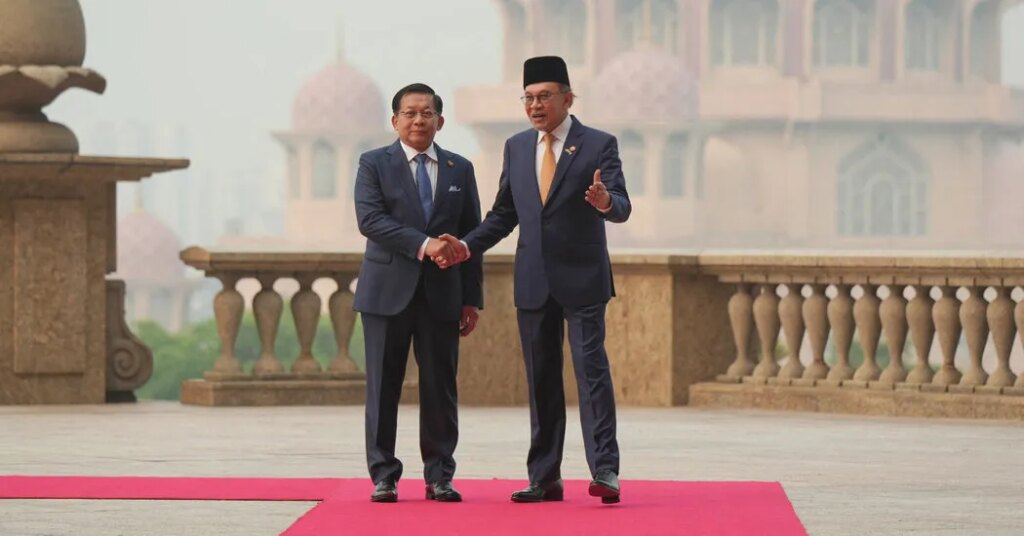
Over the past few months, he has gallivanted to Russia, China, India, Belarus, Cambodia, Vietnam, Thailand and Laos. Now, the leader of one of the world’s most repressive governments, U Min Aung Hlaing of Myanmar, is being feted by Malaysia, where he met on Thursday with Prime Minister Anwar Ibrahim.
The summit, in which the two sides discussed the repatriation of Myanmar asylum-seekers in Malaysia and investment opportunities in a war-torn Myanmar, was the latest sign of a remarkable makeover for Mr. Min Aung Hlaing. Five years ago, he presided over a military coup that plunged Myanmar into full-blown civil war and made the Southeast Asian nation a global outcast.
But after trading his military uniform for civilian clothes earlier this year, the onetime junta leader has been basking in international recognition. In public remarks on Thursday, Mr. Anwar declined to utter a single critical word about the reign of terror unleashed under Mr. Min Aung Hlaing’s rule.
“Now we have had excellent relations for a long time, but of course, recent developments have somewhat blocked that sort of progress, so I think our interest is, of course, to enhance this collaboration,” Mr. Anwar said, in a delicate description of the coup and its deadly aftermath.
Since taking the presidential post, Mr. Min Aung Hlaing has traveled to five countries in the Association of Southeast Asian Nations, or ASEAN. But he is still officially banned from attending its summits, an international affirmation that he craves, Myanmar observers say.
Mr. Anwar gave a wink-wink acknowledgment of the Myanmar leader’s efforts to work himself back into ASEAN’s good graces.
“You will continue your policy to engage with all parties to avoid further escalation of violence, and of course, I welcome that and convey it to my colleagues not only here but also in ASEAN,” Mr. Anwar said.
In April, Mr. Min Aung Hlaing became president, following his retirement as army chief and a set of stage-managed elections that the military’s proxy party contested virtually unopposed. Since then, the military’s attacks on civilian nationwide have not abated. A.C.L.E.D., a conflict monitoring group, says that Myanmar is one of the most dangerous places on earth, the severity of its conflict outranked only by that in the Palestinian territories. Last week, at least 50 people were killed in a military airstrike on a market in western Myanmar.
The two-day visit to Malaysia marked a rare foray by Mr. Min Aung Hlaing, one of the world’s leading jailers of political prisoners, to a nation that regularly holds unfettered elections. Mr. Anwar himself spent nearly 11 years in prison for what are widely regarded as politically motivated convictions.
On Thursday, a “cooperation dialogue” after the two leaders’ 40-minute tête-à-tête was dominated by business discussions. Among those attending on the Malaysian side were the trade minister and the central bank head, as well as top figures representing the palm oil industry, a telecommunications conglomerate, private banks and the state-owned oil and natural gas company. Mr. Anwar said that year-on-year trade with Myanmar had increased more than 140 percent.
After the coup, major democracies placed financial sanctions on members of Myanmar’s military leadership, as well as on the cronies propping up the regime. But on Thursday, the Myanmar delegation in Putrajaya, the Malaysian administrative capital, was studded with businessmen and generals-turned-cabinet ministers who are the subjects of asset freezes, travel bans and other financial restrictions imposed by Western nations.
Myanmar’s economy, once buoyed by foreign investment during a brief reform period, has contracted sharply since the military takeover, a downturn that Mr. Min Aung Hlaing has blamed on foreign sanctions and rebel incursions. More than two-thirds of Myanmar’s population is impoverished or in danger of falling into poverty, according to a new report from the United Nations Development Program.
Mr. Anwar’s decision to welcome the Myanmar leader comes amid growing xenophobia toward migrants in Malaysia, which prompted his plan to deport people from Myanmar back home. On Thursday, he praised Mr. Min Aung Hlaing for his “candid manner and willingness to collaborate” on the mass repatriation.
“Very few, hardly any country, in my experience, are willing to accept this repatriation in a large, in large number, at their own expense, as you have shown in Myanmar,” Mr. Anwar said.
The first batch of about 1,470 people left Malaysia on a Myanmar Navy ship a day after the airstrike killed more than 50 people in the country’s western Rakhine State. Much of Rakhine is now in the hands of a rebel militia. The Myanmar government minister for Rakhine was part of the Malaysia delegation.
Among the first deportees was Ko Min Nyan Tun, who said that he had to sign a document absolving Malaysia of legal responsibility if the ship back faced any difficulties. The journey itself was comfortable, he said, with plentiful food and karaoke breaks, although his family was made to pay the Myanmar Navy for these luxuries. His dread grew when he returned to Myanmar, he said, because he was given signals that he would likely be drafted into the military.
Fear of conscription has led at least a million young people to flee Myanmar since the coup. More than half the country is now in the hands of armed rebel groups, and the military has made up for a soldier shortfall by drafting men to the age of 35 and women to 27.
Mr. Min Nyan Tun, 34, said he has now been deported three times from Malaysia. But he said he would head back there again, somehow.
“If I had to choose between being arrested again in Malaysia and being sent to the front line, I would choose going back to Malaysia,” he said. “I can’t go to the front line and give my life for the military regime.”
Hundreds of thousands of people from Myanmar are believed to be working menial jobs in Malaysia without documentation. Around 215,000 refugees or asylum seekers from Myanmar are registered in Malaysia with the United Nations refugee agency.
Before the coup, Malaysia, a Muslim-majority nation, absorbed a population of Rohingya, a Muslim ethnicity from Myanmar that has long suffered repression. Effectively stateless, waves of Rohingya were violently expelled from their homeland nearly a decade ago, an exodus that ranks as one of the fastest refugee outflows in recent history. A genocide case against Myanmar is underway at the International Court of Justice at The Hague, with a ruling expected in the coming months.
After the first repatriations on Sept. 30, Mr. Anwar said that no Rohingya had been sent to Myanmar. But the prime minister also said last month that he wants to expel the entire population of Myanmar refugees and asylum seekers in Malaysia. The majority of them are Rohingya. Complicating matters, Mr. Min Aung Hlaing said on Thursday that Myanmar would only repatriate “those confirmed as Myanmar citizens.” His government does not consider Rohingya to be from Myanmar.
“The idea that the refugee flow will somehow end after a meeting between Anwar and Min Aung Hlaing is ignorance,” said Charles Santiago, the Malaysian co-chair of ASEAN Parliamentarians for Human Rights. “The flow will end when the violence ends.”
Mr. Min Aung Hlaing’s visit to Malaysia was capped by a state luncheon in which the guests feasted on lamb with mint and black pepper sauces, jumbo prawns in buttermilk and a cheese and passion fruit pudding, among other delights.
One in three people in Myanmar, the U.N. says, now does not have enough to eat.
The post Guess Where’s Next on an Autocrat’s Global Tour appeared first on New York Times.