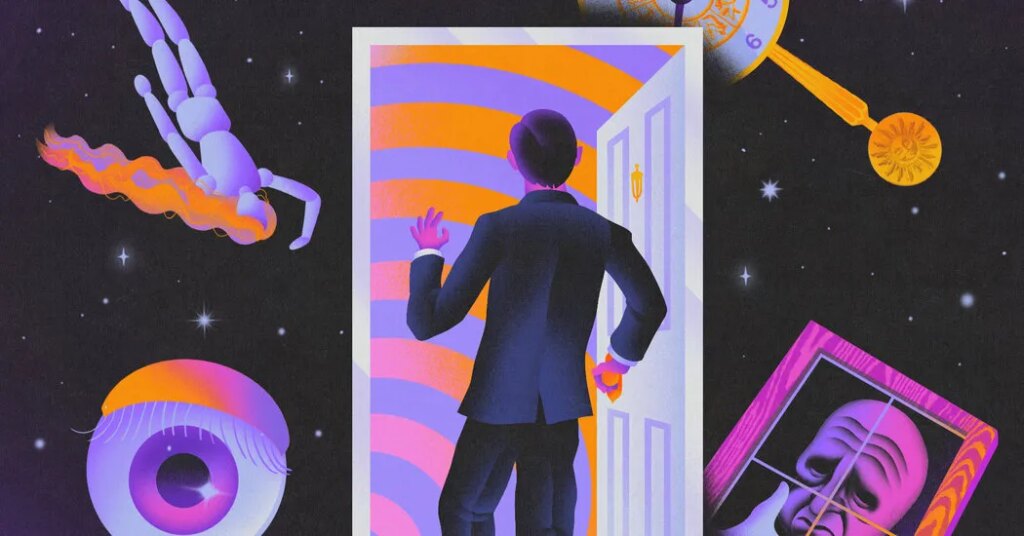
Before he created “The Twilight Zone,” Rod Serling was stuck. He’d established a reputation in the TV industry as, basically, Aaron Sorkin before Aaron Sorkin: a celebrated writer of weighty adult dramas that grappled with big contemporary issues like political corruption or the dehumanizing nature of corporate life.
He also frequently battled sponsors over what he was allowed to write and how far his scripts could go. When he worked to create a fictionalized version of the 1955 lynching of the Black teenager Emmett Till, for example, the final product was so watered down by sponsor and network pressure that it resulted in what he’d later describe in an interview with Mike Wallace as “a lukewarm, vitiated, emasculated kind of show.”
Serling didn’t want to make that kind of show. So after he was instructed to remove virtually all references to contemporary politics from a teleplay about a United States senator titled “The Arena,” he had a realization: “I probably would have had a much more adult play had I made it science fiction, put it in the year 2057, and peopled the Senate with robots,” he wrote of that experience.
Serling apparently applied the lesson of “The Arena” to a broader canvas, as he started writing speculative stories that were at sharp right angles to our own reality, in an anthology series that premiered in 1959 with the title “The Twilight Zone.” Because the series, which often featured fantastical scenarios, always with a surprising final twist, was so stylized, Serling found he could finally tell the unvarnished truth.
Almost 70 years later, at a moment when our own situation can seem increasingly ominous and surreal — when it’s hard to look anywhere, from political corruption to corporate malfeasance to the barrage of everyday headlines, without feeling as if you’ve traveled into a fifth dimension, beyond that which is known to man — Serling’s shrewd tactic for addressing political subjects offers an instructive response.
Contemporary television has often struggled to respond to the current political darkness; while shows like “The Good Fight” directly confronted the first Trump administration, few shows have done that during the second term. Some satires like “South Park” have taken direct aim, while others like “Saturday Night Live” have often seemed at sea when it comes to dealing with political turmoil.
With “The Twilight Zone,” Serling realized he could use allegory to make his political points. After all, how could a network censor or a viewer angrily insist that a story was saying something controversial about the world when it centered on a three-armed Martian?
This might help explain why “The Twilight Zone” still seems so incredibly — and at times, depressingly — relevant. Serling and his collaborators repeatedly and stealthily tackled such subjects as prejudice, creeping authoritarianism, the dangers of humans being replaced by technology and the peril of conformity as a societal ideal in ways that still resonate. Many episodes, when rewatched now, feel like they could have been written five minutes ago.
The show hit on social questions we have yet to adequately answer. Serling, a Jewish American who enlisted in the Army to fight Nazis during World War II, wrote often with his collaborators about the dangers of fascism and how easily people can succumb to its allure, including in such episodes as “The Obsolete Man” (a librarian is sentenced to death in a dystopia where books are outlawed) and “He’s Alive” (a hatemonger rises to power through coaching from Hitler’s ghost). In “The Brain Center at Whipple’s,” an aloof owner of a manufacturing plant gleefully replaces his flesh-and-blood workers with machines, unmoved by pleas from his former factory manager about the value of human thought and emotion; eventually, he himself is replaced by a robot.
“Number 12 Looks Just Like You” is set in a future where everyone upon turning 19 is forcibly transplanted into one of a handful of conventionally attractive bodies. It’s like today scrolling an Instagram feed where everyone is using the same filters or going down a rabbit hole about looksmaxxing. And the impulsive, destructive behavior of President Trump has often been likened to aspects of the plot of “It’s a Good Life,” an episode about an omnipotent child named Anthony Fremont who holds an entire town under his thumb.
Serling’s influence is evident all over modern culture. A legion of current storytellers, in television, film and literature, owe him a debt, from Steven Spielberg to Guillermo del Toro, from Curry Barker (as seen in his 2026 horror hit “Obsession”) to Ryan Coogler (“Sinners”). Charlie Brooker, creator of the anthology series “Black Mirror,” has talked about what he learned from Serling’s use of genre devices and the freedom they gave Serling to say what he wanted to say. “If he hadn’t had that rock for the river to flow around,” Mr. Brooker told me, “would the stories feel so resonant now? Or would we only read about them in academic books about the history of television?” Mr. Brooker went on to note: “Because he was forced to enter the world of metaphor, it’s the thing that gives him a superpower.”
Serling’s storytelling superpower grew from a desire to regain a lost affection for humanity — another effort that might prove instructive to us today. During his service as a paratrooper in the Pacific theater of World War II, a teenage Serling witnessed people dying under gruesome, often pointless circumstances. At 20, he watched as a close friend was decapitated in front of him by, of all things, a supply crate dropped from an airplane, and soon came perilously close to death himself.
These experiences left him traumatized and despairing about the depths to which his fellow man was capable of sinking. They also forced Serling to examine why people so often make terrible choices and whether there’s hope for them to do better in the future, a theme that would animate his TV writing. In “The Twilight Zone,” characters are often offered a magical second chance — and the ones who can’t change frequently earn karmic justice of a supernatural variety.
Despite his celebrity and acclaim — and his unnerving prescience — Serling struggled with self-doubt for much of his career. In the years leading up to his 1975 death of a heart attack at the age of 50, he gave an interview suggesting his accomplishments would soon be forgotten.
“I’ve written articulate stuff, reasonably bright stuff over the years, but nothing that will stand the test of time,” he said in 1972. “The good writing, really good writing — like wine — has to age well with the years, and my stuff is momentarily adequate.”
Not only did Serling underestimate his influence, but he also failed to see how the tactic he adapted would prove to be the most successful way to process perilous times. If the Serling who gave that interview could, like some of his characters, travel forward through time, he might be dismayed that so many of the problems he wrote about still aren’t resolved decades later. But he would also see that the best way to describe the legacy of his work isn’t “momentarily adequate,” but a different phrase he repeatedly recited as the host of “The Twilight Zone”: “as timeless as infinity.”
Alan Sepinwall is a TV critic, most recently for Rolling Stone, and the author of the forthcoming “Serling: A Journey Into the Twilight Zone With TV’s First Visionary.”
The Times is committed to publishing a diversity of letters to the editor. We’d like to hear what you think about this or any of our articles. Here are some tips. And here’s our email: [email protected].
Follow the New York Times Opinion section on Facebook, Instagram, TikTok, Bluesky, WhatsApp and Threads.
The post America Feels Trapped in the Twilight Zone. This Man Can Help. appeared first on New York Times.