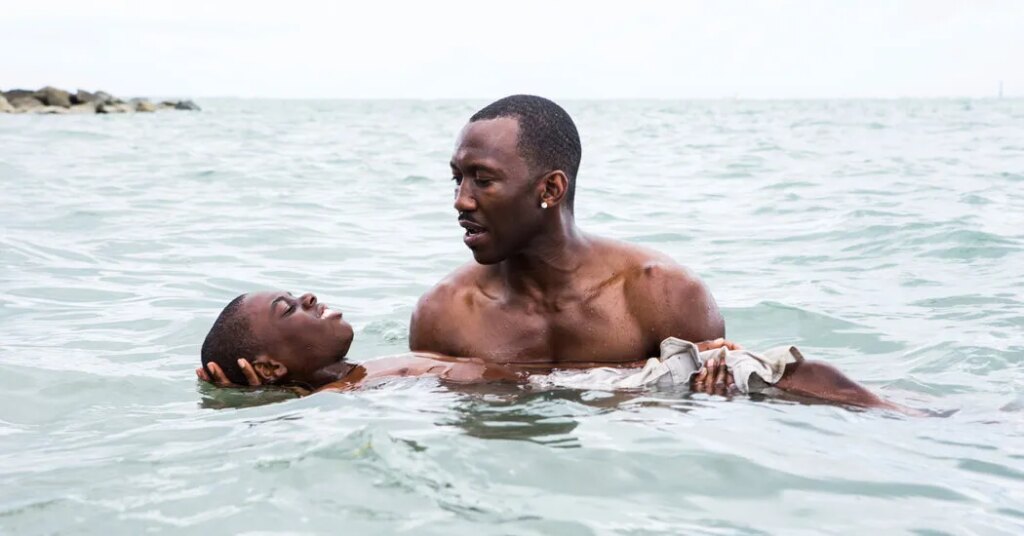
“Moonlight” is a favorite of the director Elegance Bratton’s. It’s his allegory of the cave, his Peter Parker origin story.
In 2016, Bratton was a student at New York University working on his short film “Walk for Me,” which focused on a trans performer finding her way in New York’s ballroom scene. In Bratton’s telling, when he showed a cut in class, his professor said the number of close-ups made him uncomfortable.
But then came “Moonlight.” Bratton said that the rise of that film prompted a fresh look at his film school work.
“‘Moonlight’ actually helped me, in my second year of film, succeed,” he said.
A frequent guest on best-of-century movie lists (including The New York Times’s), the influential “Moonlight” remains both subtle and layered a decade later. Its employment of multiple actors to embody one character, its use of time gaps and its introspective focus on Black masculinity trickled into the makeup of other films that followed. “Moonlight,” a co-production with Plan B Entertainment, also took the company A24 into new territory as a film financier and not just a distributor. The film helped mold the company’s reputation for unconventional filmmaking with solid box-office results.
Originally released on Oct. 21, 2016, “Moonlight” follows a Black child as he grows into a young teenager tangling with his queerness and then finally a hardened, repressed man. The film, directed by Barry Jenkins and adapted from the playwright Tarell Alvin McCraney’s unpublished play, drew adoration during its film festival run that culminated in its storied Oscar victory for best picture.
Bratton partly credited the success of “Moonlight” with opening a pathway for his own A24 feature, “The Inspection” (2022), an autobiographical drama that uses intimate camerawork (heavy on close-ups) in its portrayal of a gay man training to be a Marine. Others have also seen bits of “Moonlight” in the first-person perspective that carries “Nickel Boys.”
The director of “Nickel Boys,” RaMell Ross, said he wasn’t trying to make his own “Moonlight.” Rather, the film’s influence on him was likely subliminal.
“When you’re that moved by a work, whether or not you intentionally pursue that aesthetic or that form and add it into your work, it is in your next work because it moved you,” Ross said in a video interview.
Although queer cinema and television long predate “Moonlight,” entries centered on Black men had rarely received such widespread exposure and acclaim.
Steven Canals, a creator of the FX series “Pose,” believed the reception of “Moonlight” might have had an effect on his show’s being greenlit. He said he had spent two and a half years pitching the show, a drama that takes place in New York’s ballroom scene, only to be told by executives that they didn’t know if there was an audience for it. The year “Moonlight” reached theaters, Canals pitched “Pose” to the producer Ryan Murphy, and they sold it to FX.
“I don’t think it’s by chance that this show happens kind of on the heels of a movie like ‘Moonlight’ existing,” Canals said.
“Moonlight” draws from both Jenkins’s and McCraney’s experiences growing up in the mostly Black neighborhood of Liberty City in Miami. Its signature look, a mix of bold colors and expressive lighting, drew from the work of the Hong Kong director Wong Kar-wai and the cinematographer Malik Hassan Sayeed’s collaborations with Spike Lee. But to a degree, its style was also informed by the practicality of shooting a moody drama with roughly $1.2 million, a modest budget.
“Because of the budget and because of the tone of the film, if it was going to find an actual life it was going to be in art-house cinemas,” Jenkins said in a video call. “And yet we didn’t want to change the language of Liberty City to fit that audience.”
“Moonlight” also underlined Jenkins as part of a rising crop of Black filmmakers that included Ava DuVernay, Ryan Coogler and Steve McQueen, a class whose work had a more contained scope before expanding into a wider audience.
“It wasn’t just about making commercial fare,” said Cameron Bailey, the chief executive of the Toronto International Film Festival, which screened “Moonlight.” “It was about, ‘What do you want to express as an artist and what are the tools that you have at your disposal?’ And there were a few filmmakers who were really doing that at the time.”
Has “Moonlight” opened doors for more Black directors to tell their stories on modest budgets? Some filmmakers believe it may be more tricky for a movie of its scope to find an audience in 2026, partly because the post-Covid-pandemic moviegoing crowd is smaller yet more diffuse.
“That space has been fractured to a certain degree,” Jenkins said, mainly referring to the film market in Los Angeles, where he lives. He added: “People just got accustomed to not going to the movies. So the bigger movies are building that audience back piece by piece.”
Many involved in “Moonlight” remain pre-eminent figures in the movie business. Mahershala Ali, who won an Oscar for his turn as the film’s drug-dealing father figure, has grown into a leading man. Jenkins’s résumé includes a Disney hit (“Mufasa: The Lion King”), and Pastel, a production company of which he is a founder, has produced smaller-budget dramas that were also critical darlings (“Aftersun,” “Sorry, Baby”).
The scope of the director Bratton’s work has shifted, too. His latest film, “By Any Means,” is an action movie fronted by Mark Wahlberg and Yahya Abdul-Mateen II. Still, it’s not detached from the lessons of “Moonlight.”
“What’s exciting to me 10 years later is that the permission ‘Moonlight’ represented doesn’t have to end with autobiographical cinema,” Bratton said. “I’m working on a much bigger canvas: historical thriller, movie star, genre action. But I’m still asking questions about Black masculinity, power, vulnerability and who gets to be fully human onscreen.”
The post ‘Moonlight’ at 10: How the Movie Made an Impact appeared first on New York Times.