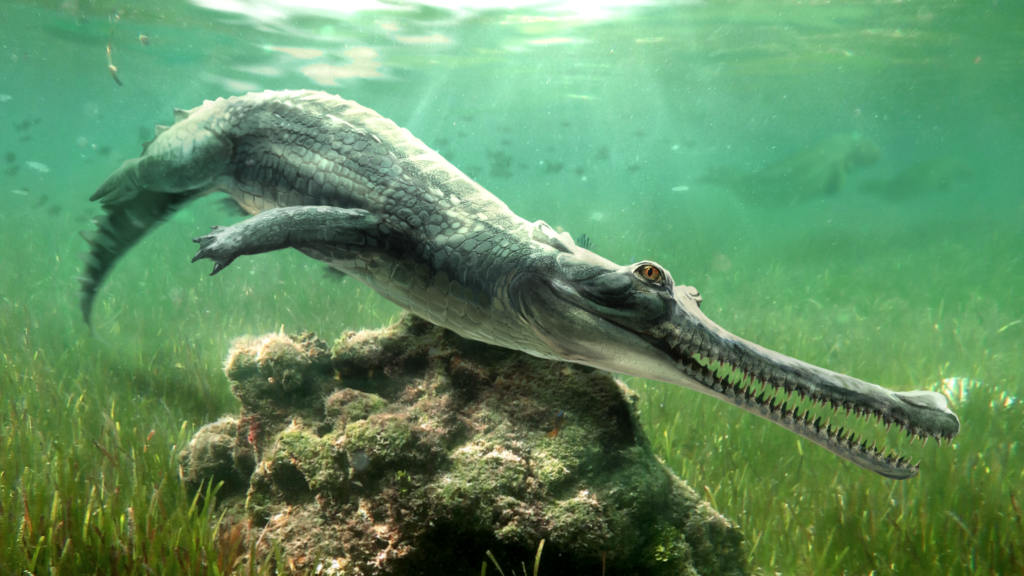
In the millennia-spanning fossil records of the order Crocodylia, there was always a group of crocodiles that made little geographical sense.
Scientists found one of these animals a century ago in a rock formation in the hills of Mokattam, southeast of Cairo — the same rock formation that was quarried to build the Sphinx of Giza. The ancient reptile was identified in the historical records as belonging to the genus Tomistoma, the “false gharial.”
The problem is that the only false gharials living today exist some 5,000 miles away, in the freshwaters of Malaysia and Indonesia. And while it’s possible to imagine that at some point in the last 50 million years this fish-hunting reptile made its way across deserts, mountain ranges, tropics and oceans, Paul Burke, a postdoctoral paleontology research fellow at the Swedish Museum of Natural History, proposed a different explanation.
As a PhD student, Burke investigated the several dozen named gharial species that had gone extinct, piecing together their evolutionary history based on their braincases (and brains, by extrapolation).
“This fossil has been flagged as being problematic because it was given the same genus name as one of the extant species,” he said. Based on the morphology of the skull, the two weren’t really closely related.
Working with CT scans, Burke and a team of international researchers compared over 300 data points on the size and shape of the skull of the Egyptian creature with that of other gharials (both living and extinct). Their findings, published Tuesday in the journal Royal Society Open Science, concluded that this was a distinct species never before identified.
“Not to discredit the work that people did in the past — because they did great work for the time — but they would make very generic statements,” Burke said in an interview from Stockholm. “They say something like ‘nasal bone, long or short?’ That’s very subjective.”
Within the last decade, thanks to a combination of scanning technology, a larger database of samples and a more advanced understanding of biological morphology, such assessments have become much more refined. Take the nasal bone. The way it is now used in classification might involve asking dozens of questions: Is the nasal bone twice as long as the jaw bone, for example? Is the nasal bone twice as wide at the back as it is in the front?
Comparing hundreds of these data points generates a finely pixelated view that can help solve specific paleontological mysteries like the Mokattam reptile — and bring into finer focus the larger picture of evolution.
So where do gharials fit in with alligators and crocodiles, their fellow members of the Crocodylia order? The international team’s approach “generates some much-needed hard data toward solving what is often termed the ‘gharial problem’ in crocodilian phylogenetics,” said Michael Stein, a researcher at the University of New South Wales who was not involved with the study.
After the scientists laid out their case that the fossil represented a newly discovered species, they got the honor of naming it. What they picked is deeply meaningful, especially to the Egyptian members of the research team.
Both the fossil and the Sphinx came from the same rock formation, which led to the name Herugavialis cairensis — Heru being the ancient Egyptian god thought to be the inspiration for the Sphinx.
“We seek to connect Egypt’s deep natural history with its human history and the legacy of ancient Egyptian civilization,” said Hesham Sallam, an Egyptian paleontologist whose Vertebrate Paleontology Center at Mansoura University collaborated on the project. “Crocodiles were part of the Nile ecosystem, which was central to Egyptian life, and they held an important place in ancient Egyptian belief and culture.”
Of course, Herugavialis was long gone by the time the Ancient Egyptians were constructing their epic monuments. The sample is about 50 million years old, dating to the Middle Eocene era, when much of what is now Northern Africa — including Cairo and its environs — was underwater.
It’s impossible to know for sure what Herugavialis looked like, but it almost certainly was something like its two closest living relatives, the false gharial and the Indian gharial. Both have long, narrow snouts — think swordfish — filled with razor-sharp teeth for use in catching fish in shallow waters. As for its size, the skull of the Egyptian sample is about 18 inches long. A typical American crocodile, by comparison, has a skull about 30 inches long.
Burke hopes the latest research finding gets people thinking beyond the most well-known subjects of paleontology.
“The public perception is very much that dinosaurs are great — and they are,” he said. But “there’s so many more cool things in paleontology, including these crocodiles. My favorite thing about this whole thing is that there’s actual living relatives of these species. We have such a cool history in their fossil record — 90 million years, if not more. There’s marine crocs. There’s terrestrial crocs. There’s just this diverse range of these species, and their relatives are still alive today.”
That means the work has real import for the future of biological diversity on the planet.
“With modern crocodilians facing extinction risks,” said Jorgo Ristevski of the Max Planck Institute of Geoanthropology, who was not involved in the latest study, “understanding how ancient animals adapted or perished during past climatic changes gives us invaluable context for today’s biodiversity crisis.”
The post Scientists identify a crocodile they never knew existed appeared first on Washington Post.