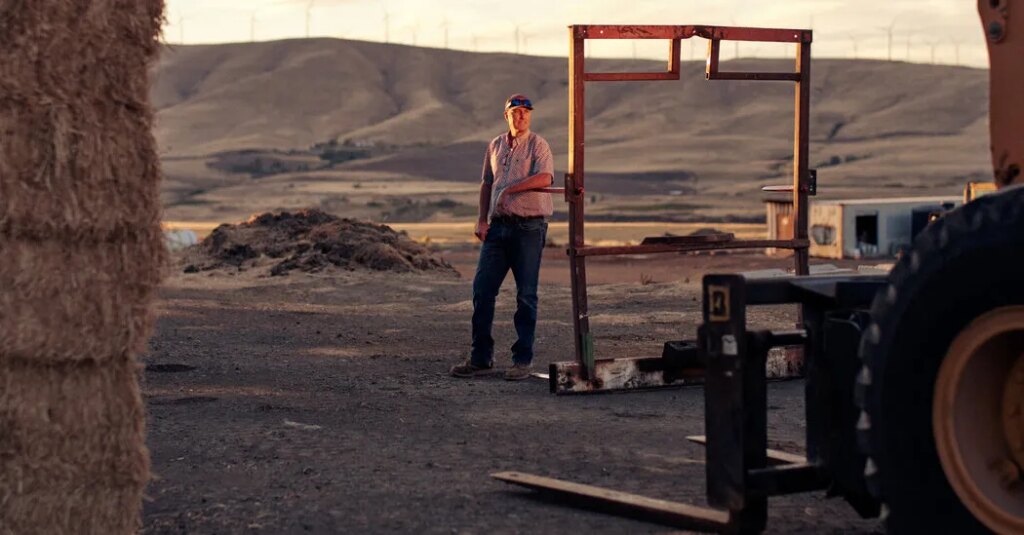
Bill Martin knows one thing: When he dies, he wants his three sons to stay close — to still grill out on summer evenings, to still gather on holidays and birthdays, to still go fishing side by side.
Mr. Martin and his brother no longer do any of those things, even though they live next door to each other in Rufus, Ore., a desert town about 100 miles east of Portland.
After their father retired, leaving them the family farm in 2022, the brothers hired a business consultant. But they clashed over the farm’s future, and their relationship devolved painfully, to the point where they no longer speak.
Mr. Martin, who grows peppermint and wheat and raises cattle, is only 55. He doesn’t plan to retire for decades. But when he does, he doesn’t want his sons to squabble. So he hired a coach-slash-therapist to help develop a succession plan that prioritizes family harmony.
“I don’t want my kids to go through the pain that I went through,” Mr. Martin said.
Over the next two decades, an estimated $124 trillion will change hands in the United States, flowing mostly from boomers to younger generations, in what has been deemed the greatest wealth transfer in history. In many cases, the decisions leading up to these inheritances, and their consequences, will be fraught. To get through the process while maintaining their sanity — and their relationships — some family members are turning to coaches or therapists for guidance.
“It’s not necessarily about getting everybody to agree,” said Donna Hillier, a Florida psychologist who’s helped dozens of families navigate inheritance issues. “It’s helping the family develop the capacity to disagree, without allowing the disagreement to determine how they interact with each other.”
Why inheritances can feel so fraught
Bequests can be both a boon and a bane: Roughly one-third of adults over 50 have experienced family conflict as a result of an inheritance, one AARP survey found.
Whether it’s Grandma’s favorite earrings or a multimillion-dollar trust fund, the answer to “who gets what” can be emotionally sticky. (After all, “Succession,” HBO’s award-winning comedy-drama, was built around that very idea.)
For the bequeathers, especially those who have founded a business, Dr. Hillier said, questions of legacy and identity abound: Who will I be after stepping down? Who will steward the business in a way I approve of? Who will take care of the money I worked so hard for?
For the inheritors, questions of worth come into play: Whom did Mom love more? Who did Dad think was more responsible? Who was paying attention to my accomplishments?
“As human beings, we make meaning of different things, like what money means, what inheritance means, what ownership and titles and authority mean,” Dr. Hillier said. “We’ll use those words and will tie them to things like fairness, trust, competence, contribution and belonging.”
Nancy Burgoyne, a psychologist and the chief clinical officer at the Family Institute at Northwestern University, agreed. “It can be as simple as money and ‘who gets more,’ but usually what’s underneath that is ‘who matters more,’” she said. Or at least that’s how it can feel to those involved.
How coaches and therapists can help
Therapists can encourage parents to think about the impact their decisions will have on their children and their children’s relationships with one another, Dr. Burgoyne said. Even when things can’t be split evenly, as is often the case with family businesses, therapists can help parents telegraph their reasoning — a small step, she said, that can make a big difference.
No matter what someone is passing down, Dr. Burgoyne advises her clients to start with curiosity. If a father is wondering what to do about the family home, for example, she might nudge him to ask his children how they feel. Maybe all of them want the house. Maybe none do.
That knowledge could inform a plan. And even if the ultimate decision doesn’t please everyone, Dr. Burgoyne said, letting people feel heard increases the likelihood of a successful outcome. “At a minimum, having the process communicates respect,” she said.
Dr. Hillier, the Florida psychologist, also tries to steer clients away from the nitty-gritty of the plans themselves and back to the people who are or aren’t named in them.
“Families devote considerable energy to the legal and financial plan, while postponing conversations underneath it,” she said. “A lot of assumptions start to happen.”
Elaine Froese, a coach and farmer from Manitoba, Canada, estimates she’s helped more than 1,400 families with the succession process in her decades-long career. Most of them have been farmers.
“I started in 1993 going to people’s farmhouses with a flip chart to get them to talk about the things they weren’t talking about,” she said. “Nobody wants to grab the bull by the horns and deal with it.”
Today, though her process often occurs virtually, Ms. Froese and her colleagues still meet with each family member separately before bringing everyone together to discuss their hopes and fears about the transaction ahead.
“Accountants and lawyers are tactical and strategic,” she said. “But our driving force is communication, understanding and conflict resolution.”
Mr. Martin’s brother, Doug, 54, wishes they’d found someone like Ms. Froese years ago. He believes he and his brother’s “biggest screw-up” was hiring a consultant focused more on the business than the people behind it.
“I wish there was some way that we could rewind and have the right person,” Doug Martin said. “My mom and dad are 83, and their family is torn apart.”
From right down the road, but worlds away, Bill Martin felt similarly.
“My relationships are broken,” he said. “We didn’t get our ducks in a row.”
Mr. Martin’s oldest son, Max, 27, appreciates that his father is trying to avoid that outcome by hiring a coach. “Any help is great through my eyes,” he said. “When you’ve lived what we’ve lived through, you don’t want to ever see that happen again.”
The post Inheritances Can Shatter Families. Could a Therapist Help? appeared first on New York Times.