When students at Paul Éluard, a high school in a working-class suburb north of Paris, arrived for the first day of school, they found classrooms lacking chairs, tables and reliable electricity, students and teachers said. With the school under renovation, students were being taught instead in prefabricated buildings with bad insulation, filthy toilets and regular power outages, they said.
Then came the staffing shortage. Two mathematics professors were moved to another school, leaving no one to cover their classes for over a week. There were no replacements for the school’s absent psychologist or careers adviser, they said, and there was only a single part-time nurse to provide on-site medical care to roughly 2,000 students.
“It was a completely chaotic way to welcome students,” said Irène Cailleteau, a mathematics teacher at Paul Éluard since 2020. “It was an extremely difficult way to start the year.”
Those are among the frustrations that have fueled a surge of student protests since late September, both at Paul Éluard — one of the wellsprings of the unrest — and at hundreds of high schools across France.
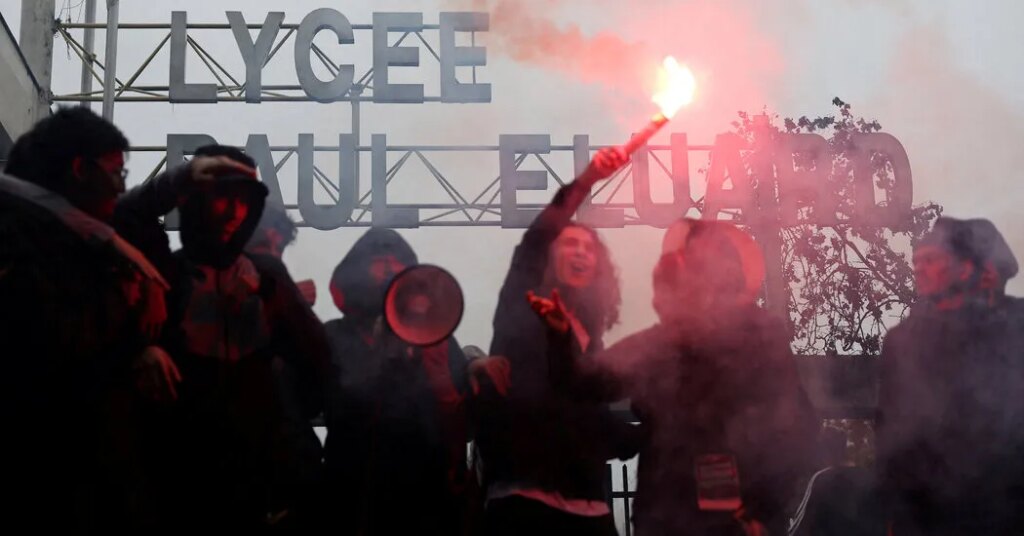
Thousands of students, sometimes backed by teachers like Ms. Cailleteau, have blockaded their schools to protest widespread teacher shortages, creaking school infrastructure and grueling schedules — and to demand an overhaul of the national system that allocates places in higher education programs.
The movement, which was bolstered on Tuesday by union-led rallies in more than 40 French cities, has divided the country and inflamed political tensions, particularly after many demonstrations descended into violence. Some protesters have shot off mortar-style fireworks, burned public buildings and looted shops, while rights groups and jurists have accused the police of disproportionate force. In just over two weeks, more than 6,500 people have been arrested, and more than 750 police officers, as well as roughly 300 students and staff members, have been injured, according to French officials.
At the demonstrations at Paul Éluard, footage showed largely peaceful protesters, disrupted by some participants who pulled down part of the school fence and set fires in the street outside. That led the authorities in late September to order the school’s closure, ban protests in front of it and arrest several students.
The school’s principal and the local branch of the Education Ministry declined to comment on the accounts in this article. The office of the regional president, Valérie Pécresse, said that her administration had recently invested about $50 million to improve the school, which is among more than 50 in the area, a suburb called Seine-St.-Denis, that has been newly renovated.
To students and teachers at Paul Éluard, that investment doesn’t do enough to reverse decades of neglect, both at the school and in the wider district.
In Seine-St.-Denis, a sprawling area with a large immigrant community, the unemployment and poverty rates far exceed the national average. That inequity is mirrored in the district’s education system: 61 percent of middle and high schools in Seine-St.-Denis and its neighboring areas had a missing teacher at the start of the year, according to a survey by a major labor union of more than 1,000 French schools. That was eight points higher than the national average.
“The problem is national, but it’s three times as bad in the suburbs,” said Bilel Narjissi, a senior at Paul Éluard and a member of the school’s student council.
Recent students and teachers at Paul Éluard said classes had spent an entire school year without a professor in some subjects, including philosophy, which heavily impacted students’ preparation for their senior exams.
France’s education minister, Édouard Geffray, said on Tuesday that the number of teaching vacancies had fallen by more than half over the past year.
But students said they had yet to feel meaningful change.
Zakarya Boukhadda, a 16-year-old at Paul Éluard, said at a rally this week that there weren’t enough special educators at the school, especially “for students with neurodivergent conditions or autism like myself.”
Frustrations That Boiled for Years
Paul Éluard, founded in 1965, was named for a French writer whose poem “Liberté” became a widely-read ode to freedom during World War II.
Over time, the school bearing his name became synonymous with decline.
In May 2023, staff members created a social media account comparing the high school to the Titanic. Pictures and videos showed cracked and crumbling walls, leaking or collapsed ceilings, and flooded floors. Those conditions were also described in interviews with former and current students, who recalled rats scouring the hallways.
In late 2024, regional officials reported finding parts of the school in a state of disrepair, warning of fire doors that had been wedged shut, a blocked emergency exit and signs of vandalism.
Ms. Pécresse’s office said that the regional government had tried to resolve the structural problems at the school, including by waterproofing its buildings, adding fire doors and providing more security, as well as investing the $50 million, about 45 million euros, which would go toward “a comprehensive transformation of the entire site.”
But to the students and their supporters, those additions are too little, too late and have left students cooped up in substandard temporary buildings while the renovation goes on.
Bally Bagayoko, a far-left local mayor, told journalists at a rally on Sunday that the regional council’s response was “contemptuous.”
“They say, ‘We’re giving you 45 million,’” said Mr. Bagayoko, who has often joined demonstrations in solidarity with the students. “That means, ‘Be satisfied with what we’re giving you, be happy that we’re giving you anything at all’,” he added
Mr. Bagayoko, 53, grew up in the area and recalled studying in badly insulated buildings when he was a student himself.
“How many times did I sit in a classroom where there was so much construction going on?” he asked. “We were sitting there in our coats because we were freezing our butts off,” he added. “That’s why it’s unbearable to see those who have the power to act pretending that they’re just now discovering this.”
Ms. Pécresse has dismissed Mr. Bagayoko as a rabble-rouser, pledging on social media to send him “the bill for the 100,000 euro replacement of the gate at Paul Éluard High School.”
“Let the mayor take responsibility for his actions,” she added. “I’ve taken responsibility for mine: a complete renovation of the high school.”
For some at Paul Éluard, the conditions at the schools compound the perception that the national leaders care little for the area or its alienated and underprivileged residents, many of whose families come from France’s former colonies in Africa.
“They simply don’t care about us,” said Zorah Adrachi, 19, who graduated from Paul Éluard in the summer hoping to study psychology or train as a teacher. Despite passing her senior exams, an achievement that generally guarantees entry to university, Ms. Adrachi is among thousands of young high school graduates who have not been offered a place on a higher education program, leaving her in limbo.
Mr. Narjissi, the student council member, who wore the French tricolor on the collar of his woolen coat, said he would not give up the fight for better learning conditions.
“Maybe our parents didn’t dare pursue executive careers or positions of responsibility,” he said. “But tomorrow we’ll be the members of Parliament, we’ll be the mayors, and we’ll keep going and we won’t give up.”
The post The School Near Paris That Shows Why French Students Are Protesting appeared first on New York Times.