An industrial park in Irvine, California, may seem an odd spot to show off technology that wouldn’t be out of place in Dune, but that’s what’s happening on a sweltering September morning.
The temperature is already over 80 degrees Fahrenheit as the sun rises on a 20-foot-tall, metal-clad machine in the parking lot of Atoco, an Irvine, California-based startup. Engineers open panels to check systems and an iPad that shows a steadily ascending line that reveals the device’s purpose: harvesting water from thin air using special materials known as metal organic frameworks, or MOFs.
The materials won Omar Yaghi, the company’s founder, the Nobel Prize for chemistry in 2025, and Atoco has shown they work in prototypes capable of producing gallons of water per day. What’s unique about this iteration of Atoco’s technology is what it doesn’t require. No grid connection or even electricity is needed to grab water from the air at the microscopic level, nor is it required to in turn wring the water out of the materials in a form useful for humans.
Instead, all that’s needed is low-level industrial heat. That, Atoco says, makes them a perfect candidate to hook up with AI data centers, which throw off loads of waste heat as servers churn out everything from math proofs to virtual editors while also often requiring massive amounts of water.
“We were not really thinking of AI data centers,” four or five years ago, says Atoco CEO Samer Taha. But the massive buildout has created an opportunity for the startup that could allow it to get a step closer to its larger goal of ensuring people living in water-stressed regions have control over an increasingly precious resource.
When Yaghi was a PhD student, he says, creating something like MOFs was “every chemist’s dream.” Part of his Nobel-winning work over the past 20 years has been taking theoretical research into the real world, creating a stable molecular structure that links organic material with metal ions.
The structure of a MOF looks somewhat “like a jungle gym on a playground,” says Seth Cohen, the dean of the School of Physical Sciences at UC Irvine. MOFs are essentially “molecular sponges—they’re a solid material that’s very, very good at absorbing other molecules,” says Cohen, who is not involved with Atoco. Like a sponge, the materials can also be wrung out using methods including heat to release whatever they’re holding onto.
These jungle-gym-like frameworks create open spaces on the microscopic level that can hold an unbelievable amount of material, and small tweaks can yield even more interior space.
“The footage of a gram of MOF could cover two football fields,” Yaghi explains. “They can store hydrogen in there to make clean energy, or you could store CO2 in there to make clean air. Or, in this case, you can store water.”
Atoco has developed what Taha calls “precision materials” with a specific objective of being able to harvest water, release it, and then do it over again and again. He quips that, as vice president of R&D Benjie Limketkai puts it, the material has to like water but not love it. To succeed commercially, it also has to use as little energy as possible.
“The scientists reach a level of precision [where] we really know even the angle of the atom,” in a given material, Taha says.
In Atoco’s technology, air passes through the MOF, which has been specially tailored to attract water molecules. Those molecules adhere to the pores. But the material feels completely dry to the touch even when saturated, and squeezing it doesn’t release a single drop. (Taha was kind enough to let WIRED try our hand at it.) Instead, the company relies on heat to release the captured molecules.
There are other means of harvesting water. Cohen notes that silica, a popular desiccant, can also pull water out of air, but it doesn’t hold as much moisture and requires you to “heat the heck out of it to get the water back out,” he says.
The monolith in the parking lot of the company’s Irvine facility is the culmination of decades of precision development. Atoco’s materials and approach allow its off-grid system to work even when relative humidity is in the teens. The MOFs in the device can harvest and release water with heat as low as 100 degrees Fahrenheit, Taha says.
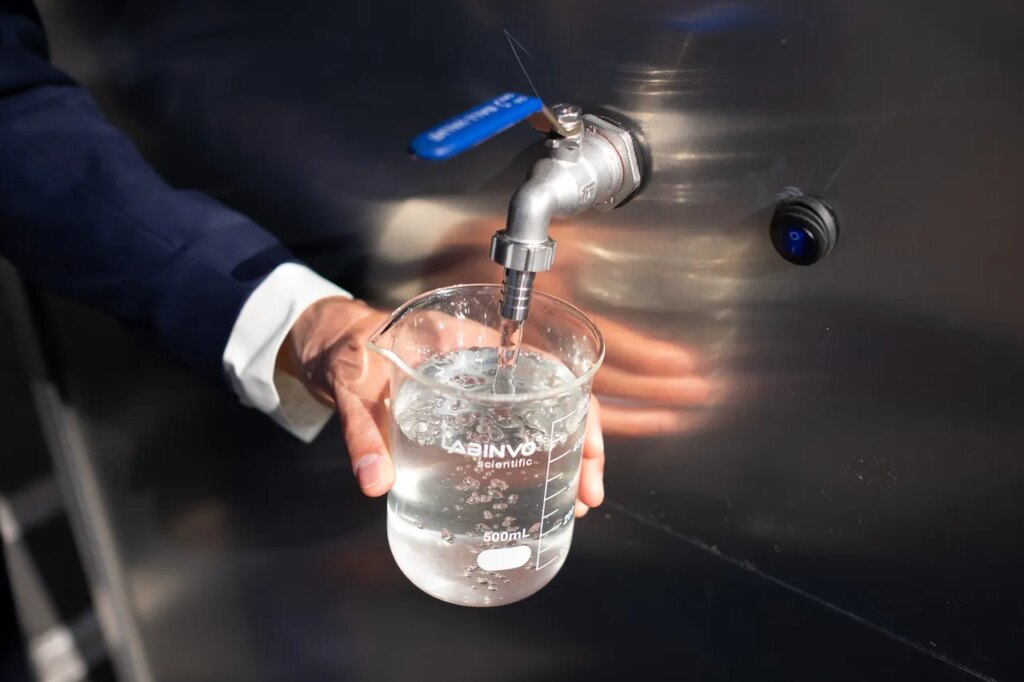
With no data center nearby, Atoco’s team simulated it by piping heat from a source that was around 150 degrees Fahrenheit. A solar panel powers various systems but not the water-harvesting operation itself, making the metal-clad machine eerily quiet. Cars pulling into the adjacent businesses create more of a sonic disruption, but Taha is ready to show the device has been working hard. It’s a little after 9 am, and the temperature is over 90 degrees Fahrenheit when he pushes a button on the side and turns a spigot. Out tumbles a clear stream of water that looks good enough to drink.
Unfortunately it’s not on offer for legal liability reasons, though Taha notes it’s the equivalent of distilled water, because Atoco’s MOFs aren’t built to gather air pollution. Tossing it in the bushes, Taha retreats to an air-conditioned conference room where he lays out the company’s vision for its new machine.
“Roughly 70 percent of the industrial waste heat is low-grade, unutilized, thrown into oceans or into the air,” he says. “If you convert that waste heat to clean water using our technology, you’re talking about trillions of liters of clean water.”
Data centers are an increasingly big source of that waste heat, with a single facility capable of pumping out as much heat as tens of thousands of homes. Operators are forced to disperse that heat into the surrounding environment, creating heat islands, while also paying for various types of cooling systems.
Many of those cooling systems also rely on water, and some can consume millions of gallons per day. Atoco’s technology would thus address two of data centers’ biggest problems.
Data centers are investing a lot of money to get rid of waste heat, Taha says. “We actually want it; we need it. We give you back water, the same product that is causing the issue.”
He says the company also wants to help deliver water to rural communities, where utilities sometimes bring in water by the truckload because of a lack of infrastructure.
To do that, let alone serve data centers that require millions of gallons of water daily, will require a big leap in scale. The demo in the company’s parking lot can generate up to 300 liters of water per day. Atoco envisions data centers using multiple units in a grid system to generate water and is working on a commercial offering that could produce up to 1,000 liters of water per day. Its parking lot prototype runs off the equivalent heat provided by a 20-kilowatt data center. Hyperscale data centers, in comparison, are orders of magnitude bigger, which presents both an opportunity and a challenge.
Atoco has deployed five on-grid prototype trials with partners in the US and within the Gulf Cooperation Council. The company says that it hopes to begin taking orders for its first product by the end of this year. It says it’s already in conversation with major tech companies about deploying a pilot project at data centers, though it declined to name them or how much customers could expect to spend on a unit. But there are signs that there could be a market: Microsoft, Google, and Amazon Web Services have all committed to being water positive—that is, returning more water to communities than they use—by 2030.
Atoco’s product might work at data centers and other industrial sites, as well as locations where there are abundant natural heat sources, such as geothermal sites. But Cohen, who worked at the Defense Advanced Research Projects Agency on MOF projects—including on a project spearheaded by Yaghi—cautions that while MOFs have incredible promise, they’re not a silver bullet for water access everywhere. Without an outside source of heat, even the most well-designed MOFs still require energy to squeeze water out. That could make rural deployment, in particular, a challenge. Atoco’s on-grid system might offer a solution, but distant locations are also frequently underserved by energy infrastructure.
Taha says the company can produce water at a levelized cost of $5 per metric ton, which makes it competitive with older desalination plants. But newer facilities are able to deliver water at a cost of $2 per ton or even less in some cases—a target he says Atoco is still three to five years away from hitting.
MOFs also remain a cutting-edge technology that’s untested at scale. While big tech companies are more likely to take risks than, say, staid utilities, it will take time to vet that Atoco’s technology can work and for the startup to scale up production of its commercial units to provide meaningful amounts of water.
Still, Atoco’s technology has already solved some incredible challenges. The use of MOFs brings the world much closer to a place where, as Yaghi puts it, everyone can control access to their own water. Yaghi describes how as a child, growing up as a Palestinian refugee in Jordan, he was responsible for filling as many containers as he could with water for his household to use when the delivery truck came every two weeks.
That experience “makes you appreciate scarcity,” he says. “Now, we’re talking about going from scarcity to abundance.”
The post A Startup Has a Plan to Make Water From Air Using Data Centers’ Waste Heat appeared first on Wired.