WILL AND ATTENTION: A Memoir, by Meghan O’Gieblyn
Many alcoholics credit religion with helping them out of addiction. For Meghan O’Gieblyn — who grew up in a Christian fundamentalist family and lost her faith in her early 20s — religion had virtually the opposite effect. When she was 28, she went into treatment for drugs and alcohol. Eleven years later, she started drinking again, not long after she had tried and failed to convert to Roman Catholicism.
In her searching new memoir, “Will and Attention,” O’Gieblyn connects her relapse with alcohol to her relapse with institutional religion: “It’s clear to me now that this was just a veiled desire for intoxication, that the experiment with Catholicism served as a gateway back into drinking and justified the severance from the stable life I was living.” She half-jokingly berates herself for a “lack of imagination” when it came time for her midlife crisis. “There are a million ways to sabotage one’s life,” she writes, “but I could not seem to come up with anything more original than the things that had ruined my life before.”
O’Gieblyn is the author of two previous books: “Interior States,” a collection of essays about her evangelical upbringing in the Midwest; and “God, Human, Animal, Machine,” a roving exploration of our enchantment with technology and our disenchantment with the world. “Will and Attention” is metaphysically inclined, too; it gets its title from a line by the French philosopher and mystic Simone Weil: “We have to try to cure our faults by attention and not by will.” O’Gieblyn keeps an index card with the quote pinned above her desk — less as a motivational slogan, telling her what to do, than as a goad to inquiry, suggesting how much she still has to learn.
So much attention is being paid to attention these days — how it’s being degraded and destroyed, how we need to reclaim it and retrain it, how we ought to pay attention to what really matters. But Weil’s notion of attention was very different from our typical definitions of the word. Attention, for Weil, was not a willful hardening of focus but a softening of gaze — not a closing in but an opening up. O’Gieblyn calls it a form of “receptivity.”
In fact, it’s the will that’s often the problem. Before she started drinking again, people used to tell O’Gieblyn that she must have “incredible will,” given her sobriety, her completion of two books and her break with the evangelical church. But she never felt these were choices she had made. She experienced them as “compulsions,” as “obedience to some kind of necessity.”
Drinking, on the other hand, seemed like a choice. “I knew that it was bad and that it made me unhappy,” she says. “But I did it anyway. I preferred what was bad for me.” As she later reflects, “I wanted to do something risky and destructive.”
O’Gieblyn doesn’t romanticize her bid for self-destruction, characterizing her relapse, which lasted nine months, as “the most boring period of my entire history with alcohol.” She limited her drinking to the antiseptic loneliness of airports and hotel rooms, and when she returned home to her husband while still buzzed, she would jump into a bath, which provided her with an explanation for her flushed face while masking the boozy scent of her off-gassing pores.
Her earlier experience with addiction had taught her “the art of dissemblance.” Her lying was instinctive and effective: “Each binge was a controlled explosion, safely contained from the rest of my life.”
She began her bid for Catholicism in similar secrecy. O’Gieblyn started attending Mass and talking to Father Aaron, a priest who could converse fluently about Henri Bergson and Dostoyevsky. Their expansive discussions of theology and literature enthralled her. But one day Father Aaron told her she needed to have a baby, adding that birth control was “unnatural,” and she immediately resisted this assertion of old-fashioned patriarchal authority. She didn’t know whether she wanted a child, but she did know that it would be “impossible” for her to have one simply because a male authority figure commanded her to.
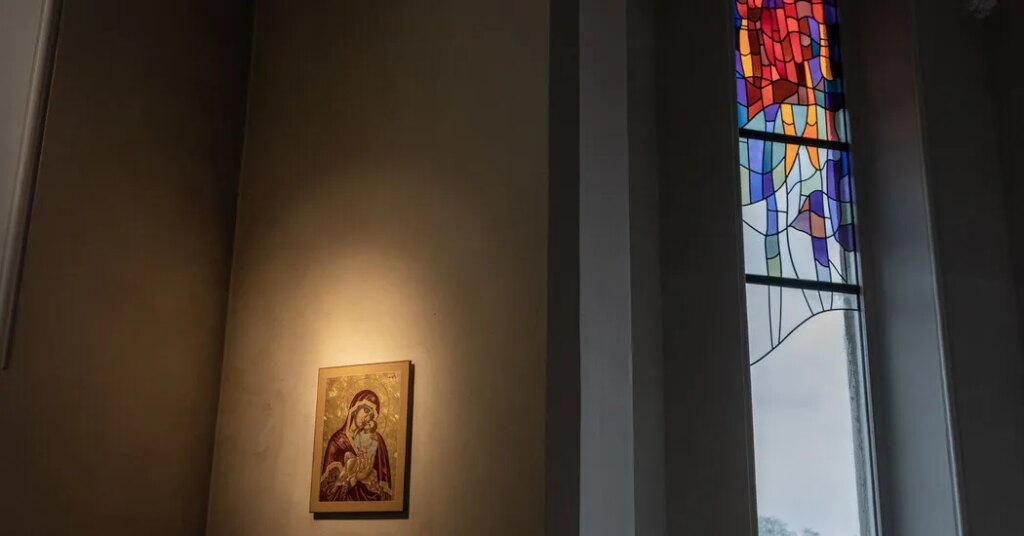
Part of what drew O’Gieblyn to Catholicism was the beauty of the Mass, the vaulted ceiling of the chapel, the endless choreography of standing and kneeling, the rituals so refined that they “did not ask you to think.” She longed to lose herself in mystery and rapture. It was the same longing she felt with alcohol. But these ostensible acts of submission turned out to be warped attempts at control. She eventually realized there was something acquisitive in both. Alcoholism, she says, “is little more than the belief that the ecstasy and joy that life doles out so sparingly and unpredictably can be had on demand, whenever you want it. It is an attempt to bottle grace.”
Catholicism, too, was an attempt to bottle grace. It seemed to promise something grander than an amorphous recovery spirituality that felt “too muddled and lukewarm.” Only later, after O’Gieblyn stopped with the Masses and the drinking, did she resolve “to live in deference to that inner muddle.” This is where life actually takes place. As thinking creatures, humans are necessarily double: riddled by contradictions, conscious and self-conscious, what Hannah Arendt called the “two-in-one.” O’Gieblyn, who had “spent so much time trying to escape inner discord by annihilating one half of the self,” ends her memoir with the suggestion that she is finally ready to accept her self in full.
Or she is ready to try. This mesmerizing book, suffused with suffering and joy, ambivalence and insight, is itself an attempt to find a sense of wholeness — even if it is momentary and elusive, generated less by acts of will than by moments of grace. As O’Gieblyn observes at one point, “If you cannot change your life, you can, at least, control the story.”
WILL AND ATTENTION: A Memoir | By Meghan O’Gieblyn | Doubleday | 272 pp. | $30
The post A Mesmerizing Quest for Ecstasy in Alcohol and Religion appeared first on New York Times.