In early 2024, an aging tanker anchored off Malaysia’s coast delivered more than half a million barrels of oil that were said to be from Oman, but were in fact from Iran.
The deception was meant to evade U.S. sanctions on Iranian oil, which have long been part of Washington’s efforts to choke off revenue for Tehran’s military and nuclear weapons program. The ship, the Palau-flagged Reneez, was not on the list of blacklisted entities that the U.S. government maintains online.
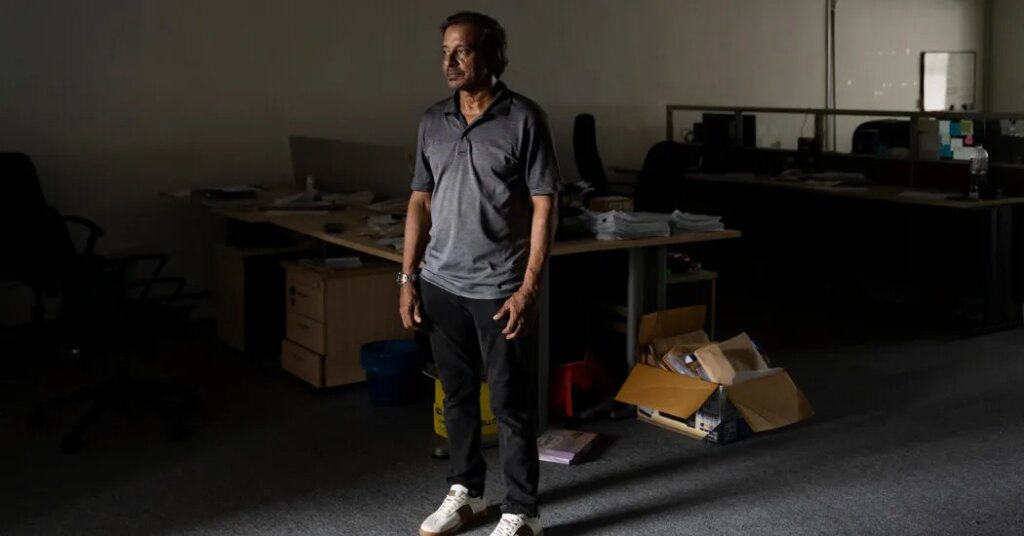
Shahul Hamid Ahmad, who owned a small Malaysian shipping agency, said he thought little of taking a job to coordinate repairs and an inspection of the ship. His firm, Tefcas Marine, was one of many companies that specialize in arranging port services for ships passing by Johor state.
But halfway through the repairs, the tanker was placed under sanctions for ties to Sa’id al-Jamal, a Houthi financier who previously had been sanctioned by the United States for leading a network that procured “tens of millions of dollars” by smuggling Iranian oil. In late 2024, Tefcas and two other Malaysian companies were hit with sanctions for having “materially assisted” Mr. al-Jamal.
The action was part of an expanding effort by Washington to crack down on foreign maritime service providers, which U.S. officials have said facilitate Iran’s oil trade.
For Mr. Shahul, 62, the outcome felt staggeringly disproportionate. His company’s bank closed his accounts and Microsoft locked his company email, which holds records he needs to file taxes.
Tefcas made around $2,500 from the 2024 engagement, according to invoices viewed by The New York Times. But at least nine other entities involved with the Reneez since it began shipping Iranian oil in 2023 went untouched, The Times has found. Among them was a major East Asian oil company that received the cargo.
“We always turned down sanctioned vessels,” Mr. Shahul said. “I would not jeopardize my company for that money.”
The waters around Malaysia have increasingly become the center of Iran’s oil trade. It’s where tankers transfer the crude to vessels that take them to the eventual customer, mainly Chinese refineries. In August, the U.S. Treasury Department announced sweeping new sanctions to target the shipping facilitators that enable the trade.
But Tefcas’s case, experts said, illustrated the limits of such an approach.
“Sanctioning these small players is a warning shot, but I’m honestly not sure if that warning shot has been heard given this activity continues,” said David Tannenbaum, a former official at the Treasury’s Office of Foreign Assets Control and the director of Blackstone Compliance Services, a consulting firm.
Since Tefcas was sanctioned, the trade of Iranian oil near Malaysia has only grown, contributing to almost 667 million barrels exported by Tehran in 2025, according to data from United Against Nuclear Iran, a nonprofit.
In Malaysia and Singapore, the buyers of Iranian oil have continued to operate with impunity, said Jeffrey Soh, the director of Contemporary Logistics, a Malaysian maritime services firm.
Mr. Soh, whose company owned the floating storage unit into which the Reneez had deposited its Iranian cargo in 2024, said that both his company and the local port authority had failed to screen out the vessel. So did the apparent charterer of the oil, which was a major state-linked oil corporation in China, according to a contract viewed by The Times.
But all three of them avoided sanctions, Mr. Soh said, adding that his company had cut ties with that client, which he believed knew of the oil’s Iranian origins. He spoke on the condition that the customer not be named, citing risks of legal retaliation.
“Some companies, it’s an open secret that they trade Iranian barrels,” he said. “The case with Tefcas was really an injustice.”
U.S. sanctions, by design, do not necessarily point to the biggest or most culpable actors, said Erich C. Ferrari, the founder of Ferrari & Associates, a Washington-based law firm.
“The consequences of designating a large trading house or a counterparty in a politically sensitive jurisdiction are weighed at the interagency level,” he said.
“OFAC designates to produce an effect,” he added, referring to the Office of Foreign Assets Control. “And the effect it wanted here was to deter the service ecosystem around these transfers, which you can do with small agents at very little diplomatic cost.”
While some companies deliberately flout sanctions, many others are likely unwittingly exposed. While Mr. Soh’s firm has spent thousands of dollars to upgrade its screening capabilities, he said not every business has “the financial ability to do that.”
Last year, Mr. Shahul asked OFAC to reconsider his case. He has not yet heard back. A Treasury spokeswoman declined to comment on his case.
Because Mr. Shahul has been accused of collaborating with a terrorist, his former clients refuse to settle unpaid invoices, but he still owes various creditors $240,000.
“I think I have under a year to solve this,” he said.
But the Reneez has continued to ship Iranian oil, according to satellite data from TankerTrackers.com. It was spotted near Malaysia as recently as May, under a new name and flag.
Zunaira Saieed contributed reporting.
The post Iranian Oil, a Minor Player and the Limits of U.S. Sanctions appeared first on New York Times.