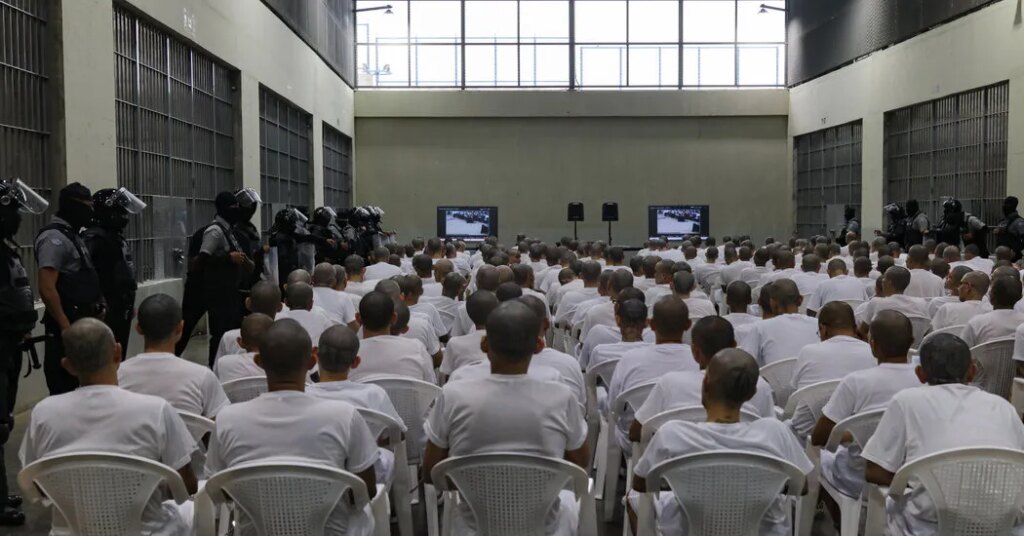
Across El Salvador, hundreds of inmates appear in court by video simultaneously for a single, joint hearing. Some lawyers say that they are first meeting their clients on the same day as their trial. And individual anonymous witnesses are testifying against dozens of suspects at a time, human rights groups say.
More than four years after President Nayib Bukele’s administration arrested tens of thousands of people in a crackdown on gang violence, those detained are finally getting their day in court.
But the trials are unlike anything seen before by most lawyers.
Hundreds of detainees at a time face mass trials that result in near-universal convictions for gang-related offenses, according to a new report released Wednesday by Human Rights Watch, as well as four defense lawyers who spoke directly to The New York Times.
The lawyers and Human Rights Watch reported widespread violations of international human rights conventions in these trials.
The human rights group determined that judges routinely blocked access to files and prosecutors threatened proposed defense witnesses with prosecution. The findings were based on interviews with 15 lawyers representing people arrested for gang-related crimes — four of whom spoke to The Times — and a review of four indictments covering more than 600 defendants and a sentencing document. Lawyers said that the fast-paced mass proceedings gave them little time to present a defense. Furthermore, the cases rely heavily on anonymous plea-bargain testimony and on reports that some police officials have acknowledged are fabricated or based on uncorroborated evidence.
The Human Rights Watch report added that prosecutors and judges have little, if any, independence from Mr. Bukele’s office.
One lawyer described being threatened by a judge with arrest for representing a detainee who had tattoos that the authorities had interpreted as evidence of gang membership.
The lawyers interviewed for this article spoke on the condition of anonymity because they were barred from talking publicly about their cases and feared government reprisals. All said their clients had been in detention for at least three to four years before facing trial.
“First it was mass arrests, now it’s mass convictions,” said Juanita Goebertus, the Americas director of Human Rights Watch. “These trials don’t provide redress to victims of gang violence. They are designed to rubber-stamp arbitrary arrests and deliver long prison sentences, in many cases to innocent people.”
The Salvadoran Attorney General’s office, a spokeswoman for Mr. Bukele, and the Supreme Court, which oversees the organized crime tribunals where the trials are being held, did not respond to requests for comments.
Under Mr. Bukele, the small Central American nation of six million people — once racked by gang violence — was transformed into one of the region’s safest countries.
It is a feat that Mr. Bukele, 45, touts repeatedly. He has drawn the admiration of the Trump administration and conservatives around the world. But human rights groups, some governments and the United Nations human rights office have criticized the strongman tactics Mr. Bukele used to achieve the turnaround.
Mr. Bukele has defended his practices by saying that there is too much focus on the rights of suspects and not enough on citizens freed from gang violence. In April, he said mass hearings aren’t new, pointing to the Nuremberg trials of Nazis after World War II.
“The only ‘novel’ aspect is holding the leaders accountable for crimes committed by their organizations,” he posted on social media. “But we did not invent that principle. It is called ‘command responsibility.’”
An estimated 90,000 people were arrested under a state of emergency put in place in spring 2022 that remains in effect today. The measure brought the country’s prison population to roughly 120,000, creating one of the highest incarceration rates in the world.
Some national police officers in El Salvador told The Times last year that they were under intense pressure to meet arrest quotas and admitted that arbitrary detentions and flimsy evidence helped reach those totals.
Since his political party gained a supermajority in 2021, Mr. Bukele has exerted control over all aspects of the Salvadorean government, including the legislature, prosecutors and courts. Anti-gang measures were enacted, including increased penalties for gang membership or “unlawful association,” the elimination of pretrial detention limits and the permission to prosecute up to 900 people at once if they were tied to the same criminal group.
The result has been a presumption of guilt rather than innocence, and a simulation of justice, not a fair shake in court, according to the four lawyers The Times spoke with. Three of them said that gangs were a grave problem in their country and needed to be brought to justice but that the government’s measures went too far.
“Objectively, there are gang members, criminals and hit men, but among all those people, there are innocent ones, too,” said one lawyer, who has represented nearly 30 people arrested under the state of emergency.
The lawyer said El Salvador needed fair processes to determine who were the real criminals.
In fact, the system is rewarding some gang members who serve as anonymous witnesses through arrangements with prosecutors and receive reduced sentences in return, the lawyers said.
In court, the anonymous witnesses are hidden behind screens so that only judges and prosecutors know their identities, they added. The accused appear in groups by video from prison. Earlier this year, nearly 500 suspected MS-13 gang members watched their court proceeding together virtually from prison.
The lawyers said the witnesses’ testimonies were frequently vague, not verified and contradictory, yet often served as the main evidence used to convict. There was also a lack of supporting evidence, they said.
One lawyer, who currently has more than 25 cases, said that one anonymous witness had testified against 300 people in a single hearing, including two of his clients. And because there were so many people being tried at once, another lawyer said, lawyers were each allotted only about five minutes for cross examination.
“Imagine being a public defender and defending 80 people at once,” another lawyer said.
One lawyer, who has three cases, said that he had once been given only about 20 minutes to make closing arguments. Another lawyer said he felt his argument had been little more than a formality because the judge appeared to have already made up his mind; all 70 defendants were convicted.
Judges, too, remain anonymous during the trials to protect them from reprisals, and the hearings, like the case files, are sealed.
The lawyers said that they had not been allowed to meet or speak with their clients before the trials. The first time they ever met, they said, was virtually in court during a hearing. The few pretrial client meetings allowed to take place have been virtual and recorded by the authorities, according to the Human Rights Watch report.
The lawyers interviewed said that all their clients who reached trial had been convicted, often receiving sentences of 20 to 30 years.
In late 2024, Mr. Bukele acknowledged that 8,000 innocent people had been freed from detention. Human rights groups have said that roughly 30,000 innocent people were arrested, an estimation Mr. Bukele has denied.
Prosecutors have grouped the accused into two categories. There are “homeboys,” or gang leaders, and there are “collaborators,” the most common but loosely defined designation. It refers to anyone who receives a “direct or indirect benefit” from assisting a gang in any way and can include people who serve as lookouts or even provide food.
Under Salvadoran law, convicted leaders face sentences of 40 to 45 years, while collaborators face 20 to 30 years.
The government, the lawyers said, has disproportionately arrested residents of poorer communities where gangs operated and sometimes forced residents into working for them.
One mother, who spoke on the condition of anonymity because she were barred from talking publicly about the case and feared reprisals, said her son, now 29, had been arrested on his way to work in June 2022. She acknowledged that he had occasionally bought marijuana but insisted that he had none on him the day of his arrest and did not belong to a gang.
Last month, she said, he was sentenced to 25 years for being a collaborator. Her lawyer plans to appeal.
The post Mass Trials Put Hundreds in One Dock in El Salvador appeared first on New York Times.