The European Union and China are heading toward a trade showdown.
Europe’s trade negotiators are meeting with Chinese officials on Thursday and Friday in Beijing. A week later, Europe’s presidents and prime ministers will gather in Brussels to discuss industrial competitiveness with China, among other agenda items. Their concern is urgent. The region’s trade deficit with China is running at 1 billion euros ($1.1 billion) per day.
European officials blame an undervalued Chinese currency and Beijing’s state-controlled banking system, which has supplied vast amounts of cheap credit to build export-focused factories.
Chinese officials offer a different explanation. They say much of the widening imbalance reflects Europe’s surging imports of electric cars, solar panels, batteries and battery chemicals. European demand for those products has risen as the continent tries to combat climate change, adjusts to the loss of inexpensive Russian oil and natural gas and copes with the war in the Middle East — developments for which China argues it should not be blamed.
Europe is not alone in its concerns. China’s export push has unnerved other trading partners, including the United States, as Beijing’s trade surplus reached a record $1.19 trillion last year.
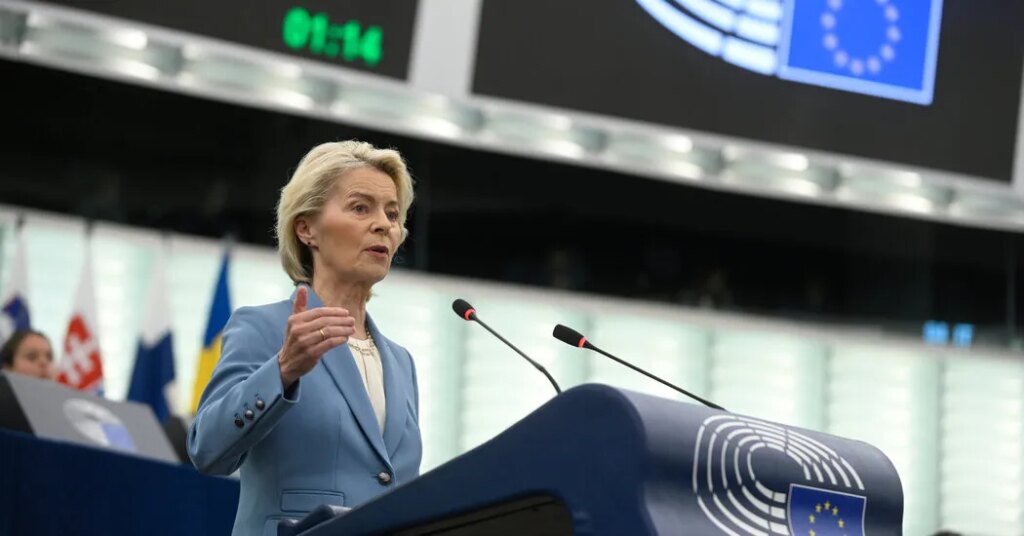
Ursula von der Leyen, the president of the European Commission, warned in an address last month that Europe’s trade deficit with China had reached a “tipping point,” leading to “deindustrialization in the industrial heartlands of Europe.”
Friedrich Merz, the German chancellor, and Emmanuel Macron, the president of France, added to the pressure on Monday, urging Brussels to expand its arsenal against economic imbalances. In a letter to Ms. von der Leyen, they called for a mechanism that could rapidly restrict access to the European market. European media quickly labeled it a “kill switch.”
Europe already has the right under the World Trade Organization’s so-called safeguard rules to impose steep tariffs on broad categories of imports from all countries, but not against a single country. Beijing has opposed safeguard tariffs designed in practice to target Chinese exports and has hinted that it would retaliate if they were imposed.
“China will not accept any discriminatory measures,” said Tu Xinquan, dean of the China Institute for W.T.O. Studies at the University of International Business and Economics in Beijing.
For now, time favors Beijing. Each passing month adds more than $30 billion to China’s trade surplus with Europe, supporting hundreds of thousands of Chinese industrial jobs. Meanwhile, European manufacturers continue to weaken. Germany alone has been losing at least 10,000 industrial jobs each month, according to analysts.
Yet despite Europe’s tougher language, China is seeking a compromise. “Both sides will ultimately seek to tackle those problems on a mutual benefit basis and maintain the overall trade relationship,” said He Weiwen, a prominent Chinese trade analyst.
Here are some of the key issues at stake.
Cars
The biggest point of friction — and perhaps the hardest to resolve — is China’s rapidly growing automobile exports to Europe.
Two years ago, the European Union imposed tariffs of 7.8 to 35.3 percent on battery-electric cars from China, on top of its existing 10 percent tariff on imported cars. But the measure left a significant loophole.
The extra tariffs do not apply to plug-in hybrids that combine an electric drivetrain with a gasoline engine, even a tiny one.
Chinese automakers have already developed many such models. Their popularity began with a practical problem drivers in China faced. After electric-car sales started surging in China in 2020, urban families driving home for Chinese New Year often encountered villages with only one charger and long lines. Automakers responded by adding small gasoline engines as backups.
But China has built charging infrastructure at an extraordinary pace, reducing the need for plug-in hybrids. Chinese automakers have increasingly exported them instead.
Exports of plug-in hybrids have soared from fewer than 10,000 a month to almost 200,000 a month in just three years, with many going to Europe.
Beijing strongly opposes widening those E.U. tariffs to include plug-in hybrid cars. But European officials face growing pressure to respond, particularly after Volkswagen, struggling against Chinese competition, announced on Sept. 3 that it would cut another 50,000 jobs, bringing its total planned reductions to about 100,000.
Renewable Energy
The European Union is investigating imports from China’s state-controlled Goldwind Science & Technology Company, the world’s largest wind-turbine manufacturer. In February, the bloc issued a preliminary finding that Chinese subsidies were giving Goldwind an unfair advantage in Europe, potentially laying the groundwork for tariffs.
Goldwind has said it complies with all international and local laws and regulations and will cooperate with the investigation.
Wind turbines are among the technologies covered by the European Union’s proposed Industrial Accelerator Act, an effort to rebuild the region’s manufacturing by requiring key components to be produced in Europe and by restricting some foreign investment. Solar energy, chemicals and other industries are also covered.
China strongly opposes the legislation.
Rare Earths
In her address last month, Ms. von der Leyen said Europe had become dangerously dependent on China for rare-earth metals, which are crucial for automobiles, drones, lasers, semiconductors, jetliners, electronics and other advanced industries. After previously accusing Beijing of restricting rare-earth shipments to Europe, she called for the union to develop its own supplies.
China has tightened controls on exports of rare-earth processing equipment and restricted rare-earth technicians from leaving the country.
In July, Beijing also imposed stringent restrictions on rare-earth exports to 14 European companies, including Germany’s leading defense manufacturer and several businesses that turn rare earths and other critical minerals, like antimony and tungsten, into the alloys and specialty chemicals that many manufacturers need.
Market Access
E.U. officials and business leaders also complain that Beijing continues to limit foreign companies’ access to the Chinese market.
In telecommunications, China has steadily replaced imported equipment with domestically manufactured alternatives and curtailed purchases from foreign suppliers. Nokia, the Finnish telecom giant, is closing much of its mainland China operations this autumn.
European makers of hospital equipment, pharmaceuticals and other products have encountered similar obstacles. China’s state-owned companies have expanded at the expense of private businesses and have shown a particular reluctance to buy imports.
Yet European enthusiasm for the Chinese market is also fading for reasons beyond government policy. China’s prolonged housing market downturn has left many Chinese households and companies with little money to spend, while industrial overcapacity has driven fierce price competition and eroded profits.
Jeanna Smialek contributed reporting from Brussels.
The post Europe’s Trade Tensions With China Are Coming to a Head appeared first on New York Times.