“I’ve been voting Republican my whole life. I’m super conservative,” Pine Tree superintendent Steve Clugston tells the camera in an Instagram reel. “I’m gonna tell you what, when Greg Abbott sold us out to the billionaires and sold out our schools, I’m done with his leadership.” In the Texas governor’s race, Clugston is voting for Abbott’s Democratic opponent, State Representative Gina Hinojosa.
The Pine Tree public school district is in the bright red, small city of Longview in East Texas, between the big cities of Dallas and Shreveport, La. The majority of its 4,400 students are economically disadvantaged. When I caught up with Clugston on Friday, hours before the Pine Tree football team trounced its opponents under the lights, he was at his farm. “My wife’s a teacher, my daughter’s a teacher, my son-in-law’s a teacher, both my sisters are teachers, my brother-in law’s a retired superintendent. So I’d say education’s kind of in our blood,” he told me over the phone.
Clugston told me he’s sick of his fellow Texas conservatives straying from their principles of fiscal common sense and straight talk; he even attempted a run for the Texas State Senate as an independent conservative. He is particularly appalled by Texas’s voucher program, known as Texas Education Freedom Accounts, which went into effect earlier this year. This program puts state money in accounts for Texas families to use outside the public school system: up to nearly $10,500 for children enrolling in private school, up to $30,000 for children with disabilities and up to $2,000 for those who are home-schooled.
The State of Texas has no say over the curriculum taught at the institutions that accept vouchers, and participating schools can discriminate against applicants for any number of reasons, including religion and disability status. Texas’s vouchers are universal, which means anyone can apply for them, regardless of financial means, though poorer students have been prioritized.
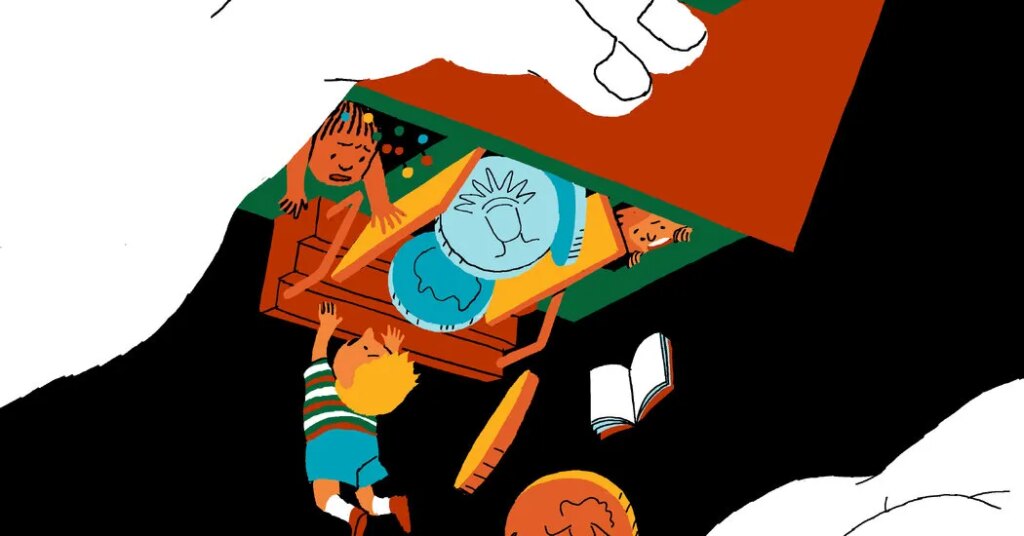
Around 70 percent of this year’s voucher recipients were already enrolled in private or home- school. Vouchers are costing the state about a billion dollars this year alone, and could ultimately end up costing $4.4 billion annually. While funding for vouchers comes from a budget that is separate from the public school pot, the state’s funding for public schools has not kept up with inflation.
Texas public schools will lose a projected $227 million just this year, as they shed head count, according to The Houston Chronicle. More public schools may close as a result of vouchers siphoning that money away from them. In Clugston’s opinion, vouchers are “a billion-dollar giveaway program for the rich and we’re gonna have no accountability in it. Zero.”
Hinojosa has made saving public education central to her campaign for governor, and it is what got her started in politics. Her child’s school was on the brink of closure, and she describes her political trajectory as concerned parent, to local school board member, to Texas House member. If elected, Hinojosa has vowed to “end the voucher scam.”
I have long been frustrated at the way both parties barely talk about K-12 public education, despite plunging test scores and post-Covid woes. But the reason politicians don’t talk more about education is because voters don’t care about it. What makes Hinojosa’s message on schools effective beyond irate public school parents and educators is that she ties the passage of vouchers to larger themes plaguing Republicans in the age of Trump: corruption and the outsize power of billionaires.
Vouchers failed in the Texas Legislature multiple times, with rural Republicans tending to side with Democrats to block the measures. In rural areas, “school choice,” even with vouchers, tends to be a mirage. There are few private schools, and public schools are often the biggest local employers and the heart of small-town life; nearly every Texan I spoke to for this newsletter said the reverence for “Friday Night Lights” is real.
When Gov. Greg Abbott couldn’t get vouchers passed the honorable way, he decided to primary Republican state legislators who opposed the policy. Abbott took $12 million from Jeff Yass, a pro-voucher Pennsylvania billionaire, got most of his preferred candidates into office, and got vouchers passed in 2025, as The Washington Post noted.
The outcomes for students participating in voucher programs in other states have been decidedly mixed, but Yass doesn’t give a rip. “If the mother or the parent wants the kid to go from one school to another, who the hell is anyone to tell them not to?” Yass told The Post. “I don’t care what the studies say.”
Yass isn’t the only billionaire who meddled in vouchers in the Lone Star State. The religious Texas billionaires Tim Dunn and Farris and Dan Wilks, have also poured money into pro-voucher candidates over the years. As The Texas Tribune explains, “Dunn is also the founder of Midland Classical Academy, a private school that offers its approximately 600 K-12 students a ‘Classical Education from a Biblical Worldview,’ according to its website.” (It’s worth noting that many of the elite, popular and highly ranked private schools in Texas refused to accept vouchers this year).
Some voucher proponents claim that Texas offers more choice to underprivileged children in underperforming schools. But the data we have on other states with universal voucher programs, like Arizona’s, suggest that they are redistributing money to the highest income and most educated ZIP codes in cities and suburbs. An Arizona ABC station found that parents were spending their voucher money on everything from trampoline parks to ski tickets.
In Iowa, which has a universal voucher program for private schools that’s similar to Texas’s, the Democratic candidate for governor and the current auditor, Rob Sand, has made a similar connection between vouchers, special interests and corruption. “The current school voucher program is an open invitation to waste, fraud and abuse of taxpayer dollars,” Sand explains on his campaign website.
Sand lists his voucher stance under the headline Accountability for All, where he also talks about protections for whistle-blowers and banning stock trading. By doing so, Sand is saying that you don’t have to care about what’s going on in the classroom to be outraged that a New York-based company called Odyssey, which manages his state’s voucher program, allegedly got a “sweetheart” deal for the work. As auditor, Sand found that the company “more than doubled its rate less than a month after signing their no-bid contract, costing taxpayers an additional $2.7 million.” (Odyssey, which has ties to Yass, also administers the voucher system in Texas.)
Whatever you think about public schools, it is difficult not to seethe at the fundamental unfairness of voucher programs that give money to schools that don’t have to educate all students. The Texas Observer found that of 291 private schools approved for voucher funds from the state, over 90 percent were religious or faith-based schools, “more than 100 of those schools require or prioritize for admission students of the same faith, and more than 60 have a written policy that discriminates against L.G.B.T.Q.+ students, the schools’ own data shows.”
Though the Texas vouchers prioritize students with disabilities, The Observer also noted that most of the private Texas schools they analyzed lack special education services. A Dallas Morning News analysis found that thousands of students with disabilities returned state money, in part because private schools either rejected them or didn’t even respond to their applications.
Some educators I spoke to in both Texas and Iowa told me that they’d already seen students ricocheting back to public schools because their private or home-school experience wasn’t all it was chalked up to be. Another outrageous part of this legislation is that Texas public schools are still required to do the disability testing for families that choose vouchers, and it’s straining their limited resources.
When put to a public vote, school vouchers have been unpopular; they’re perennial losers on the ballot. It’s maddening that ideologically motivated billionaires, who likely never sent their own children to public schools, have been able to push this policy through.
According to the latest New York Times/Sienna University polling, Hinojosa is up by four points, and Sand is up by 11. Texas is obviously the tougher battle, but after spending the week talking to parents there, I’m cautiously optimistic. Rebekah Baus, who described herself as a conservative Christian and lives in the Dallas-Fort Worth area with her husband and two kids, told me she is so upset about the state of public school policy that she doesn’t know which way she is voting.
The State of Texas, Baus said, is trying pretend “our public school system is failing, but in the reality, we’re failing our public school system by not funding them properly.”
End Notes
-
Rural schools tend to be particularly ill served by vouchers. If your rural school is closing, or at risk of closure for any reason (including a declining population of children), I want to hear from you: drop me a line.
-
ProPublica has been doing excellent work on vouchers and the lack of oversight into vouchers and private schools. They tried to start a fake private school as an experiment and found that the requirements were so scant, “we could enroll students in two states right now, if we wanted to. Arkansas even suggested ways our school could accept public money through the state’s voucher-style program.” They even created a quiz to show how “many states invite anyone with a dream and a heartbeat to start a school.” Take it here, you’ll be shocked.
-
Given that I adored the Sharon Horgan show “Catastrophe,” I was not surprised to find that I also love her new HBO show “Youth.” Horgan plays Alex, a divorced literary agent who is struggling with sandwich generation headaches while she tries to get back into dating. Her 18-year-old won’t launch, her ex-husband pretty much stopped parenting and her parents are in poor health. Horgan always manages to make the mess of life into something funny and real, and I want half her outfits. (If someone can source her booties or the perfect cropped sweatshirt she wears in Episode 1, please tell me.)
Read past editions of the newsletter here.
If you’re enjoying what you’re reading, please consider recommending it to others. They can sign up here.
The post The School Policy Scam Turning Voters Blue appeared first on New York Times.