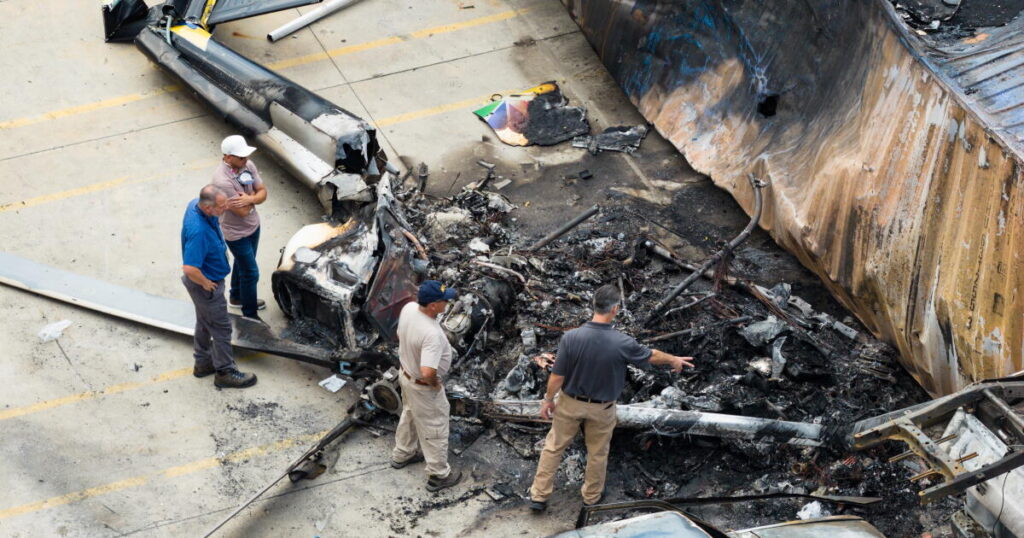
A news helicopter that crashed in Chatsworth last month — killing the pilot, an onboard journalist and a bystander on the ground — was flying low and had slowed down to an airspeed of about 6 knots in the minute before it went down, according to a preliminary federal report.
The National Transportation Safety Board report, released Tuesday, said the Airbus AS350 B2 helicopter maneuvered above a collision involving an SUV and an L.A. Metro bus to gather footage for NBC4 and Telemundo 52 for about 1 hour and 24 minutes before it crashed.
Just before it went down, the craft was about 800 feet off the ground and had slowed to nearly 7 mph, conditions that may have prevented the pilot from executing a safety maneuver known as autorotation, experts say.
When a helicopter’s rotors stop rotating, a pilot can use autorotation to try to gain enough momentum and upward flow on the rotor blades to increase their rotation, which helps control the aircraft as it descends, according to Jack Cress, a former U.S. Marine Corps helicopter pilot and a helicopter accident investigation instructor at USC’s Aviation Safety and Security Program.
“I am not convinced that the guy was not in a height velocity problem, and I think that the fact that his ground speed was a mere 6 knots suggested he did not have that part of the kinetic energy that he needed to make a successful autorotation from where he was,” Cress said.
NBC4 reporter Eliana Moreno and pilot George Marciniw were killed in the crash along with 29-year-old Edy Gutierrez Mejia, who was on the ground when the chopper went down.
The NTSB report did not outline what specifically caused the helicopter to crash. But the report includes details that investigators have probed in an effort to determine a cause.
The best piece of evidence so far appears to be a roughly four-minute video taken by the onboard news reporter on the night of the crash, Sept. 15, that captured ambient helicopter noise — including sounds from both the main rotor and the engine.
“During the last 29 seconds of the flight, the recording captured the helicopter noise as it changed frequency, along with intermittent and continuous horns, consistent with the helicopter’s main rotor high rpm, low rotor rpm and other aural advisories,” the report states.
About 7:55 p.m., data show the helicopter rapidly descending while turning right, according to the report. Security cameras from several buildings in the area recorded the chopper as it descended quickly and struck a metal storage container. The helicopter then caught fire, the report states.
Helicopter pilots are generally trained to refrain from hovering in the air at low altitudes with little forward momentum, known by pilots as a “dead man’s curve,” because it gives very little recourse if there are engine problems. But it is a common practice for police and news choppers, Cress said.
“They spend a lot of time in areas where the helicopter pilots are told not to be,” Cress said. “Every helicopter pilot is told that that region exists, and they are warned of the fact that if you’re anywhere near that thing, you may very well not be able to make a successful autorotation.”
The post NBC4 helicopter was flying low and slow before crash, NTSB says appeared first on Los Angeles Times.