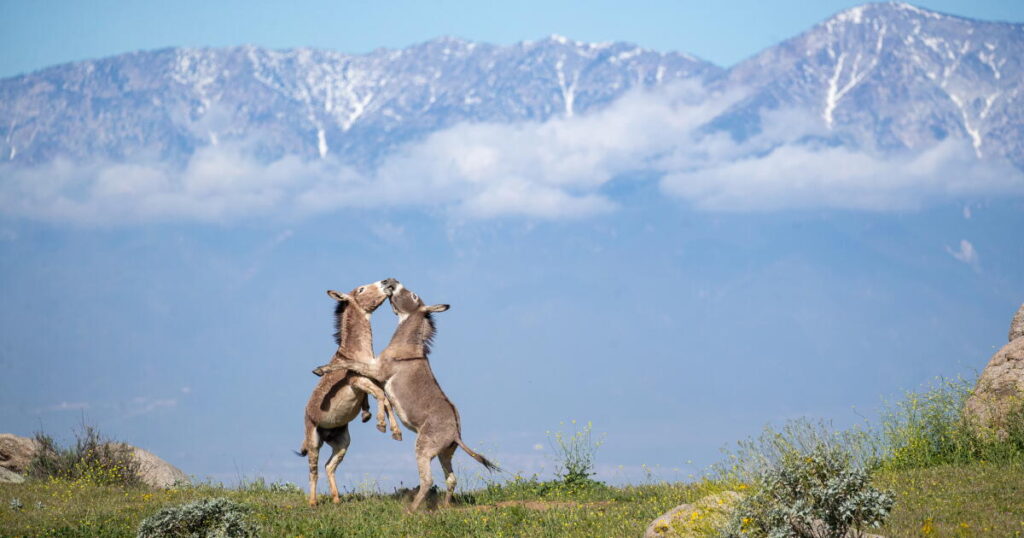
For students at UC Riverside, the start of fall semester means picking up their class syllabus, catching up with friends and snapping selfies with the adorable wild donkeys that roam around the school.
The hoofed Highlanders have been embraced as an unofficial mascot on campus, with Reddit threads dedicated to donkey spotting and burro plushies for sale in the campus store.
The animals’ relationship with residents in the surrounding hillside communities of the Inland Empire is more complicated.
Though many residents share a love for the wild burros, others see them as a public safety risk due to the possibility of car crashes, property damage or injuries during close encounters.
And when it comes to decisions about how best to manage the population, tensions often run high.
A community firestorm erupted after San Bernardino County contracted with a Texas-based nonprofit to relocate hundreds of wild donkeys to a sanctuary in the Lone Star State, resulting in death threats against the nonprofit’s leader and ultimately leading officials to terminate the agreement last year.
Outrage was sparked again this year after reports that someone (or possibly multiple people) had shot at least half a dozen donkeys with arrows in a series of unsolved attacks.
Despite the extensive commentary swirling around the burros, surprisingly little is known about the herd itself. This includes key questions such as how many live in the Inland Empire, whether the population is growing and how they are affecting the ecosystem.
A team of researchers at UC Riverside is on a mission to change that by studying the wild population in hopes of gaining insights that can improve coexistence between humans and donkeys.
“Donkeys are very strong animals; they bite, they kick,” said associate professor Marko Spasojevic. “We want to avoid those conflicts by better understanding where they go, what resources they need and ideally help Riverside County take care of these populations.”
Spasojevic, who teaches in the Department of Evolution, Ecology, and Organismal Biology, is leading the university’s research into the local donkey population. One of the first tasks is gaining a precise understanding of the herd’s population size and birth trends.
It is currently estimated that several hundred donkeys live in the Box Springs Mountain Reserve and are known to wander into the nearby Riverside and San Bernardino county communities of Loma Linda, Riverside and Moreno Valley, he said.
As temperatures spike and vegetation dries in the summer and fall, donkeys often travel down the hillside to graze on UC Riverside’s well-irrigated lawns or enjoy a nap in the cool shade of the parking structures.
This fall, graduate student Wyatt Hall is deploying motion-activated wildlife cameras across the burros’ habitat to help track and count the population.
“Understanding how quickly that population is growing will help us think about things like minimizing traffic collisions,” Spasojevic said. “If the population is growing a lot, we may need to think about putting in barriers or wildlife overpasses.”
Another long-term goal of UC Riverside researchers is to understand the ecological role and impact of the donkey herd, which can also help inform whether population control or other interventions are needed.
Based on his observations thus far, Spasojevic believes the burros could play an important role in the local ecosystem by grazing on non-native grasses and preventing them from overtaking native plants. At the same time, he’s concerned that the animals’ trails around the mountains could be causing damaging levels of soil erosion.
In order to learn more about their feeding habits, researchers plans to analyze poop samples. If funding allows, in future years Spasojevic would also like to put GPS collars on wild donkeys to better understand their movements and how certain seasonal or weather patterns increase their likelihood of wandering into urban areas.
This year, Spasojevic and colleagues Ellie Armstrong and Kieran Samuk are also planning to use genetic technology to try to understand the origin of the Inland Empire’s wild donkey herd.
Scientists have traced the origins of donkeys back more than 5,000 years to eastern Africa. The animals reached Spain during the Roman Empire and were later brought to what is now Mexico by Spanish colonists in the 1500s. In the 1770s, Spanish explorer Juan Bautista de Anza led an expedition of settlers into what would later become California, bringing donkeys and horses with him.
There are two predominant rumors about how a wild herd ended up in the Inland Empire, Spasojevic said. The first is that miners abandoned some donkeys in the region during the gold rush; the second is that a group of ranchers drove over a population of burros from Death Valley in the 1950s.
Spasojevic hopes to be able to gain a clearer answer by comparing DNA samples from local donkeys to DNA collected from populations elsewhere.
One thing that is unique about the Inland Empire’s wild donkey population is its proximity to urban areas.
“Most of the places where there are large populations are places like Arizona where they’re out in open wildlands,” Spasojevic said. “Here we have them walking through neighborhoods.”
On campus, students are educated on the importance of not touching or feeding the donkeys, which weigh about 500 pounds and can charge at humans when feeling threatened. Students are also instructed to slow down when driving near donkeys as collisions can cause injury or even death to humans and animals.
As development continues to expand in the Inland Empire, it’s likely that contact between humans and donkeys will continue to increase, underscoring the importance of better understanding and managing this unique population.
The post Riverside has a donkey dilemma. Can science offer clues for coexistence? appeared first on Los Angeles Times.