Democrat Xavier Becerra, the frontrunner to become the state’s next governor, often invokes the story of his parents’ humble beginnings as immigrants from Mexico who, through hard work, built happy and productive lives in California.
“My parents came to California with $12 in their pocket. They lived the California dream,” Becerra said during last week’s gubernatorial debate with Republican rival Steve Hilton, aired nationally on CNN.
Becerra for years has described himself as the “son of immigrants” when talking about his upbringing, but that claim has come under scrutiny by Hilton and other critics who accuse Becerra of embellishing his family history. Becerra’s mother is from Guadalajara, Mexico, but his father was born in Sacramento and raised in Tijuana — making him a U.S. citizen and not a legal immigrant.
“Unlike Xavier Becerra, I am an immigrant. Unlike Xavier Becerra, my father was an immigrant. My stepfather too. My whole family,” Hilton wrote in a post on X.
Hilton is an immigrant from the United Kingdom and is the son of Hungarian immigrants who fled their homeland during a revolution in 1956.
Richard Grenell, a former Trump administration official, accused news outlets of letting a lie “continue for decades” throughout Becerra’s tenure as California attorney general and then as a Cabinet official in the Biden administration.
Becerra has openly discussed the details of his parents’ story, which unfolded on both sides of the border and in many ways reflects Mexican immigrant trajectories during the historical period of the 1920s and 1930s.
During speeches and in interviews Becerra has described how his father, Manuel, was born in Sacramento in 1928 and taken back to Tijuana as a young boy, with few jobs for Americans during the Great Depression, and even fewer jobs for Mexicans working in the U.S. His father traveled between the two countries often, and, as an older child, he would look for work in the U.S.
Becerra on Tuesday accused Hilton of “casting lies” about his family’s background, saying that the Republican failed to understand the struggle that many Mexican immigrants and Mexican Americans faced in this county decades ago. He said his dad would tell of the days when he couldn’t walk into some establishments that had posted signs that read “No dog, Negros or Mexicans allowed.”
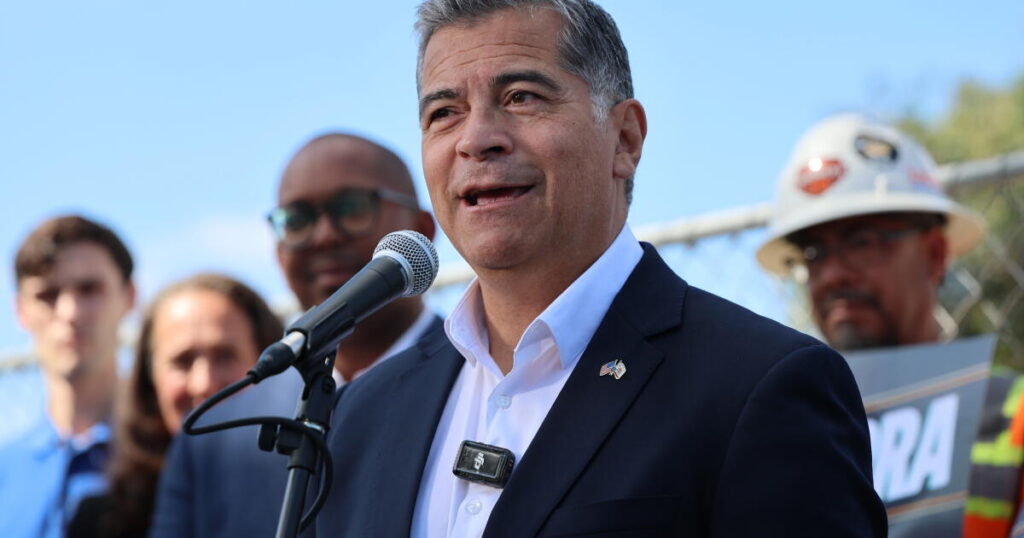
“This is what happens when people who don’t understand immigration start to pontificate,” Becerra said Tuesday after a morning rally against Proposition 39, a voter identification measure, at Guelaguetza, a Oaxacan restaurant in Los Angeles’ Pico-Union neighborhood.
“I am very proud of my parents, and I consider them immigrants because even though my dad was born in the U.S. — in a country that wouldn’t treat him the way it would treat other U.S. citizens — my dad was a proud immigrant,” Becerra said. “I am proud that I am their son. I am the son of immigrants.”
G. Cristina Mora, a UC Berkeley professor of sociology studying attitudes toward immigration, said Becerra’s critics misunderstand a common phenomenon at the time, when immigrants moved back and forth across a southern border that was much more porous — very different from the militarized border of today.
Beyond the dwindling jobs and precarious economics of the 1930s serving as a push factor for many Mexican families, a wave of xenophobia also helped send hundreds of thousands back to Mexico. A wave of mass deportations across the Southwest states resulted in more than 1 million Mexicans and their descendants being forced out of their homes and loaded on trains out. More than 60% were U.S. citizens.
Mora, who also serves as co-director of the UC Berkeley’s Institute of Governmental Studies, said “it was a time of very great anti-Mexican fervor.” Many sought to later return. Some were deported multiple times.
“There are many types of immigrants. There’s so much nuance,” Mora said. “To think there’s only one immigrant story would just be to not know California.”
Becerra’s campaign spokesperson Jonathan Underland in a statement accused Hilton of hypocritically attempting to capitalize on an immigrant narrative.
“Steve Hilton doesn’t seem to have a problem with immigrants who look like him — but openly attacks immigrants who look like Xavier Becerra,” Underland said. “Trump ignited a deep anti-immigrant animus among MAGA voters, and Hilton is tapping into that as he scrambles to distract from his bizarre ad campaign that alienated some of his closest allies.” Last week, Hilton’s campaign put out a provocative, sexually suggestive ad that drew criticism from his fellow Republicans.
Becerra, both on Tuesday and throughout his long political career, has often described his parents’ upbringing.
He said his father’s family moved back to Tijuana during the Great Depression. His father, he said, was the eldest child and was forced to leave school after the sixth grade to help support the family. He began working as a preteen, bouncing back and forth between the U.S. and Tijuana. He would tell stories about being a shoe shiner, at times of celebrities and movie stars. He also worked in the farm fields with his dad and sometimes with his uncles.
In the early 1950s he married Becerra’s mother, Maria Teresa, who lived in Guadalajara.
“When they decided to make a go of it outside of Guadalajara, they went to Tijuana. They didn’t have great success, so that’s when they decided to come to the U.S.,” Becerra said on Tuesday. “So when I say my parents came to California with $12 in their pocket, it’s because, Steve Hilton, my parents came to California with $12 in their pocket.”
Becerra’s father later began a construction career that lasted 30 years, while his mother worked as a clerical worker and later purchased rental properties.
Times researcher Cary Schneider contributed to this report.
The post Becerra’s ‘son of immigrants’ story emerges as latest flash point in governor’s race appeared first on Los Angeles Times.