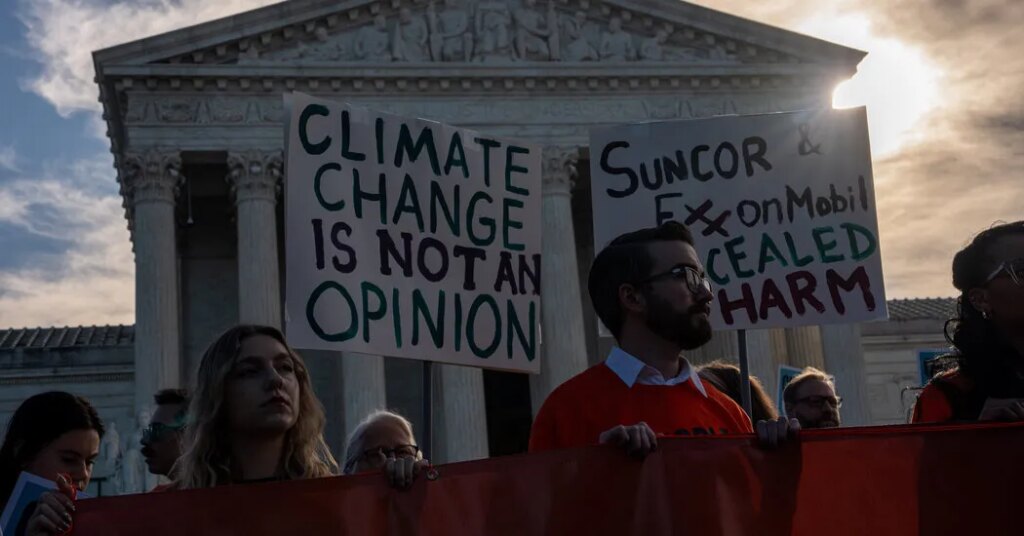
For more than a decade, a growing movement has attempted to hold fossil fuel companies liable for the damages caused by climate change. On Monday, the campaign reached the Supreme Court.
The case at hand involves officials in Boulder, Colo., who sued two oil companies, Exxon Mobil and Suncor Energy, over pollution the firms caused and their alleged efforts to conceal the dangers posed by a warming world.
Monday’s arguments were technical, focusing on whether federal law prevented a case like this from being brought at the state level and whether the Supreme Court has the power to hear it at all, according to my colleague Abbie VanSickle.
The justices did not make a decision about whether the case could move forward. That is expected to come next summer. But however the court rules, the implications will likely be profound.
If the justices decide that Boulder’s case can proceed, it could open the door to oil and gas companies owing many billions of dollars in damages.
But if the justices side with the oil companies, it will throw dozens of similar cases into jeopardy and undermine a legal movement trying to hold big polluters responsible for the mounting damages caused by global warming.
“If that’s what happens, all these other cases will go away,” Michael Gerrard, director of the Sabin Center for Climate Change Law at Columbia University, recently wrote.
‘Chapter 3’
During Monday’s arguments, members of the court appeared largely split along predictable ideological lines.
Justice Elena Kagan, part of the court’s liberal minority, compared the case with previous efforts to hold tobacco and opioid companies responsible for broad societal harms. If those cases were Chapters 1 and 2, she said, the climate case was Chapter 3.
Chief Justice John G. Roberts Jr. and Justice Brett M. Kavanaugh, members of the conservative majority, appeared more deferential to the oil companies.
“Presumably if you prevail, the next day, a municipality in every single state will file a lawsuit that will probably copy your pleadings,” said Justice Roberts, addressing the plaintiffs’ attorneys. “How would you think that will work out on the ground?”
Justice Samuel A. Alito Jr. recused himself from the case after coming under fire from environmental groups who noted that he owns stock in oil companies and flew on the private jet of an investor in a company involved in the dispute.
That leaves open the possibility of a deadlock, with the justices split four to four. If that happens, Boulder’s case could continue in the lower courts, which are generally seen as more favorable venues for cities and counties pursuing claims against corporations.
‘A get-out-of-jail-free card’
While a decision likely won’t arrive for many months, the battle lines were already drawn among environmentalists and legal scholars.
“Coal, oil and gas companies have made trillions of dollars in profits from the sale of fuels that are driving the climate crisis,” Matthew Tejada, senior vice president for environmental health at the Natural Resources Defense Council, said in a statement. “They have knowingly misled the public for decades. They lobbied to derail or delay action to confront climate hazard and harm, abetted by a Trump administration hellbent on locking future generations into decades more dependence on destructive fuels. Now a staggering bill is coming due.”
“Communities deserve to have their day in court,” wrote Kathy Mulvey, the accountability program director for energy and climate at the Union of Concerned Scientists. “The Supreme Court should let this case be heard on its merits in Colorado and Congress must not stand in the way by gifting Big Oil a get-out-of-jail-free card.”
John Yoo, the conservative legal scholar, said on Fox News that this case was the most important one of the new term, and argued that the framers of the Constitution would have rejected the idea that states and cities could have a hand in determining the outcome of an industry vital to national security.
Other conservatives said it wasn’t appropriate for municipalities to threaten the solvency of major corporations.
“What’s being sought are damages that would be crippling,” former Attorney General Bill Barr, a partner at Torridon Law who has represented fossil fuel interests, told Politico. “It’s imperative these cases be put to rest and this whole approach be put to rest.”
As the Alps melt, ancient objects tell stories of the Stone Age
The Alps are losing ice faster than almost anywhere on the planet. And as the glaciers and ice patches disappear, they are releasing secrets that had been locked away for millenniums.
Secrets like an enigmatic, 2,500-year-old ski that melted not long ago out of a strip of dying Swiss ice.
Secrets like a fragment of an elm wood bowl from the fifth millennium B.C., long before the pyramids of Egypt and Stonehenge. A birch bark quiver with two flint arrowheads tucked inside, from around 2800 B.C.
And a two-foot-long statuette sculpted from larch, with a human figure at one end and a sharpened point at the other, from the last two centuries B.C., its purpose unknown.
Such discoveries are challenging old ideas about how early societies interacted with the alpine environment. Far from being forbidding, off-limits zones, the icy mountain passes apparently bustled with traffic: hunters, herdsmen, traders bearing barrels of wine on mules.
Between a winter of little snow and a summer of broiling heat waves, this year has been another devastating one for Switzerland’s glaciers. They have shed nearly 20 percent of their volume over the past five years, scientists said this month. At the current pace of global warming, 97 percent of today’s glaciers across the Alps could be gone by century’s end, posing big challenges for the tens of millions of Europeans for whom the ice is a vital reserve of water in dry years.
Read the article and watch a video of the hunt for ancient objects.
— Raymond Zhong
More climate news from around the web:
-
For the first time, sales of gas-only cars dipped below 50 percent globally in the first six months of the year, according to Car Buzz.
-
Nearly 320,000 acres of public land in northwest Arizona, an area with little to no known oil or gas reserves, have been nominated for leasing, the Arizona Republic reports.
Read past editions of the newsletter here.
If you’re enjoying what you’re reading, please consider recommending it to others. They can sign up here.
Follow The New York Times on Instagram, Threads, Facebook and TikTok at @nytimes.
Reach us at [email protected]. We read every message, and reply to many!
The post Climate Lawsuits Have Their Day in Supreme Court appeared first on New York Times.