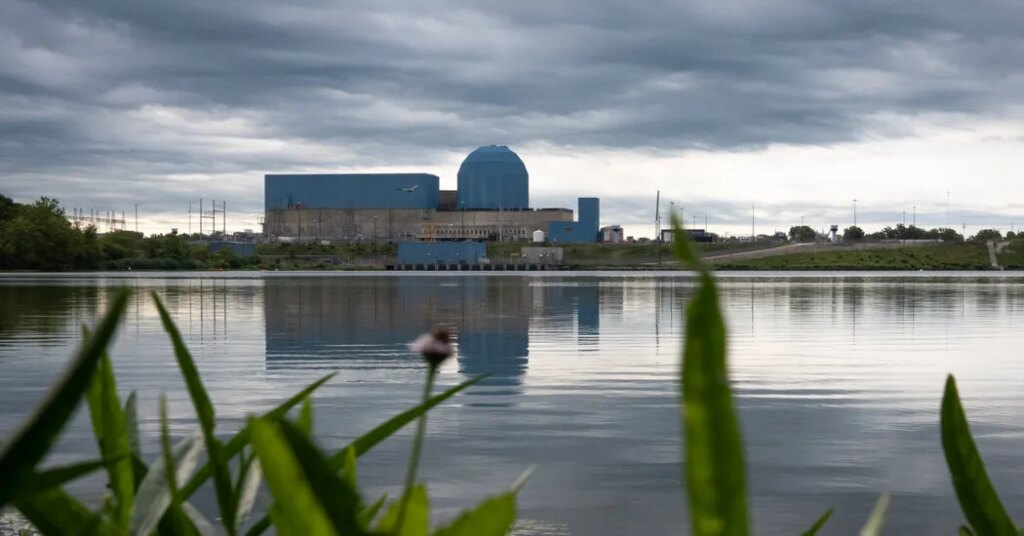
Building a nuclear power plant is a long, hard slog. So lately, many companies are eyeing a faster, cheaper solution: squeezing even more power out of old reactors that were built decades ago.
This process, known as a “power uprate,” involves upgrading key components inside nuclear plants such as controls, turbines or pumps so that they can generate more electricity. These upgrades can cost billions and require approval by regulators, but they can often be completed in five years or less at a fraction of the cost of building a nuclear plant from scratch.
With demand for power rising as artificial intelligence booms, many tech giants are eager to pay for these upgrades. Increasing production from existing nuclear plants could ultimately add as much as 6,000 to 8,000 megawatts of electric capacity to U.S. grids, companies and analysts estimate. That’s roughly the equivalent to building six to eight giant new reactors.
Google, for example, is investing in new nuclear plants to fuel its data centers. But uprating older plants is “the fastest way to get new additional clean capacity online confidently and reliably,” Amanda Peterson Corio, the company’s global head of energy and power, said in an interview.
On Tuesday, Constellation Energy, the nation’s largest nuclear power plant operator, said it would spend more than $4.3 billion to refurbish and wring more electricity out of 11 reactors at six plants in Illinois, Pennsylvania and New Jersey.
That will add 890 megawatts of generating capacity to the grid, Constellation said, roughly enough to meet the power needs of 700,000 homes. Google has agreed to buy electricity from those plants at an undisclosed price.
It’s the latest such deal.
On Monday, the Energy Department said it would loan $4.2 billion to help the energy company Vistra raise power levels at three nuclear plants in Pennsylvania and Ohio, adding another 430 megawatts of capacity. Amazon last week struck a deal to upgrade Constellation’s Calvert Cliffs Nuclear Power Plant in Maryland. Google is also investing in squeezing more electricity out of four reactors in Georgia.
The Trump administration, which has set an aggressive goal of quadrupling U.S. nuclear power capacity by 2050, has hailed these upgrades as a first step.
“By getting more power out of the nuclear plants we already have, we can deliver more affordable, reliable, around the-clock energy,” Energy Secretary Chris Wright said in a statement.
The improvements can entail steps like putting in modern digital controls to increase plant performance, using more potent fuel or installing new turbines and generators that can handle even more steam from the reactors and convert it into more electricity.
Increasing the power levels of existing reactors isn’t exactly new. During the 1990s and 2000s, many operators around the country refurbished older plants to crank out more power. Yet as U.S. electricity demand plateaued in the 2000s, many nuclear operators began to struggle financially, and interest in upgrading plants waned.
The A.I. boom has changed all that. Tech giants are racing to build energy-gobbling data centers — and they are willing to pay a premium to get electricity quickly. Nuclear power, which can operate around the clock and doesn’t generate planet-warming emissions, is also attractive to companies like Google with ambitious climate goals.
Joe Dominguez, the chief executive of Constellation, said that Google’s willingness to pay extra for power was essential.
“These are capital intensive, labor intensive projects that require a different price point than the market trades at, frankly,” Mr. Dominguez said.
The first of Constellation’s expansions under the deal with Google is slated to be finished by 2028, the last around 2032. Building a new reactor from scratch would take much longer, he said.
While regulators need to carefully analyze any changes that would increase power levels from existing reactors, experts said there shouldn’t be major safety concerns.
“We know a lot about the safety performance of these plants,” said Koroush Shirvan, a professor of nuclear engineering at M.I.T. “The confidence is high there.”
Still, he added, some plants in the past have run into operational difficulties after upgrades. If, for instance, the higher power levels subjects equipment to more wear and tear, plants may have to be shut down more frequently for maintenance — and, counterproductively, reduce how much total power is produced.
Some in the nuclear industry think even bigger expansions are yet to come.
Many recent announcements have aimed for small power increases. But, in theory, it’s possible to increase the output from an older reactor by 20 percent or more. And fewer than two dozen reactors of the nation’s 94 operating reactors have been fully tapped out, energy experts said.
“The power uprates being done right now are on the tinier side,” said James Krellenstein, the chief executive of Alva Energy, a nuclear start-up. “That’s not a bad thing. The industry is walking before it can run.”
One of the big barriers to major upgrades is that plants often have to stop producing power for months while their generators and turbines are replaced and overhauled, which means they’re not bringing in revenue during that time, Mr. Krellenstein said.
Alva is proposing to speed up that process by building an additional turbine and generator next to an existing reactor while it’s still operating and then quickly connecting the new equipment to the plant when it briefly goes offline for refueling. The start-up is currently exploring upgrades at six U.S. reactors.
If the United States ever plans to significantly increase its use of nuclear power, companies will have to move beyond upgrading existing plants and start building new ones. Yet many investors remain wary of the risk and difficulty.
The stock prices of companies that are developing a new generation of smaller reactors — such as Oklo, NuScale Power and Nano Nuclear Energy — have collapsed in the past year, losing more than two-thirds of their value. Another nuclear technology company, Holtec, scrapped its planned initial public offering at the last minute in September.
Many utilities are also reluctant to build large new AP1000 reactors similar to two recently built in Georgia — which ultimately cost $35 billion and arrived after roughly 15 years, seven years later than planned.
Focusing on uprates in the near term could eventually make it easier to build new reactors by helping to develop the necessary work force and expertise, Mr. Krellenstein said.
“What’s going on right now is that the industry is really focused on getting its execution muscle back,” he said. “Power uprates are a training ground.”
The post A New Trend in Nuclear Energy: Squeezing More Power Out of Old Plants appeared first on New York Times.