As with any good mystery, the crucial clue was something easy to overlook: a single hair stuck to a page in a 200-year-old manuscript.
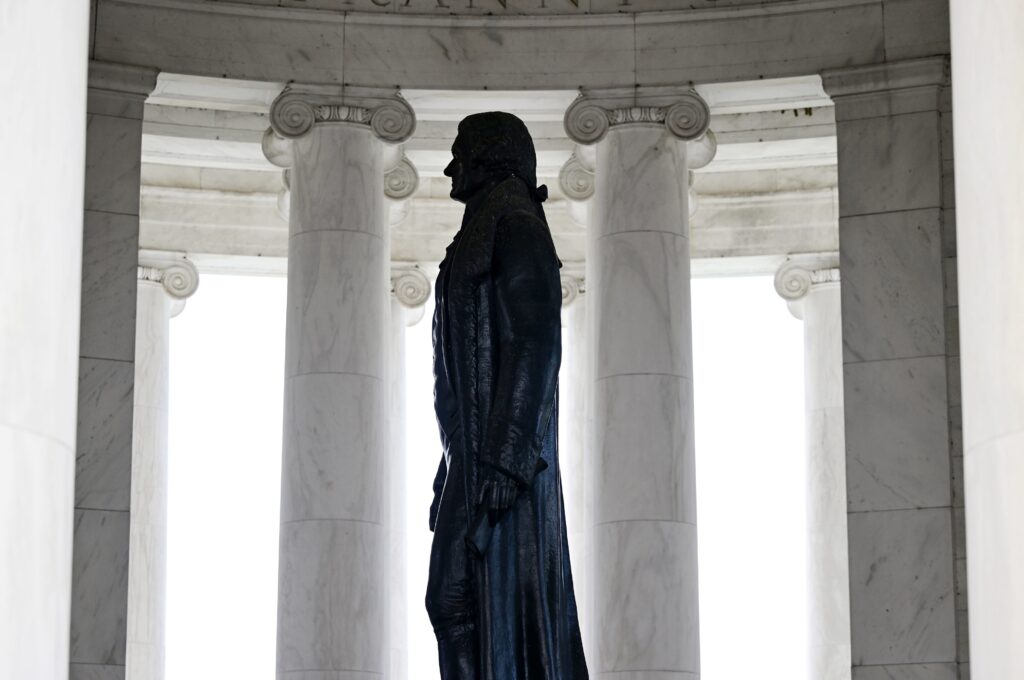
Richard Kurin was previewing an exhibit at the Smithsonian Institution, where he was a top administrator, in 2011 when the hair caught his eye in a copy of Thomas Jefferson’s handmade version of the Bible. Light red or blond, the strand was stuck in glue that Jefferson had used to piece together this Bible from text cut out of other books.
If this was Jefferson’s hair, Kurin thought, maybe its DNA could be analyzed. And maybe that would finally solve what Kurin considered one of the great mysteries of American history: whether Jefferson fathered children with Sally Hemings, the enslaved half sister of his late wife.
Most historians already accept that the author of the Declaration of Independence fathered children with Hemings, but the DNA testing done over the years to settle the case did not involve samples from Jefferson himself. There was enough wiggle room that some skeptics continue to believe it could have been another male relative, such as one of Jefferson’s nephews, who fathered the children.
“People wanted certainty,” Kurin, now the Smithsonian’s distinguished scholar and ambassador at large, said in an interview. So he undertook a 15-year effort to see whether advances in DNA science could make that possible.
The results, chronicled in his new book, “History by a Hair,” suggest with 99.9 percent certainty that Jefferson himself was the father of at least one of Sally Hemings’s sons.
The release comes as the Trump administration has vowed to purge “improper ideology” from the Smithsonian and the president has said the institution was too focused on slavery. Kurin said he is operating on the faith that his effort is something the nation will welcome.
So far, Kurin said, he hasn’t heard from the White House on the book.
The foundation that runs Monticello, Jefferson’s historic home outside Charlottesville, responded to the book with an essay headlined “Thomas Jefferson and Sally Hemings, Again” that points out the institution accepted the likelihood of Jefferson’s paternity more than a quarter-century ago.
Kurin’s findings are one more step in a long line of historical and scientific evidence, Thomas Jefferson Foundation president Jane Kamensky writes with Andrew Davenport, vice president for research and director of the Robert H. Smith International Center for Jefferson Studies.
“Is there room for doubt? The scientific method, like the historical method, insists there is, always,” they write. “The frontiers of knowledge can only move forward with humility.”
Many descendants of both Jefferson and Hemings participated in the study and have accepted the findings as further confirmation of what they knew. A few have pushed back, noting that the test results have not yet been substantiated by a scientific peer review committee. Mary Brady-Atkins, 98, a retired professor and the oldest living descendant of Hemings, asked to be removed from the study and told the Chronicle of Higher Education that Kurin had lost her trust by publishing before validating the science.
And still others continue to doubt.
The Thomas Jefferson Heritage Society, formed as a skeptical response to the earlier DNA reports, posted an analysis of Kurin’s findings that praised the recovery of Jefferson’s genome as “a genuine achievement” but stopped short of endorsing the conclusion.
“The fair reading is that their study raises the question well and recovers remarkable material, but has not yet answered it,” John H. Works Jr. wrote in the analysis. Works has been active in the Jefferson descendant community for years and said in an email to The Washington Post that he is awaiting peer review of his own analysis of another line of the Jefferson family.
“My own view is that restraint is warranted,” Works said in the email. “Until the genome and underlying data from Dr Kurin’s study are released and the findings survive independent testing, I would not describe the question as settled.”
Kurin said a scientific panel has completed a review of the methods and conclusions and had it accepted by “a major journal,” which is just completing the editing process.
When Kurin got his big idea in 2011, he reached out to Lonnie G. Bunch III, now the Smithsonian’s top official but at the time working to assemble the National Museum of African American History and Culture. Kurin said he told Bunch that if they succeeded in sequencing Jefferson’s DNA, it could prove that the former president was the father of Hemings’s children or it could prove that he was not.
“Lonnie told me straight up — the museum has to be built on a foundation of truth, whatever it is. That was the whole aim of the study, just follow the truth,” Kurin said.
The question of Jefferson’s relationship with Hemings has been in the public eye at least since 1802, when a muckraking journalist named James Callender — who had once slung dirt on Jefferson’s behalf but came to feel betrayed by him — wrote in a Richmond newspaper about the president having mixed-race children by an enslaved woman at Monticello.
Jefferson never responded directly to the accusations, which reverberated among his political opponents for the rest of his life and beyond. Even then, the idea that the Founding Father who penned the words “all men are created equal” without freeing his slaves might have had an illicit relationship with an enslaved woman and kept his own children in bondage was seen as shockingly hypocritical.
Jefferson did free Sally Hemings’s children upon his death — but not the rest of Monticello’s enslaved population — and the story of their true parentage passed down through the generations. In the late 1990s and early 2000s, DNA testing made it possible to finally attempt a scientific answer, and since then Monticello has depicted the relationship as accepted fact.
Taking the science further turned out to be complicated. The hair that inspired Kurin was one of three found in that manuscript, which was not actually a Bible but was Jefferson’s attempt to cut-and-paste a volume of the moral teachings of Jesus without reference to miracles or the supernatural.
Without follicles, the hairs would not have been testable under earlier versions of DNA science. Advances had made it possible to consider using them, but eventually scientists at the University of California at Santa Cruz determined that the samples did not provide enough material.
Kurin enlisted help from officials at Monticello, who said they had other samples of what was purported to be Jefferson’s hair. In the end, it was a clump that a doctor clipped from Jefferson on his death bed in 1826 that proved to be the most promising source.
Testing took years, and during that time Kurin reached out to families descended from Jefferson and from Hemings, who had four children who lived to adulthood. They provided their own DNA for comparison.
The descendants, he said, were generous and ready to accept whatever the science told them. “It gave me great faith in the American people,” Kurin said.
The testing identified the hairs as belonging to Jefferson and provided what’s likely to be the best confirmation possible of his paternity, short of exhuming the former president’s remains. Because of the complex nature of the testing — which the book goes to great lengths to explain — the results are strongest for two of Hemings’s sons.
After 50 years at the nation’s premier set of public museums, Kurin couldn’t help viewing the project through a grand lens: bringing together Americans Black and White, bloodlines literally divided by slavery, but possibly sharing family ties woven into the roots of the nation.
“I take that as a metaphor for our larger country,” he said. “We have a lot of different ancestries, different origins, but we’re one country. There are some rocky relations but somehow we Americans are all one family and we share one future together. Figuring out how we live together is better than being divided.”
The post Jefferson’s link to Sally Hemings’s children may have been settled by a hair appeared first on Washington Post.