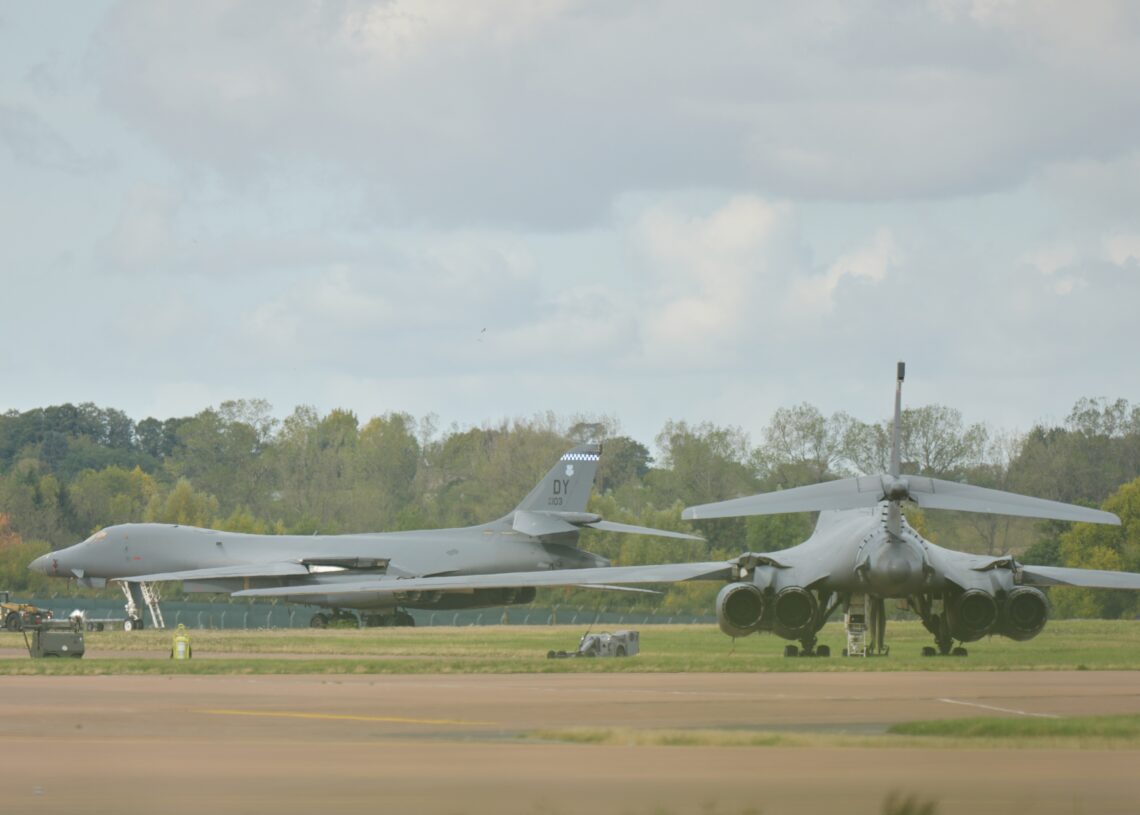
LONDON — Pentagon commanders abruptly evacuated a fleet of long-range B-1 bombers from a British air base over the weekend when fears spiked of a potential Iranian drone attack against planes and personnel at the facility, according to two people familiar with the decision and a British official.
The two people, who spoke on the condition of anonymity to discuss sensitive military matters, said about a dozen B-1 bombers were moved from Royal Air Force Fairford in response to multiple streams of intelligence warning about possible attacks. Particularly concerning was the possibility of a swarm drone attack similar to one Ukraine launched against Russia in June 2025.
In that attack, known as “Operation Spiderweb,” Ukraine smuggled more than 100 small armed drones into Russia concealed in cargo trucks and stationed near air bases; the operation destroyed an estimated one-third of Moscow’s long-range bomber fleet.
Concerns for the security of the U.S. bombers began to rise in late September, when police arrested five men in white vans outside of RAF Fairford, although they found gasoline, not drones or explosives. Top U.S. and British officials said Iran might have paid them, but to do what is unclear. All five, as well as a sixth suspect detained later, were released on bail.
British police said Tuesday that they had made a seventh arrest in the case, detaining a 22-year-old British national in London on suspicion of planning an act of terrorism.
“It clearly raised concerns,” said the British official, who also spoke on the condition of anonymity in order to discuss the issue. “But it was the idea of something big with drones that led them to fly the bombers out.”
President Donald Trump confirmed Monday the planes were moved in relation to a threat. “They didn’t fly out by accident,” he told reporters. “There were some threats, and rather than tempting the enemy — we’ll capture the enemy and beat the enemy — but why should we leave them there? So we moved them around a little bit,” he said, adding that the United States knows who made the threat.
Vice President JD Vance said the decision came out of an “abundance of caution.”
“We do feel with some confidence that the Iranians are, you know, they’re trying to do what the Iranian state has done for 49 years, which is engaged in acts of terrorism against the United States,” he told reporters Monday. “So we are being extremely cautious.”
The people familiar with the decision to move the aircraft noted also that the long-range conventional bombers could still launch from U.S. bases as needed in operations against Iran.
Britain has faced dozens of plots traced to Iran in recent years, but no details have surfaced from these cases to suggest that Iran is capable of orchestrating a sophisticated swarm drone attack on a high-security military bases used by American bombers.
Attacks attributed to Iran in recent years have mainly been low-level sabotage operations or violent plots involving proxies recruited from criminal networks on social media platforms. Even the arrests near RAF Fairford ended with the release of suspects after no explosives or other weapons were detected.
But if Iran was behind the massing of suspicious vehicles and personnel at the very edge of the air base, it may have been sending signals that it is capable of taking at least “the initial steps” of such an operation in British territory, even it stops short of carrying them out, said Ali Vaez, deputy Middle East program director at the International Crisis Group.
That could “amount to a carefully calibrated warning shot,” Vaez said, “a way of demonstrating that Iran can extend the battlefield onto European soil without crossing the threshold that would almost certainly invite a much more severe response.”
The sudden repositioning of aircraft illustrates how technological advances in warfare have heightened concerns about the vulnerability of bases such as Fairford and other hard-to-protect military facilities in populated areas.
Relatively low-cost drones, including some carried into place by vans and trucks, have delivered sharp blows to high-end military assets in Russia and other theaters, such as the Iran war.
Based on recent operations in other countries, the officials who whistled the B-1s home from Fairford would have been keenly aware of how much damage an attack — by drones costing just a few thousand dollars and, in some cases, available for purchase on Amazon — could do to a $3.8 billion fleet of long-range bombers, experts said.
Nor would an attack need to destroy any aircraft to expose the vulnerability of the base and land a sharp psychological blow, according to Robert Tollast, a land warfare research fellow at the Royal United Services Institute, a London-based military think tank.
“I think the Americans have acted out of extreme caution or a very low risk tolerance for what would be an extremely high-impact event,” Tollast said. “Even if it’s something really crude, like a petrol bomb that they could somehow get to ignite on a drone.”
Militaries face similar questions at bases across Europe, Tollast said.
He cited Germany’s Leipzig/Halle Airport, which serves as both a civilian field and a NATO hub. The base was breached by an explosive drone in August that technicians managed to defuse. Germany blamed Russia and ordered a Russian consulate closed. Russia denied responsibility.
“It speaks to the risk of large, fixed military infrastructure to [drone] attacks as something that NATO countries are still grappling with,” Tollast added.
It was unclear how long the B-1s would stay away from a base that the U.S. has used for decades.
Among the first missions ever flown from Fairford was the dropping of paratroopers over Normandy, France, on D-Day on June 6, 1944. The most recent involved dropping bombs on Iran.
U.S. officials who ordered the evacuation of the bombers have ready evidence of the potential risk to aircraft parked at a base in the British countryside.
Beyond Ukraine’s dramatic drone mission deep inside Russia, Israel orchestrated similar attacks from inside Iran, using swarms of armed drones and explosives that had been concealed in ordinary vehicles before being unleashed to destroy missile launch sites, air defense batteries and other targets.
The covert operation, led by Israel’s Mossad intelligence agency, helped cripple Iran’s defenses and to clear the way for 12 days of U.S.-Israeli airstrikes in mid-2025 on Iran’s nuclear weapons sites, as well as the targeted killings of nuclear scientists and members of the inner circle of Ayatollah Ali Khamenei, Iran’s supreme leader
The U.K. national terrorism threat level remains “severe” — unchanged since the arrests near Fairford in late September.
The details that have emerged so far about that suspected plot provide no indication that Iran — or any other adversary — managed to position explosive drones or other devices capable of penetrating the base’s defenses or damaging U.S. aircraft.
The release of the six suspects, amid an investigation by British counterterrorism police, indicates that authorities do not see them as posing any imminent danger to the public.
Investigators are still combing through the suspects’ cellphones, dashboard cameras and other devices for clues about potential links to Iran, which in recent years has repeatedly mounted plots on British soil using criminal networks and other proxies.
The suspects were arrested while traveling in white vans near RAF Fairford. No explosives were found on board those vehicles, but authorities said they recovered barrels or other containers containing gasoline, raising the possibility of a plot to set the vans on fire.
British police say they were alerted to the possible attack by one of the five men arrested at the scene, an individual who has not been identified but called Britain’s emergency phone line at 12:45 a.m. — roughly an hour before a second call came in from a local citizen who encountered the men and the vehicles.
It is not clear why the suspect made that call or what he reported.
Investigators are seeking answers to questions including whether he was not fully apprised of the plan and called after realizing that he and his associates were approaching a British military compound.
If Iran did orchestrate the van activity, it may have scored a win in its fight with the Pentagon without ever detonating anything. Bombers flying from South Dakota to targets in Iran would cost more in fuel and flying time than those taking off from England’s Cotswolds region, which is 3,900 miles closer to Tehran.
“It’s hard to conclude anything other than that this will be seen as a success by Iran,” Peter Ricketts, a former British national security adviser, told the BBC.
Tara Copp in Washington contributed to this report.
The post Intelligence on potential Iranian drone attack led U.S. to move bombers appeared first on Washington Post.