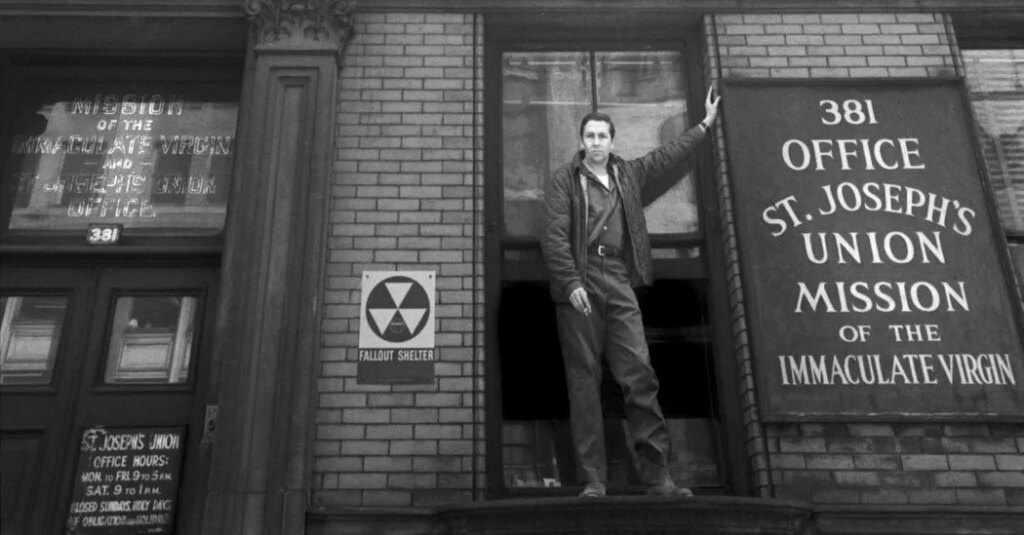
It seemed it would be there forever, that brick townhouse at 381 Lafayette Street, with its quaint red-painted front door. For years it served as the home and studio of Robert Rauschenberg, a deity of postwar American art. After he died, in 2008, his foundation stayed on in the building, and I often visited to see the changing exhibitions of his work or do research in the archive upstairs, lingering among his old papers and books and imbibing an uncanny sense of the artist’s presence.
But the Robert Rauschenberg Foundation quietly listed the building for sale in August (no price was given), informing the staff only afterward, according to three people familiar with the planned sale who spoke on the condition of anonymity because they were not authorized to comment publicly.
Courtney Martin, the foundation’s executive director since 2024, said in an emailed statement, sent through a spokesperson, that the five-story building bears no great relevance to Rauschenberg’s life or work. “Rauschenberg’s worldview was not tied to a particular building or location,” she wrote. “By 1975, the majority of his artmaking practice occurred elsewhere.”
That elsewhere was Captiva Island in Florida, where Rauschenberg owned a 22-acre compound and became known as a community-minded resident intent on protecting land from development. In March, his foundation sold the property for $45 million to a group that owns South Seas Island Resort. The foundation maintained that hurricanes and shore erosion had turned the property into a huge financial drain. The Captiva Civic Association, in a statement, called the sale a “grievous betrayal” of Rauschenberg’s values.
Many artists and art historians dismayed by the sale of the Captiva property, and the shuttering of its well-known artists’ residency program, have criticized the decision of the Rauschenberg Foundation to jettison the Lafayette Street building in New York as well. The last remaining home of Rauschenberg, it has an estimated value of $25 million. The foundation, one of the largest artists’ nonprofits in the country, has assets of $524 million, much of it in artwork, according to its recent tax forms.
Martin said in a second statement that the foundation was considering “a range of options, including possible relocation” in pursuit of increased square footage. “Recent programmatic assessments have underscored the need for additional space to realize our philanthropic mission,” she wrote.
Several artists, including Laurie Anderson, the performance artist and longtime friend of Rauschenberg, said they hoped some of the money from the sale would be reserved for artists’ grants. Martin did not respond to a question from The New York Times about that potential use.
It certainly won’t benefit the building’s many fans. Anderson’s memories of the house date to the ’60s, when she could hang out with fellow avant-gardists “and not pay,” she said. “Everything is so monetized these days, even parking. I feel for young artists especially.”
Kathy Halbreich, a veteran museum leader and curator who was the Rauschenberg Foundation’s executive director until 2023, is as baffled as anyone. “One of the things I am most proud of is introducing people to Bob through the building,” she said. “Anytime I brought anyone there, they gasped and had an immediate inhalation of what New York once was like, and who Bob Rauschenberg was.”
She added, “I thought the building felt like Bob in its elegance and eccentricities. He brought a lot of junk in.”
An urban scavenger par excellence, Rauschenberg came of age in the ’50s and pioneered a junk-into-art aesthetic that introduced shards of reality into avant-garde art. Eager to challenge the reign of Jackson Pollock and the Abstract Expressionists, who had led a generation to conceive of art as a lofty calling, Rauschenberg found his inspiration in city streets, with their random juxtapositions of objects and experiences. What did he bring to art? A stuffed goat, an automobile tire, a man’s necktie, a kneepad, lightbulbs, a pillow and a patchwork quilt, to cite some of the found objects he incorporated into his Combines, which collapsed the age-old separation between painting and sculpture. Today, when so many artists are blurring boundaries between painting, photography, digital printing and other genres, Rauschenberg is revered as the original mix-master.
And his studio was his lab. He bought his house on Lafayette Street on Valentine’s Day 1966, according to the deed of purchase, when he was 40 and newly established, having won the prestigious grand prize for painting at the 1964 Venice Biennale. Unlike more famous artists’ haunts, like Claude Monet’s water-lily garden at Giverny, the Rauschenberg manse, for which he paid $65,000, is grittily urban, a 9,200-square-foot townhouse set on a wide, truck-rumbling block just north of SoHo. For years gold letters were visible above the red door — Mission of the Immaculate Virgin — hinting at the building’s former life as a home for orphaned boys.
Rauschenberg set up his studio on the ground floor, in a high-ceilinged room that was once the chapel. The artist Brice Marden, who was then unknown and working as his assistant, moved in the furniture and washed the tall, pointy Gothic windows. Interviewed in the film “Painters Painting” (1972), the cult documentary by Emile de Antonio, Rauschenberg adopted a raffish pose. He sits on top of a ladder in the deconsecrated chapel, a figure of easy garrulity with brown curls, a gaptoothed grin and a glass of scotch in his hand.
The possible sale of the building might seem surprising, coming at a time when other artists and their representatives are investing enormous effort in preserving their studios for future generations. Jasper Johns, now 96 and the last major survivor of the heady postwar art scene that also produced Rauschenberg, has plans to convert his bucolic estate and 170 acres in Sharon, Conn., into a residency program for up to two dozen artists at a time. Dorothy Lichtenstein, the widow of Roy Lichtenstein, donated his former studio at 741/745 Washington Street in the West Village to the Whitney Museum of American Art, which recently repurposed it as the first permanent home for its Independent Study Program.
Other former studios have become important centers of research. The foundation of Ellsworth Kelly, the dean of hard-edge abstract painting, who died in 2015, recently unveiled a connoisseur’s art library across the street from his studio (both are open by appointment) in Spencertown, N.Y.
And art lovers can all look forward to eventually visiting the former studio of Jack Whitten, the revered abstract painter and sculptor who died in 2018. He worked in a converted firehouse in Woodside, Queens, that is expected to open to the public in 2028. On a considerably smaller scale, the estate of Tom Wesselmann, the Pop artist, recently hosted its first public exhibition in his former studio on Peter Cooper Square.
Born in Port Arthur, Texas, in 1925, Rauschenberg came to New York for much the same reason that artists have sojourned to the capitals of culture for centuries: to be part of a creative milieu and meet other seriously talented people. He had an easy rapport with artists he admired and also with animals, and his menagerie in New York included a turtle. “He thought the turtle was male until it laid an egg one day,” recalled David White, his longtime assistant and a current adviser to the foundation.
The heart of the house was the third-floor kitchen, where friends gathered on a nightly basis, helping to prepare dinner on a massive cast-iron stove, an ancient Vulcan from the building’s days as an orphanage. (“Among Friends” was the apt subtitle of the acclaimed retrospective organized by Leah Dickerman at the Museum of Modern Art in 2017.) He liked to cook Cajun stews, the spicier the better, and his style of hospitality, like his art, left room for collaboration. At the time he bought the building, he was organizing Experiments in Art and Technology, known as E.A.T., which invited engineers to join with artists in a quixotic attempt to solve the world’s ills.
At some point during dinner, Rauschenberg would invariably disappear into his studio. “The building was the soul of his existence because he could have his friends around him, and then he could leave the kitchen and do his work at night downstairs,” recalled Alanna Heiss, a leader in the nonprofit arts sphere, who added she was “heartbroken” by the potential sale.
But how many people would vote to save an artist’s archaic kitchen if offered, in its place, an eight-figure real-estate deal? Rainer Judd, the daughter of the artist Donald Judd, and the president of his foundation, is one. “We get emails every week,” she said, with offers to buy Judd’s former home and studio at 101 Spring Street, which opened to the public in 2013. It has been described as the last cast-iron building in SoHo whose interior has not been broken up.
“You just say: It’s not for sale,” she said firmly. “There’s no confusion on our part about this. There’s not even a .01% confusion.”
She emphasized that owning a building is a helpful and sometimes essential resource for extending the life of any enterprise. “My mom and I love going to historic restaurants and pubs,” she continued. “All of the ones that still exist — Fanelli’s McSorley’s, Raoul’s — are there because they own the building.”
She added of her father, “Don specified Spring Street in his will.” The foundation’s archivist emailed me a few pages from Judd’s will, with relevant passages highlighted in yellow. It specified that sculptures installed by Judd in his house must remain in the same place. “Frequently as much thought has gone into the placement of a piece as into the piece itself,” the will explained.
I requested a copy of the artist’s will from the Rauschenberg Foundation but the request was declined. I was puzzled by the cloud of secrecy, especially after the foundation’s spokesperson accidentally copied me on an email to the artist’s son, Christopher, the president of the foundation, whom I had called the day before. “If she does call again, we would appreciate if you did not speak with her,” the email instructed.
As it turned out, Rauschenberg’s last will was filed in Lee County, Fla., where he died, and anyone can view it on the county’s website. It was last updated years before his death and left no instructions about how his homes in New York and Captiva should be used in the future.
Perhaps the very act of estate planning was antithetical to Rauschenberg’s sensibility. He was free-spirited, generous and trusting. He was known to write countless checks to cover the medical expenses of artists in need. His was not the sensibility of someone eager to think about who would own his every sketch 70 years into the future.
Still, the building has not sold, according to the city’s database for property records, and its fans are hoping 381 Lafayette may still be preserved. As critics and scholars have discovered, the house offers rewards that money cannot, taking us back to a vanished era when the cultural vitality of New York was measured by the quality of the artists it drew and their ability to live here with dignity.
The post Should Robert Rauschenberg’s Art Studio Be Saved? appeared first on New York Times.