I stepped out of a building in New York City, put on my helmet, and was about to hop onto my scooter. That’s when I caught a passerby staring at the thing I was about to straddle: a funky-looking solar-powered two-wheeler called the Lightfoot. We locked eyes, and he asked, “Did you make that?”
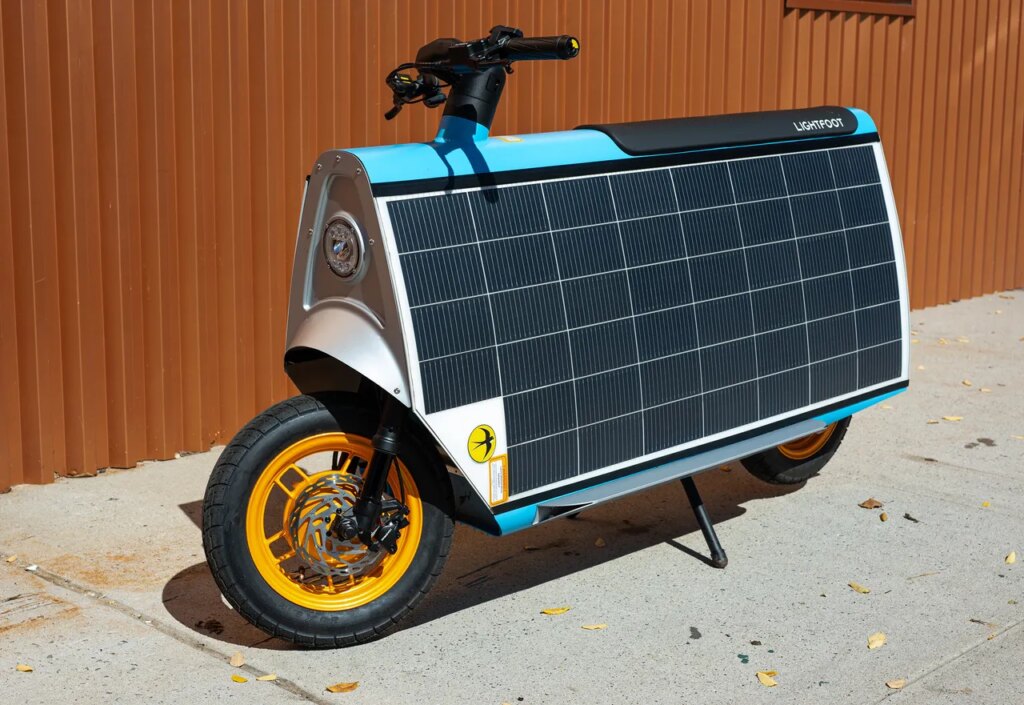
That’s essentially what the Lightfoot feels like—something tinkered into existence in a garage, rather than a factory overseas. It’s like a rectangular pod on wheels, with two large solar panels on the side and a bench seat up top that fits a rider and a passenger. It’s designed to be ridden in the bike lane—without pedals, it’s designated as an electric scooter rather than an ebike—and has a top speed of 20 miles per hour.
Almost everyone who sees it says it looks ridiculous, but in a fun, whimsical sort of way. No doubt that’s why its maker dubs it the “smile machine.” No other vehicle I’ve ever ridden has commanded this much attention. People have commented on the Lightfoot at traffic lights and even mid-ride, where several cyclists precariously pulled out their phones to take photos.
The Lightfoot hails from Otherlab, a research and design company founded by inventor Saul Griffith, who also cofounded Rewiring America, a nonprofit that helps US households switch from fossil fuels to clean energy. Griffith tells WIRED that the project started several years ago after publicly available data showed that 52 percent of all US passenger trips across all modes of transportation were less than three miles. Instead of relying on a car, why not try a simpler vehicle for short trips that can also recharge itself during the day?
“Solar can make a meaningful contribution. There’s a nice pathway here for an easy vehicle that people really engage with that’s simple and robust,” Griffith says.
Making it a scooter instead of a bike gives it a broader appeal too. “I think for every one person who wants something with pedals, there’s nine people who don’t give a fuck about pedals,” Griffith says.
Lightfoot Specs
- Speed: 20 mph
- Power: Dual 750-watt brushless hub motors
- Battery: 1.5 kW
- Range: 37 miles
- Solar: Dual 120W panels
- Rider height: 5’2″ to 6’2″
- Weight: 137 pounds
- Max payload: 419 pounds
I’ve been living with the Lightfoot for a little over two weeks. Unfortunately, for most of that time, New York City has been facing heavy rainfall—with a nor’easter sprinkled in. Not ideal conditions for a solar-powered scooter. That’s why Otherlab is initially focusing on selling its $4,495 vehicle in California—it’s now officially on sale (in sky blue or solar orange), and you can reserve one for $100.
Eventually, Griffith says, the company plans to expand into more southern states, beelining toward the Sunshine State, Florida, then gauging interest in northern states. Griffith says the company is talking to resorts, campuses, and fleet managers and plans to sell the Lightfoot in countries like Vietnam, where Hanoi will heavily restrict gas-powered scooters starting in 2027. But that’s the larger vision—for now, the focus is to produce enough vehicles and get them to initial customers first.
“If you look at the bloodbath that is people who’ve done micromobility companies, they nearly all raised too much money and tried to be gigantic immediately,” Griffith says. “We just didn’t want to do that.” He says that the first couple of production runs should prove that people like the Lightfoot and allow the company to study how people are using it.
Part of that involves servicing, and Griffith says the company wants to establish a service infrastructure as it expands. However, he points out that the Lightfoot uses common off-the-shelf components that should make repairs easy for most mom-and-pop bike shops (after removing the solar panels).
More evidence that the Lightfoot isn’t built for New York City? If you’re facing a slew of cloudy days, the only other way to charge it is by plugging it directly into an outlet. You cannot remove the battery. Also, the 137-pound vehicle is designed to be parked outside, meaning you’ll need access to a power source that can reach the sidewalk or your patio. I’m lucky enough to have a secure backyard space with an outlet, so I was able to top it up despite the cloudy conditions.
Also, the Lightfoot is a very simple machine. There’s no app, no speed modes, no turn signals, nothing. You can set a PIN to secure the thing when you leave it locked up, but that’s about it. Unlike ebikes like Infinite Machine’s Olto, which feature an alarm system and an always-on GPS to track the vehicle, you’ll have to rely on a trusty bike lock and your preferred Bluetooth tracker to keep it safe.
The Power of the Sun
Riding the Lightfoot has been tremendous fun. (That might partly be because it’s the first two-wheeled vehicle I’ve been able to ride since I broke my foot earlier this year.) It has a low center of gravity, and the suspension is excellent, even on rough Brooklyn roads.
It quickly vaults to its 20-mph top speed via the twist throttle, though the torque may be a little too much for some. There’s also a small delay from when you twist to when the Lightfoot starts moving, which can feel a little awkward, but I got the hang of it after a few minutes. Power isn’t a problem at all. Most e-bikes and scooters I’ve tested slow down on steeper inclines, like going up and over any of the bridges in New York City, but the Lightfoot maintained its 20-mph speed throughout. (Griffith says it’s designed to handle San Francisco’s hilly terrain.)
I rarely used the hydraulic disc brakes, instead relying entirely on the aggressive regenerative braking system that kicks in as soon as you stop throttling. Griffith says you can get back about 15 to 20 percent of battery life just from this regen system.
I have some qualms about the Lightfoot’s fit and finish. There’s a small gap between one of the panels and the scooter frame, and a similar seam between the bench seat and body, meaning some water can get into the inner storage area. The kickstand is also hard to access—it needs a lip that sticks out from under the frame—and when I make tight turns, the kickstand slightly scrapes the road. Griffith says his team is aware of these issues; my unit is a preproduction model, and many of these gripes have already been addressed or will be.
The most underrated feature is the internal storage compartment. It’s so nice to toss a backpack or groceries in here instead of carrying them on your back or dangling them off the handlebars. You get two keys to lock the compartment, but I wouldn’t leave anything precious in there. Someone could probably break into it with little effort.
Gauging the range is a little tough for something designed to suck up power when it brakes and by just sitting on the street. The company claims 37 miles, and I’m pleased to say I achieved 36 miles on a single charge. It’s rare that I get this close to the quoted range, especially considering I’m 6’4″ and 220 pounds; these range estimates are usually tested by people with more average heights and weights.
In one day, I scooted from my home in Bed-Stuy, Brooklyn, to Bryant Park in Manhattan for a doctor’s visit. Then I rode down to a meeting in Chelsea and another in lower Manhattan. I rode back home and didn’t plug in. The next morning, I took the Lightfoot back over the bridge for a meeting in the Financial District, then rode home. A full 36 miles, and the vehicle didn’t even slow down when the battery was almost gone, the way some electrics do.
Again, how much of that comes from the regen assistance and sun power is hard to say. I tried to park the Lightfoot in sunny areas as best I could (point one panel toward the sun to get the most power), but this isn’t as easy as it sounds in a city dense with tall buildings. Coupled with the rainy days, I didn’t see the battery bar gain any power while the scooter sat in my backyard for several days.
Then the sun broke the clouds. Finally, on a sunny Saturday, I parked the Lightfoot at the front of my house where it gets the most sunshine. After about six hours, the solar panel was finally doing its job—the battery meter went from around 50 percent to 60 percent. The next day, it sat in the same spot to bask in the sun, and it rose to 72 percent.
Those aren’t huge gains, but again, the Lightfoot isn’t designed for a place like New York City. Otherlab claims its solar panels can add up to 18 miles of range in a day under good conditions—around 3 miles per hour of quality sunlight. That seems too good to be true, but I couldn’t test it in those conditions.
Still, I nearly leaped for joy when I saw the battery meter ticking upward for the first time. The power of the sun in the panel of my scooter. It’s ridiculous. And amazing.
The post A First Ride With Lightfoot, a Solar-Powered Scooter appeared first on Wired.