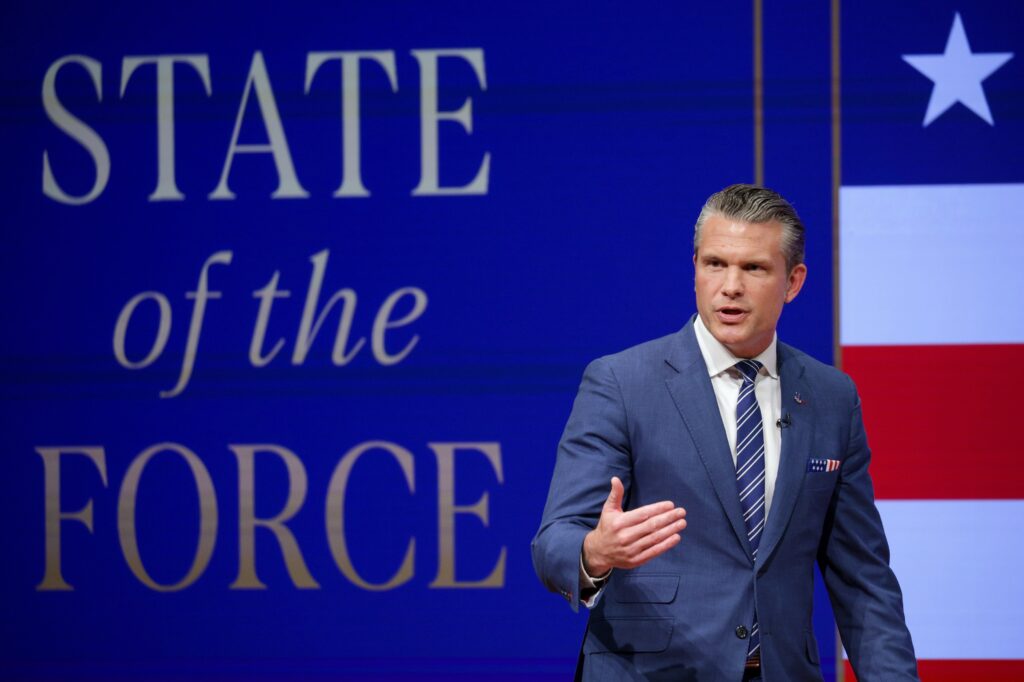
Regarding the Oct. 1 front-page article “Hegseth maps out new goals in a fiery address to troops” and the Sept. 30 news article “Hegseth’s plan to cut military ranks raises concerns among officials”:
Defense Secretary Pete Hegseth declared he will reduce the number of generals and admirals in the U.S. military by 20 percent. There are currently about 850 general or flag officers in the military, which is less than 1 percent of the total force.
Picking an arbitrary number has the potential to greatly harm the military’s ability to have the right levels of leadership that can ensure combat readiness and success.
This is not a new struggle. In the mid-1990s, there was a similar move in Congress to define the number of generals and admirals that were needed by the U.S. armed forces.
When the Senate Armed Services Committee, then chaired by Sen. Sam Nunn (D-Georgia), wanted the facts, my firm, the Hay Group, was hired. A committee of admirals, generals and colonels was convened, and it looked at the technical, managerial and people knowledge; the problem-solving complexity; and the responsibility for budgets and results of each job. The work took many months, and the results were shared with the Pentagon and the Armed Services Committee. It supported a number significantly higher than the number of generals and admirals who were in service at the time. But despite the rigor of the work, it was not long before the cap on flag-ranked officers was reduced.
A disciplined study should be done to see whether Hegseth is headed in the right or wrong direction. The cost of a mistake at this level is very high for our military and our country.
Andrew L. Klein, Clarksburg
On Wednesday, Defense Secretary Pete Hegseth unveiled six new initiatives for U.S. troops. In addition to railing against “fatties,” “beardos,” “weirdos” and more, he also introduced the Office of Religious Affairs within the Pentagon to provide troops with religious support.
Our military is a multiracial, multireligious force with thousands of chaplains from multiple religions capable of performing their mission. Hegseth is entitled to his personal beliefs. But his views should not violate the separation of church and state in our military.
Hegseth should be spending his time trying to resolve the Iran war instead of worrying about the souls of our troops.
Paul L. Newman, Merion Station, Pennsylvania
The military’s best
Although I disagree with some of the assertions in John Teichert’s Oct. 1 online op-ed, “‘Lethality and readiness’ have always been cool,” I wholeheartedly agree with his central point: “The next war will be won by the best minds, not by the most might.”
During my five years in the U.S. Air Force, I scored a perfect 100 on every physical fitness test I took, which was a rare feat. Considering Defense Secretary Pete Hegseth’s intense focus on physical prowess, one could conclude I epitomized lethality and readiness. But that thinking is dangerously misguided.
Indeed, the officers I served with who truly bolstered our military’s lethality and readiness were not necessarily the fastest or strongest. They were the ones who embodied the qualities Teichert identified: “smart, creative, courageous, disciplined, discerning, moral, skilled and savvy.”
Fortunately, many of my peers who were slower than I was around the track possessed those qualities in abundance and were duly promoted. Today, they are still enhancing the Air Force’s lethality and readiness in ways I never could.
T. Michael Spencer, Washington
How to pay lawmakers
The Oct. 1 editorial “A better way to compensate lawmakers” was right to argue for the elimination of the shady reimbursement program for House members, but I think its proposal to raise members’ pay is the wrong solution.
Of course, a program to reimburse House members for food and lodging expenses without requiring receipts and public review is ill-advised. But I do not think members of today’s Congress deserve a pay increase based on their current performance. Maybe eventually rules to increase compensation annually could be enacted, as long as their pay is in step with civilian federal employees.
I think the best solution would be to amend the Constitution so every state assumes the responsibility of paying for their members of Congress, which would get the expense off the federal budget. These representatives truly work for their constituents, not the federal government.
Glenn Easton, Chevy Chase
An Oct. 1 editorial argued that the reimbursement program in the House should end and that members’ salaries should be raised. However, as the editorial noted, conventional wisdom is that members of Congress raising their own salaries would be political malpractice because voters would see it as corrupt. And there have been cases where lawmakers who voted to raise elected officials’ pay have lost their seats in the next election.
I think there is a potential sweetener that may make this bill more palatable to the public: Pair it with a bill to restrict members of Congress from buying new stocks of publicly traded companies. The Stop Insider Trading Act would prohibit the buying of stock by members of Congress and their immediate families, while also requiring public notice prior to the selling of stock.
The politics behind such a move make sense. Both Democrats and Republicans widely support a ban. Furthermore, in this year’s State of the Union address, President Donald Trump urged the passage of the Stop Insider Trading Act “without delay.” Boosting congressional pay but banning stock trading might be a trade-off that the public is willing to take.
Michael Bednarczuk, Clarksville, Tennessee
Letter submissions
Send letters to [email protected].
Submissions must be exclusive to The Post and should include the writer’s address and day and evening telephone numbers. Letters are subject to editing and abridgment. Please do not send letters as attachments. Because of the volume of material we receive, we are unable to acknowledge submissions; writers whose letters are under consideration for publication will be contacted.
The post I helped study the Pentagon’s top ranks. Hegseth should, too. appeared first on Washington Post.