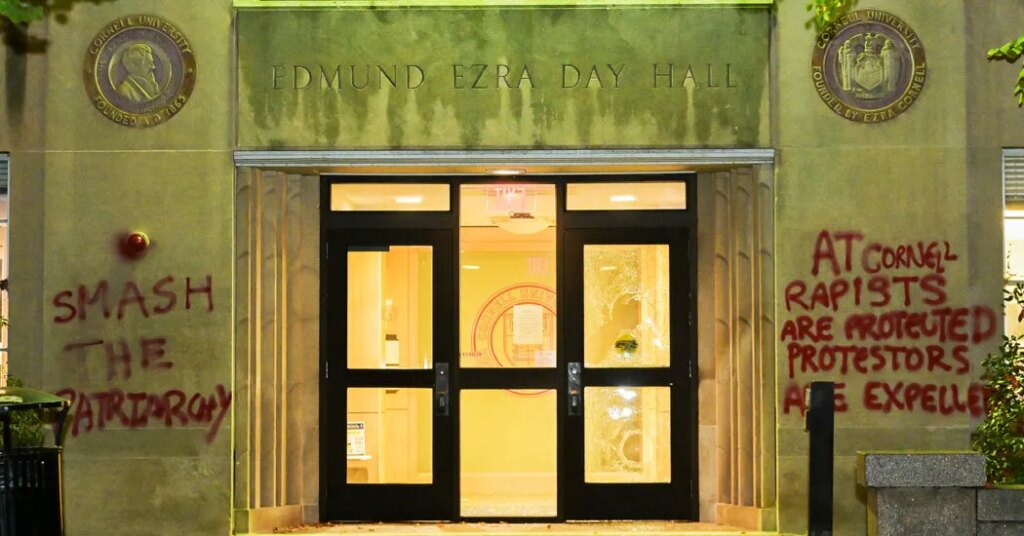
Vandals shattered a glass door and sprayed graffiti on Cornell University’s main administration building early on Monday, in a turbulent start to a week of planned protest of the way the university handled allegations of sexual assault at a fraternity.
The door to the five-story building, Day Hall, was smashed, with two large holes visible and shards of glass covering the ground. On one side of the door graffiti in red paint read: “At Cornell rapists are protected protesters are expelled.” On the other side, also in graffiti, were the words: “Smash the patriarchy.”
The Cornell administration said the vandalism was under investigation.
“We understand the frustration and strong emotions being expressed across our community,” Kyle Kimball, vice president for university relations, said. “Those concerns deserve to be heard, but damaging property is not the answer. We are investigating the vandalism at Day Hall and will address it in accordance with university policy and applicable law.”
The middle-of-the-night vandalism was the starkest demonstration of anger on campus since a woman’s lawsuit detailing allegations of sexual assault at a fraternity party ignited outrage around the country.
It comes ahead of a “Justice for Survivors” protest planned for Monday by 20 student organizations calling for sexual assault prevention. On Wednesday, some student groups are planning to skip class and hold a seven-hour sit-in in solidarity with the woman, known as Jane Doe, who has said she was plied with drugs and raped by several men at the Chi Phi fraternity house on Oct. 19, 2024. Last month, the woman sued seven men, the university, Chi Phi and her sorority.
The protests follow an emotional week on campus, as students expressed frustration with the way the administration and law enforcement handled the sexual assault allegations. Many students have questioned why some of the men accused of sexual assault had been permitted to remain on campus.
While the identity of the vandals was not known, a group whose members referred to themselves as “autonomous activists” released a statement on Monday taking credit for the action and accusing Cornell of using “its power and resources to protect rather than condemn sexual violence.”
The 2024 incident at the fraternity, the activists wrote, was part of a “rampant pattern of sexual assault perpetrated by members of Greek life at Cornell University and hundreds of other academic institutions throughout the country.”
The Cornell Police Department did not immediately reply to a request for comment.
Last week, Gov. Kathy Hochul appointed a special prosecutor, Attorney General Letitia James, to investigate Jane Doe’s allegations.
All the accused students have denied wrongdoing, and none have been charged with a crime.
The New York Times reported on Saturday that two of the seven men were expelled, two more were suspended and another was barred from campus. The remaining two students received lighter punishments. The university, the fraternity and prosecutors have said they responded appropriately given the information they had.
The administrative building that the vandals targeted has been at the center of campus activism for decades, serving as the site of a takeover by Latino Studies advocates in 1993.
It was not the first incident of vandalism at Cornell related to the events at the fraternity, Chi Phi. In November 2024, after reports of a rape accusation at the fraternity surfaced and the fraternity was suspended, a student activist group smashed the windows and spray painted the exterior of the building, The Cornell Daily Sun reported.
Since last week, when the Tompkins County district attorney announced he was reopening the investigation into Jane Doe’s allegations, Cornell has been forced to grapple with the cloud that the allegations have cast over the university.
The vandalism at the building was the latest example of visible anger over the school’s handling of various on-campus issues.
Since 2024, at least 15 students have been suspended for their activism around the Israel-Hamas war. In April, after a group of students surrounded his vehicle to protest the university’s suspension of the activists, the university president, Michael Kotlikoff, bumped a student with his car.
The language in the activists’ statement on Monday echoed that of the pro-Palestinian activists who have been a fixture of Cornell’s protest scene for the last two years. Among references to the Palestinian cause and “global violence against women” in countries like South Africa and India, it connected support for Jane Doe with a struggle for “all lives being squashed by the American empire.”
The activists, in their statement, denounced what they viewed as a double standard concerning the suspension of pro-Palestinian students and the punishment meted out to the men accused by Jane Doe. One of the pro-Palestinian activists was banned from campus after graduation, while two of the men accused by Jane Doe had to write essays and undergo sexual harassment training.
The post A Building Is Vandalized at Cornell as Week of Protest Begins appeared first on New York Times.