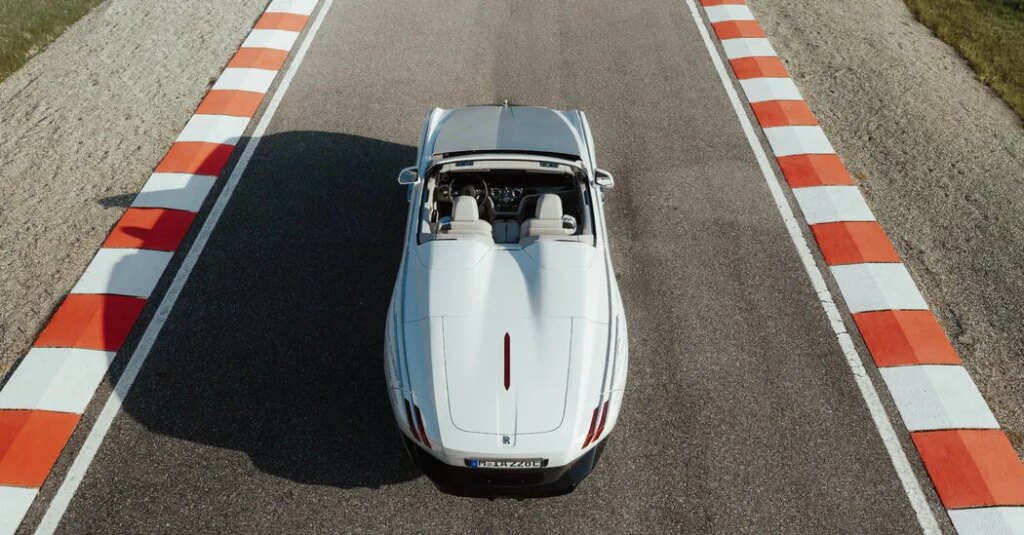
This April, Rolls-Royce unveiled a new model meant to look down at even the highest of high-end cars. Its battery-powered roadster, known as Project Nightingale, is imposing and intentionally impractical. Though it is as long as a Cadillac Escalade, it sports only two seats. Like an elite speedboat, it’s all prow and tail.
Limited to 100 units globally, this handmade vehicle starts around $3.5 million. And that’s before expensive customization options, which are myriad and de rigueur, and could add 50 percent to the price. This makes it not just the venerable British carmaker’s top offering, but also an exclamation point on its business strategy: expanding profit by catering to its elite customers’ desire for something uniquely personalized and conspicuously consumable.
“We wanted to respond to the growing demand that we see from our clients to create coach-built cars,” said Chris Brownridge, chief executive of the 122-year-old ultraluxury brand, which the BMW Group has owned since 1998. The demand is real. According to the brand, all 100 Project Nightingale allocations were reserved before the project was even announced publicly.
Coachbuilding isn’t new to Rolls. During the company’s first five decades, every Rolls-Royce was coach-built. The brand would sell a rolling chassis with an engine, drivetrain, instrument panel, steering wheel and upright “Pantheon” grille, and clients would hire a specialty firm to construct a body to their specifications.
Rolls never entirely gave up the practice, as it has recently demonstrated with its Sweptail coupe (just one was made, and topping eight figures) and Droptail roadster (a robust four of these were built). But it is now prioritizing in-house coachbuilding, doubling the size of its manufacturing plant in southern England to accommodate the practice, without noticeably increasing its annual production capacity.
More, and more complex, customization processes also invite clients “behind the curtain,” as Mr. Brownridge said, to meet with designers, engineers and executives, providing the access and direct involvement they crave.
“People consuming luxury don’t just want things. They want stories, they want experiences. They want to, with the most ambitious clients, create a legacy of something which they’ll hand down to future generations,” he said.
Milton Pedraza, chief executive of the Luxury Institute, a consulting firm, sees alignment here with the desires of the very affluent. “These clients are willing to pay for value,” he said. “And that is not only functional value, but personal value.”
To serve, and catalyze, these desires, Rolls-Royce has opened “Private Office” locations in key markets: New York, Shanghai, Dubai, Seoul, and at its headquarters in Goodwood, England. Here, top clients work directly with advisers who prompt their idiosyncratic fantasies with the latest materials and capabilities — be they on an “entry level” $370,000 Ghost sedan, or a one-off coach-built vehicle.
According to Philippe Fabre de la Grange, Rolls-Royce’s head of bespoke, the options go well beyond the burl veneers and flawless Connolly leather hides for which the brand is known.
“We’re playing with technical fibers, with new textiles integrated within lacquer, with new types of material that we use in the context of marquetry — not only carefully curated woods, but mother-of-pearl, abalone, metal,” Mr. de la Grange said. He also mentioned hand-painting, embroidery and the enhanced use of light and projection.
Rolls-Royce is constantly seeking fresh “canvases” for in-car personalization. Clients can now design constellations of thousands of tiny rheostatic LEDs to be impregnated into their vehicle’s door panel, headliner or cargo area. They can have personal text or iconography engraved on the reverse of their spherical metal climate vents.
“It’s like the lining of a jacket,” Mr. de la Grange said of these practices. “You don’t show it off straightaway, but you know it’s there. It makes you feel good. And if you want to flash it, you can.”
On the vehicles’ exterior, plebeian paint will not suffice. Colors can be developed and named exclusively for a client to match a favorite artwork or article of clothing. Finishes can feature frosted, layered, crystalline, color-shifted or laser-engraved elements.
Rolls even maintains a special workshop, the EX Vault, which, like James Bond’s “Q” gadget workshop, gathers designers, engineers and craftspeople to experiment with new materials and processes.
“We want to be pushing the boundaries, doing new content, evolving skills,” Mr. de la Grange said. The company’s hiring of artisans has helped increase factory head count by around 50 percent in the past decade.
Of course, Rolls-Royce isn’t doing this simply to keep dying skills alive. “At the highest level, our goal as a business is to create value,” for clients, but also for the business and shareholders, Mr. Brownridge said.
Rolls’s decision to focus its corporate strategy on customization is prescient. According to Michael Dean, global head of automotive research at Bloomberg Intelligence, volume in the ultraluxury automotive business is expected to stagnate through 2030. He attributes this to shrinking demand in China, owing to punitive ultraluxury taxes and a shunning of ostentation, and in the Middle East, related to regional instability.
“To improve profitability, we see luxury brands increasing prices,” Mr. Dean said. “But also providing more limited editions and more personalization.” Customization is “hugely profitable,” according to Mr. Dean, yielding margins of “well over 50 percent.” In fact, Bloomberg Intelligence estimates that while Rolls-Royce made up just 0.2 percent of the BMW Group’s 2.5 million car sales in 2025, it produced 13 percent of its operating profit.
Adding to this bottom line is the fact that, when clients want a new bespoke technique or material incorporated into their car — a new seating material, or even an outré dashboard color — Rolls-Royce can graciously charge them for the development costs.
“The opportunity to work on new content in itself has a high perceived value for our clients, because they’re able to differentiate themselves,” Mr. de la Grange said. “So, it’s something that they’re willing to pay for.” Rolls can further its gains by selling similar practices or components to other clients once any exclusivity arrangements end.
Other industries have adopted similar tactics. Fashion houses like Hermés have raised prices to emphasize craftsmanship and scarcity. The jewelers Cartier and Van Cleef & Arpels now intentionally sell fewer, higher-priced, individuated pieces, even “destroying” lower-level inventory to maintain low supply and high prices. The avant-garde watchmaker MB&F has forsaken expanded production, catering to a dedicated “tribe” of buyers, with increasingly artistic and customizable offerings.
“I think this concept is taking a leap now that there’s a lot of commodification — via A.I. and ‘efficient’ manufacturing — in the luxury industry, with a small l,” Mr. Pedraza said. “A true Luxury industry, with a capital L, means personalization, customization, co-creation, totally bespoke. That category is really beginning to thrive.”
Perhaps the only challenge for Rolls, Mr. Dean said, is that such extremely customized vehicles will struggle to find buyers should they ever enter the secondary market. Mr. Pedraza counters that their over-the-top amenities and connection with notable celebrities, heads of state and captains of industry could buoy their value.
For his part, Mr. Brownridge believes these clients are unlikely to ever sell these commissions. “They’re like masterpieces that they’ll hang on their wall,” he said. “And they’ll pass them to their children, which fits with this clear trend of creating legacies.”
If Rolls can maintain its exclusivity, while enhancing its offerings and providing clients with the kind of relevant access that makes them collaborators and co-conspirators, it seems poised for continued success in this new Gilded Age.
“Wealth will accumulate at the top,” Mr. Pedraza said. “So, Rolls-Royce has very little risk doing this.”
The post To Make More Money, Rolls-Royce Is Aiming Higher on Price, Not Production appeared first on New York Times.