Not so long ago, heroic public statuary felt irrelevant—good for locating yourself in traffic circles but otherwise dismissed as a relic of some credulous, great-man-besotted past. The fact that places like Pyongyang and Ashgabat still went in for it just confirmed the association with autocratic backwardness and childish megalomania.
Things have changed. In Washington, D.C., millions of taxpayer dollars were spent on regilding a pair of allegorical equestrian bronzes with the cheap sheen of a dollar-store trophy, and the Trump administration has been defiantly pursuing legally contested plans for an arch of hypertrophic vulgarity. Meanwhile, in Los Angeles, an exhibition with Kara Walker’s dismembered and reconstituted statue of Stonewall Jackson and his horse became one of the most widely covered art events of the past 12 months. Figurative monuments are now being taken seriously—desired by some (well, at least one guy), vilified by many, and argued over by just about everybody. Whose history do they tell? When should they be pulled down or repurposed? How effective are they anyway?
In this environment, the advent of two big museum shows with “Pharaohs” in the title feels timely. No people on Earth have done monuments more ambitiously and lastingly than the ancient Egyptians. Staking claims to eternal fame, pharaohs stamped their names and features on objects of mind-boggling scale: the Great Sphinx of Giza, the Colossi of Memnon, the mountainous figures of Ramesses II at Abu Simbel.
Curated by the former director of the Egyptian Museum in Cairo, Tarek el-Awady, and with a catalog by the high-profile Egyptian archaeologist Zahi Hawass, “Treasures of the Pharaohs” is both a buzzy blockbuster and an assiduous cultural survey. (Now at the de Young Museum, in San Francisco, it will travel to the Kimbell Art Museum, in Fort Worth, next year.) Its 100-plus artifacts stretch from tiny gold animal amulets some 5,000 years old to a gilded incense burner about 2,700 years younger, and from a child’s clay rattle found in a workers’ settlement near Thebes to the gold funerary mask of the 21st-dynasty king Amenemope, his bland face framed by the flanged nemes headdress still de rigueur for all costume-party pharaohs.
Styles changed over that enormous time span: The French-bob wig shown on a statue of Lady Hekenu in the fifth dynasty differs from the Gidget flips worn by Ukh-Hotep’s wives in the 12th dynasty, which look nothing like the elaborate braided wigs of Senetnay and her daughter in the 18th dynasty. Wigs aside, however, the story is one of overarching continuity: a society structured around divine kingship, detailed preparations for the afterlife, and the cosmological ideal of truth, justice, and order known as ma’at, all of which found expression in a remarkably stable set of visual forms.
New pharaohs imitated the monuments of old pharaohs or had them retailored to fit themselves. The essential Egyptian pictorial convention of figures in profile with torsos twisted forward was already in place by the time of King Narmer (around 3000 B.C.E.) and was still serving Cleopatra in 30 B.C.E. (It’s worth noting that the distance between those two rulers is 1,000 years longer than that between Cleopatra and us.)
The hook is Bronze Age glamour, and exhibition publicity gives pride of place to the beautiful golden face and blue-lined eyes of Thuya, mother-in-law of the pharaoh Amenhotep III. But Hawass also wants viewers to understand Egypt as “a pioneering power that demonstrated how to build a unified state, establishing the fundamental principles of science and governance.” A model boat from the early Middle Kingdom (circa 2000 B.C.E.), fully staffed with oarsmen, a captain, and a sailor plumbing the depths, serves a discussion of Egyptian nautical sophistication. Tomb portraits of commoners such as the carpenter Inty‑Shedu back up Hawass’s claim that Egypt’s social stability rested in part on its allowance for skill-based upward mobility.
The problem for big surveys like “Treasures” is that it’s hard to keep track of so many pharaohs, dynasties, kingdoms, and gods (Hawass counts more than 1,500 deities). The larger sociological points land, and many objects dazzle, but the individual biographies tend to blur.
“Maverick Kings: Three Visionary Pharaohs of Egypt’s Golden Age,” at the Museum of Fine Arts in Boston, takes a different approach. Lawrence M. Berman, the exhibit’s curator, has written two books that tease out tales of individual lives from objects in his care. This exhibition does something similar, zeroing in on Hatshepsut, Amenhotep III (him again), and his son Akhenaten. All belonged to the 18th dynasty (circa 1550–1292 B.C.E.), when Egypt was at its richest and most self-assured. All were outliers in different ways, and all were committed (it’s tempting to say addicted) to proclaiming their achievements and broadcasting their images as broadly as possible.
The daughter of one pharaoh and the half sister and wife of another (a frequent Egyptian arrangement), Hatshepsut was serving as co-regent with her young nephew/stepson when she took the title of king herself—an extraordinary, though not unprecedented, action. For more than two decades, she kept the peace, expanded trade, and transformed the temple complex of Karnak at Thebes. She aggrandized processional routes with monuments, including obelisks of solid granite that rose 100 feet and were topped with electrum (a mirror-bright natural gold-silver alloy). Built into the cliffs on the west bank of the Nile, her memorial temple rises in stepped terraces, like something Frank Lloyd Wright might have done if he’d had the power and purse of a potentate. These efforts may have been for the glory of the dynasty’s official state god, Amun‑Re, but statues of Hatshepsut punctuated the vistas like a visual drumbeat.
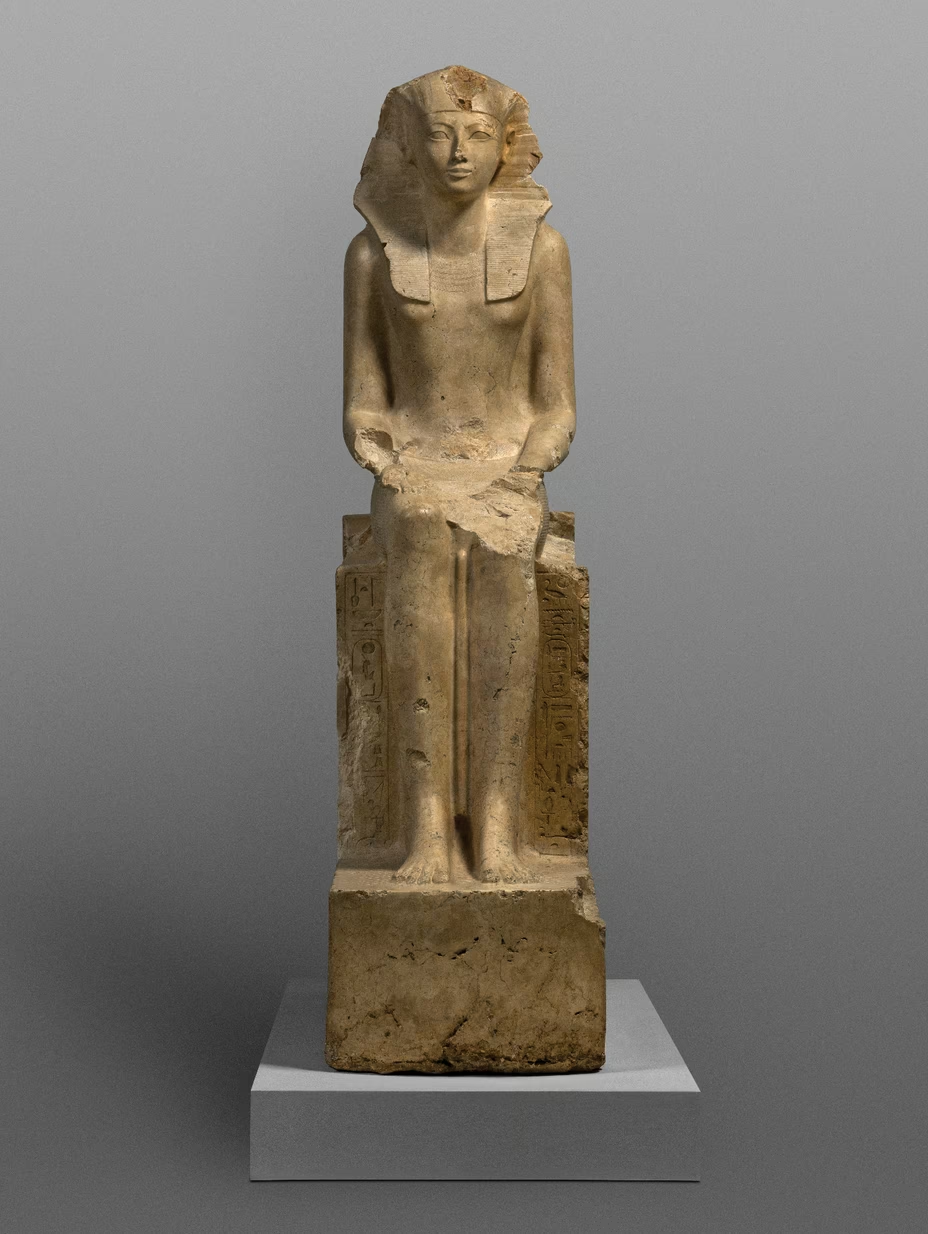
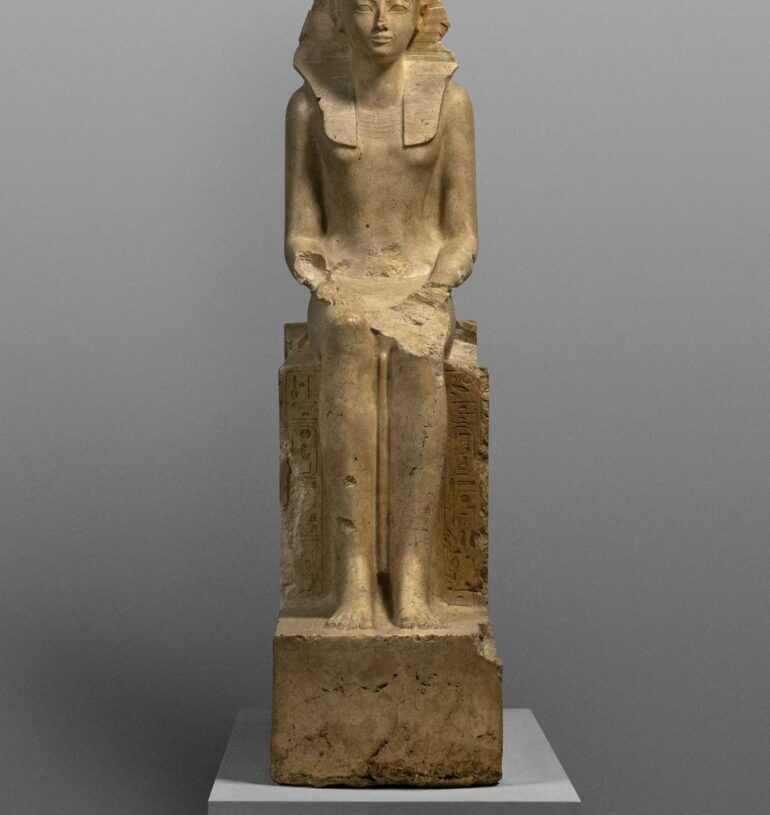
In Boston, an obelisk fragment shows Hatshepsut flat-chested and broad-shouldered, wearing the kilt, headdress, and rectangular false beard of a pharaoh. But in a beguiling seated statue on loan from the Metropolitan Museum of Art, she appears distinctly feminine, delicate and beardless, though still clad in a pharaoh’s kilt and headdress. These variations tell us less about Hatshepsut’s gender proclivities than about monuments as public performance. Egyptian kingship had a recognized visual grammar, and attributes of office could operate independently of physiognomic truth. A manly statue of Hatshepsut was no different in principle from the perennially youthful Ramesses II we see depicted across his six and a half decades on the throne.
Amenhotep III was Hatshepsut’s great-great-grandnephew and perhaps “the greatest patron of the arts in Egypt’s history,” Berman writes. Having inherited a kingdom and immense wealth, he threw himself into aggrandizing old temples and constructing new ones; he built a palace complex big enough to accommodate an artificial lake and accessorized everything with statues of himself, including the 60-foot-tall Colossi of Memnon. Tempering the geometric rigor of earlier monuments with a new sensuality of form, he established an Egyptian classicism to which later generations repeatedly returned.
It’s hard, looking at the finely carved quartzite head of Amenhotep in Boston, to grasp the majesty it would once have conveyed. His skull flows into the bowling-pin-shaped crown of Upper Egypt in a way that closely resembles the Coneheads of early SNL. And whereas most pharaohs are shown with a small, serene smile, Amenhotep’s heavy-lidded eyes, elegant brows, and grinning lips convey such self-satisfied beatitude that he looks a bit stoned. Originally, however, the head was probably part of a standing statue in which the king’s living spirit was present. Instead of conveying drowsiness, those lowered eyelids would have directed his gaze down at subjects, who would have felt themselves seen by a king and a god.
Amenhotep seems also to have been a notably uxorious pharaoh. His wife Tiye is prominent on monuments and sometimes shown at the same scale as her husband, an exceptional statement of equality. When Amenhotep declared himself to be the incarnation of the sun god Re‑Horakhty, Tiye, too, was deified. Together they began to shift the focus of royal worship to the Aten, the golden disk of the sun.
Akhenaten followed in his parents’ footsteps, dedicating himself to the worship of the Aten, but then, in a profound break with tradition, he eliminated the rest of Egypt’s crowded pantheon. When he declared himself to be one with the Aten, Akhenaten fused not just with a god, but with the god. His wife Nefertiti joined with both the king and the god in a divine triad.
In Amarna, Akhenaten’s new, Aten-focused capital, the art was as peculiar as the theology, offering both the most naturalistic and otherworldly creations in the Egyptian canon. The workshop of the sculptor Thutmose (not to be confused with the pharaohs of that name) contained faces so rough and unflattering that they are thought to have been cast from life. Yet that same workshop created the famous bust of Nefertiti now in Berlin, one of the world’s most acclaimed visions of idealized beauty.
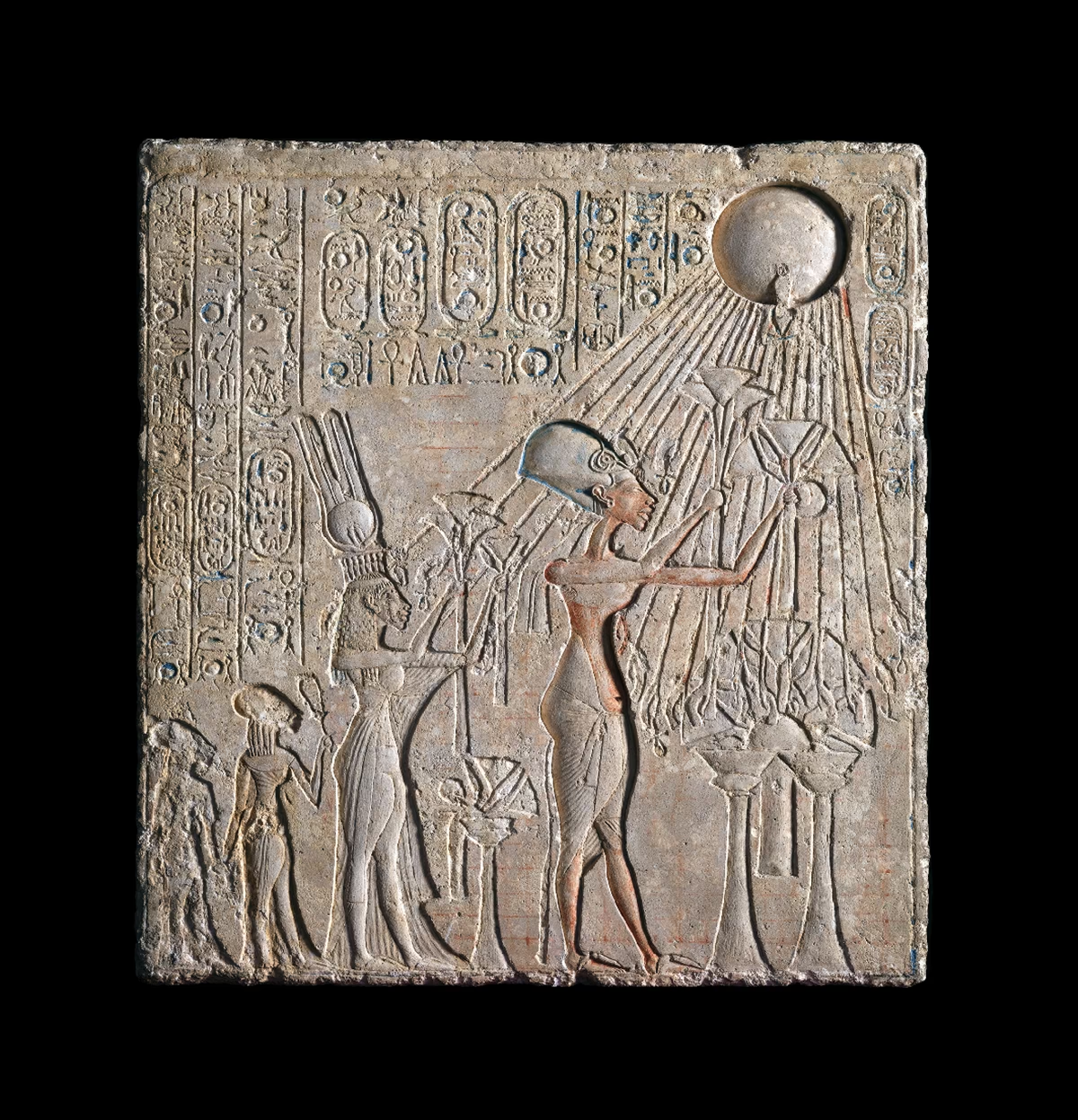
In place of the heroic proportions and rigidity of royal tradition, statues of Akhenaten emphasized eccentric curves—narrow shoulders, swelling hips, carefully detailed sagging tummy flesh, and a face at once cadaverous and voluptuous. The writer Thomas Mann used the analogy of “an aristocratic young Englishman of somewhat decadent stock; spare, haughty, weary,” but the stylizations could reach buglike extremes. A stela included in “Treasures” shows Akhenaten, Nefertiti, and two of their daughters as wasp-waisted, with bulbous thighs and spindly arms. And yet the affectionate way the two little girls hold hands seems entirely natural. In the context of royal Egyptian art, such scenes of familial intimacy were a novelty, and remain touching.
All three maverick kings did everything in their substantial power to shape their image and control their legacy. It didn’t go as planned for any of them. Hatshepsut had been dead for 20 years when her co-regent and successor, Thutmose III, began erasing her from pharaonic history. The cartouches inscribed with her name were shaved down, her statues smashed and dumped in a quarry pit and in a nearby depression that excavators in the 1920s dubbed the “Hatshepsut Hole.”
Earlier Egyptologists, unable to imagine an honorable woman with power, saw this iconoclasm as a nephew’s revenge on the “vain, ambitious, and unscrupulous” aunt who’d cheated him of his birthright. In the midst of our current culture wars, we might read general misogyny into it, or hostility toward gender nonconformity. The favored explanation among contemporary Egyptologists, however, is dynastic: The aging Thutmose was aware that Hatshepsut’s side of the family had grander bloodlines than his side did, and represented a potential threat to the ascendancy of his son. Traditionally, such women were married off to the heir to gin up his claim, but Hatshepsut’s successful kingship had set a disruptive precedent. How nice, he may have thought, if people simply forgot that she had ever been pharaoh.
Earthquakes and the death of hieroglyphic literacy during the Roman empire completed the job Thutmose had begun. Hatshepsut’s name was forgotten; her memorial temple was rededicated to healing gods and later became the Coptic monastery of Saint Phoibammon, before falling into ruin. Its walls remained mute until 1829, when Jean-François Champollion, following his Rosetta Stone triumph, visited the site and puzzled over the pairing of an image of a male pharaoh with texts using feminine grammatical endings.
Egyptologists are still sorting out what happened at the end of Akhenaten’s reign. Names came and went in quick succession; Nefertiti may have claimed the throne for herself or one of her daughters. When the young Tutankhamun (thought to be Akhenaten’s son or nephew) became pharaoh, he wasted little time in restoring the old gods. Within a generation, Akhenaten’s temples had been dismantled; within two, his name no longer appeared on the official list of kings. None of his dozens (possibly hundreds) of public statues survives intact. Akhenaten’s suppression of the divine pantheon lasted perhaps 17 years, but the disappearance of Akhenaten lasted more than 3,000. Not until the late 19th century did living people again know anything about him, thanks to excavations at Amarna sparked, so the story goes, by a farmer’s chance discovery of clay tablets.
As for Amenhotep III, his legacy wasn’t attacked, just recycled, as generations of successors helped themselves to his monuments (so much more convenient than quarrying stone from the ground). The most insatiable was Ramesses II, so it is fitting that millennia later, the impending arrival in London of part of one of Ramesses’s colossi provided Percy Bysshe Shelley with what has become a byword for futile vanity:
And on the pedestal these words appear: “My name is Ozymandias, king of kings: Look on my works, ye Mighty, and despair!” Nothing beside remains. Round the decay Of that colossal wreck, boundless and bare The lone and level sands stretch far away.
Of all the priorities that governed ancient-Egyptian life, perhaps the hardest for us to fathom is the expenditure on the afterlife, not merely as a place of immaterial spiritual reward, but as a world of material goods. If “Treasures” glitters more than “Maverick Kings,” it’s because almost everything came out of tombs and cemeteries. Those tiny gold animal amulets were found in the necropolis at Naga ed-Deir; the gold toe coverings from the mummy of Psusennes I speak for themselves. These things endured because they were hidden away for use by their dead owners and the gods. Meanwhile, the great public efforts—the colossal statuary, the expansive propaganda programs, the image campaigns, the attempts to remake the world of living people—have been shattered, defaced, and refaced. The only unbroken funerary figure of Akhenaten to have come down to us is smaller than a Barbie doll, and isn’t gold.
This article appears in the November 2026 print edition with the headline “The Greatest Monument Builders of All Time.”
The post The Greatest Monument Builders of All Time appeared first on The Atlantic.