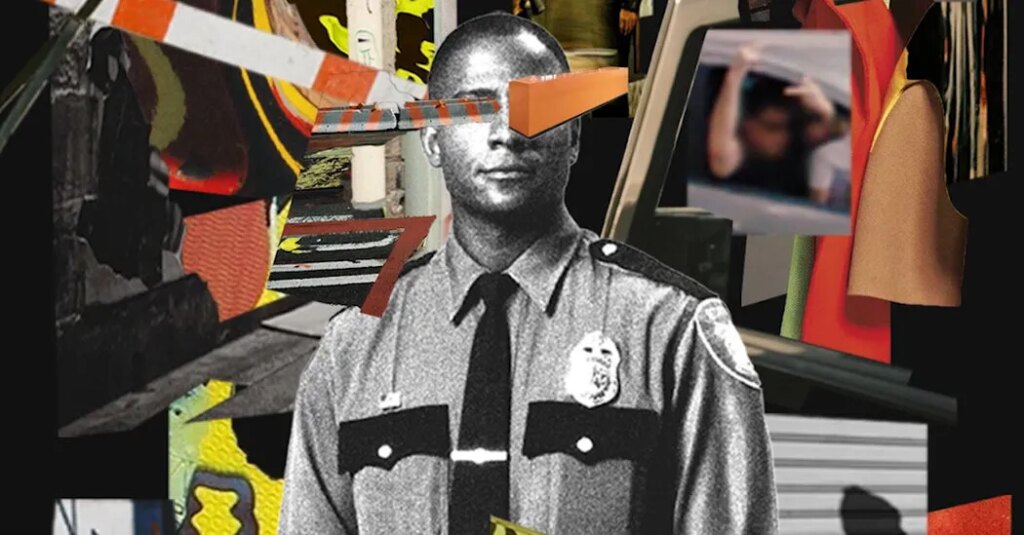
THE OCCIDENTAL BOOK OF THE DEAD, by T. Geronimo Johnson
“The Occidental Book of the Dead,” by T. Geronimo Johnson, is a strange book. In fact, it’s several strange books (an interior title page renames it “The Occidental Book[s] of the Dead”), as well as a TV show and a series of confessions and a radio broadcast, all wrapped in one big novel — though “a novel” is crossed out on the cover and title page.
The book is doing a lot, but for good reason: It wants to draw attention to the complicated reality of America’s racial, political and social failings, ranging from flawed policing to the challenge of living as an outsider in your own country. It’s an interesting song, so I decided to stop and listen.
The book opens with a prologue, set at an unspecified time. We meet Anthony, a poor, white high schooler living in The Bricks, a housing project located in Atlantis (a fictionalized version of Atlanta). Anthony is a promising student but to make ends meet he sells drugs for a local dealer, a gig that pulls him even deeper into instability.
Then the book cuts, and we jump to 1992, when the novel properly begins. George Washington Jonson is a 20-year-old Black veteran, back in Atlantis after being stationed in Germany. Now home, he has taken a new job as a police officer, or “peacekeeper,” as the novel calls them. A rookie, he’s paired with a white, deeply Southern mentor named Tucker, who doles out advice like: “Know your partner better than your old lady, he’s the only person you can trust.”
Jonson’s first assignment is to patrol The Bricks, the very community he grew up in. But he has more on his mind than work. He also wants to get back together with his childhood sweetheart, MK, but MK is now shacked up with a drug dealer named Dice. And she has a kid, who she says is Dice’s but who Jonson believes is actually his. Increasingly desperate to be reunited with the woman and child he sees as his family, Jonson makes an extreme play to take down his rival.
Cut again, and jump to 2005. Jonson is now an experienced officer giving an edited rendition of Tucker’s advice to rookies of his own. His latest trainee is “a redneck ex-prison guard” named Utner. On the night they’re paired together, Jonson and Utner find themselves in a disaster situation during which Utner shoots and kills a white teenager, maybe accidentally or maybe intentionally, it’s unclear. The fallout from that incident leads to a larger conspiracy within the department about potential shadow organizations conducting racist policing. And that leads Jonson to have to make some tough choices.
That’s just Book 1, which ends about a third of the way through the novel. Then we get Book 2, which isn’t just about George Washington Jonson, it’s also by George Washington Jonson. Here he’s revising the narrative and pushing the story forward. Then a coda forces us to rethink everything yet again.
“The Occidental Book of the Dead” is a book for readers seeking wild, ambitious literature. It’s an athletic book for nerds who pump out supersets with “Infinite Jest” and “House of Leaves,” then wind down with Percival Everett.
With so much going on, the novel seems like it’s peacocking, working very hard to show us how different it is. Readers’ tolerance for the book’s maneuvers will vary. Some of the twists land: the perspective shift of Book 2, for example, which changes the narrative we’ve just been told as it changes point of view. Others do not, such as the TV show conceit, which, though provocative in theory, will come across to many readers as functionally cosmetic.
But even with occasional misfires, “The Occidental Book of the Dead” just might be something the literary world needs to see more of: It’s ambitious, creative and, most important of all, unapologetic.
None of this will be surprising to readers familiar with T. Geronimo Johnson’s previous work. His 2015 novel “Welcome to Braggsville” also tackled thorny social issues head on. In a review for The Times, the critic Rich Benjamin wrote: “Organic, plucky, smart, ‘Welcome to Braggsville’ is the funniest sendup of identity politics, the academy and white racial anxiety to hit the scene in years.”
Though humor is present throughout “The Occidental Book of the Dead,” the novel is notably angry, and it’s not afraid to show it. There’s racial, social and cultural finger-pointing on nearly every page. Comments like “Only thing worse than a Black man who knows the law is a white man who knows the law” abound. This is a book that wants the reader to feel uncomfortable.
The second half of “The Occidental Book of the Dead,” which brings us deeper into the mind and motivations of its central character, is where it most dramatically remixes the familiar lines about police violence, Black bodies and cover-ups. Here our protagonist reveals himself to be frustrated, tired, fearful and confused. He’s doing the best he can to hold his family together, and to survive the onslaught of people who hate him for being a cop, hate him for being Black and hate him for not being Black enough. With significant flourish, the author has created a flawed, inescapably human hero you still root for.
“The Occidental Book of the Dead” is an adrenaline-filled high-wire act. It’s funny when it needs to be, hard to track when it wants to be, and meticulously engineered at every moment. It is storytelling from a writer who knows the fundamentals of the craft well enough that he can break all the rules and still build a propulsive story.
The end result is a sharp, unapologetic art-house novel full of gravitas, humor and heartbreaking revelations about the Black American experience and the thousand and one ways our nation can shatter Black souls. It will not be a novel for everyone. It doesn’t want to be. And that’s a large part of why it succeeds.
THE OCCIDENTAL BOOK OF THE DEAD | By T. Geronimo Johnson | William Morrow | 672 pp. | $34
The post A Daring New Novel About a Black Cop Breaks All the Rules appeared first on New York Times.