The United Arab Emirates said for the first time on Saturday that the co-pilot who attacked the captain of a flight from Dubai to Tel Aviv had tried to carry out a “terrorist operation,” as officials worked to uncover the full scope of his motives.
The Emirates did not name the co-pilot, but two people briefed on the investigation and an Arab official identified him as an Omani man named Hamam al-Hammami. The two people familiar with the investigation said Mr. al-Hammami had embraced extreme Islamist views, prompting Omani authorities to scrutinize him.
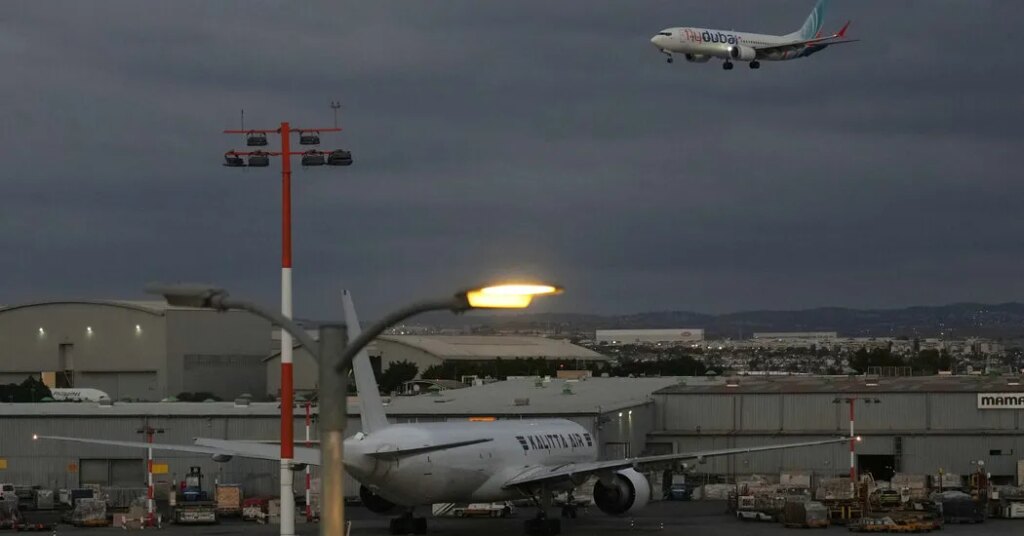
More than 170 passengers, mostly Israelis, were on the FlyDubai Flight 1073 on Wednesday when Mr. al-Hammami began attacking the pilot, Capt. Smit Machchhar, and then tried to crash the airliner. Mr. Machchhar managed to unlock the cockpit door, and passengers intervened, averting a catastrophe.
Concerns about the co-pilot’s radicalization raise questions about what checks had been carried out before allowing him to fly. It is unclear whether the Omanis had shared their concerns with security officials in Israel or the Emirates, or with the airline.
Here is what to know about the pilots.
The Co-Pilot: Hamam al-Hammami
The two people briefed on the investigation, along with the Arab official, identified the co-pilot who pressed the attack as Mr. al-Hammami, the flight’s first officer. A LinkedIn profile bearing Mr. al-Hammami’s name said he lived in Muscat, Oman’s capital, and had worked at Oman Air for seven years, leaving in 2025.
The investigation so far indicated that he had acted alone and had no known ties with Iran, which has long sought to target Israelis abroad, the Arab official and two U.S. officials said.
The three officials and the two people briefed on the Omani scrutiny of Mr. al-Hammami spoke on the condition of anonymity because they were not authorized to discuss the investigation publicly.
Many questions remain about his motive. Prime Minister Benjamin Netanyahu of Israel told Fox News on Thursday that the co-pilot had undergone “Islamist radical indoctrination,” but he did not elaborate.
The Emirati statement on Saturday did not name Mr. al-Hammami or specify the nature of his ideology. It did, however, reveal that the co-pilot had used a “crash ax” to attack Mr. Machchhar in what the statement described as a “terrorist operation.”
Al Arabiya, a Saudi Arabian broadcaster, initially reported Mr. al-Hammami’s identity, and The Wall Street Journal first reported Oman’s concerns about his radical ideology.
The LinkedIn profile bearing Mr. al-Hammami’s name said he had studied engineering at RMIT University in Australia, and, more recently, aviation at Buckinghamshire New University in England. The page made no mention of FlyDubai. The profile has been deleted.
After the failed attack on the plane, two posts appeared on the profile, CNN reported.
One depicted a photograph of Ayman al-Zawahri, who led Al Qaeda after Osama bin Laden’s death and was killed by the United States in 2022. It was unclear who made the posts or whether they had been scheduled in advance.
The Captain: Smit Machchhar
Mr. Machchhar, the Indian pilot hailed for averting a catastrophe, is being treated in Abu Dhabi, the Emirati capital, and is in stable condition, Indian officials said.
He grew up in a middle-class suburb of Mumbai, India’s capital, called Ghatkopar, not far from the city’s international airport. He attended a neighborhood school and was set to join the family textiles business until he found his love for aviation. He flew commercial planes for 13 years and later trained aspiring pilots at an aviation school.
Before the melee began, Mr. Machchhar said his co-pilot asked for a moment to pray, in an account he gave to Mr. Netanyahu. Out of respect, Mr. Machchhar said he kept his gaze forward, until about five minutes later, when he felt a big blow to the back of his head.
“The blows kept coming one after another, and that’s when I realized it’s not the aircraft, it’s the other guy who was in the cockpit with me,” he said.
In the critical moments, Mr. Machchhar, bleeding, managed to open the cockpit door, allowing passengers and crew to overpower the assailant. Describing that moment in an account he gave to his country’s prime minister, he said: “I couldn’t let all of them die.”
Although the captain does not appear to have much of a public presence on social media, interviews offer glimpses of his personality.
In an hourlong podcast, posted last year, Mr. Machchhar said he avoided “deep discussions” with his colleagues in the cockpit so he wouldn’t be distracted, and said pilots should get plenty of rest so they can perform in challenging situations.
Reporting was contributed by Aaron Boxerman, Julian Barnes, Jane Bradley, Vivian Nereim, Somini Sengupta and Pragati K.B..
The post Who Were the Pilots on the FlyDubai Flight? appeared first on New York Times.