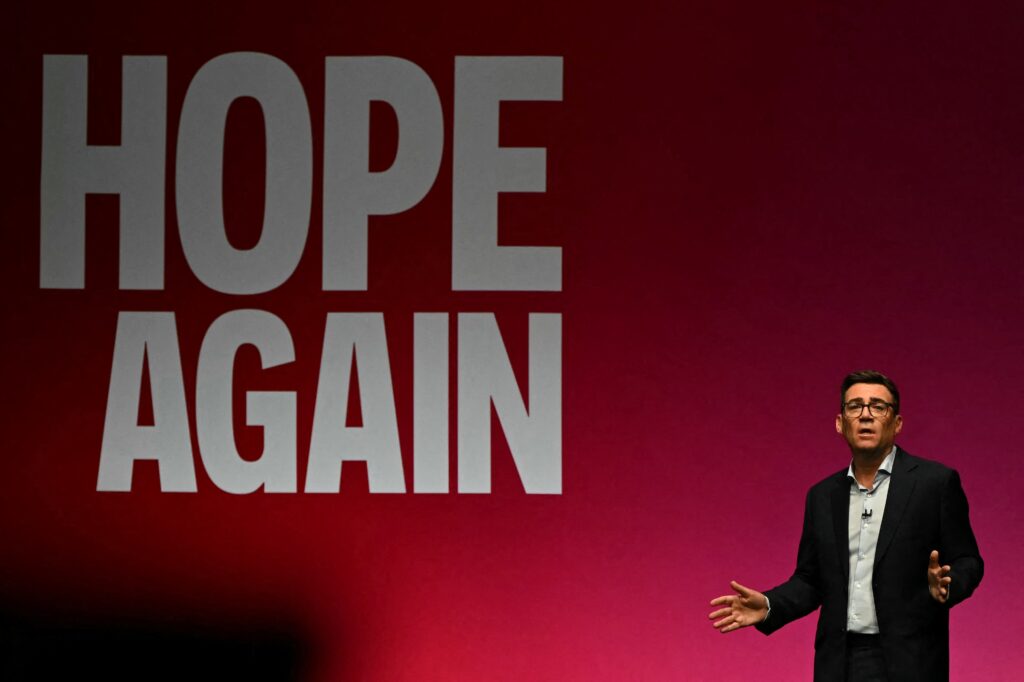
The “new path” proposed by British Prime Minister Andy Burnham in his debut speech at the Labour Party’s annual conference last week sounds a lot like the one that led the United Kingdom into prolonged stagnation.
The U.K. economy, which grew just 1.2 percent last year, desperately needs to be unleashed. Despite paying lip service to this, Burnham dedicated his much-anticipated speech to visions of a bigger government, more public ownership and more spending on entitlements that Britain cannot afford.
“This country isn’t where any of us would want it to be,” Burnham told his party. The former mayor of Greater Manchester, who replaced Keir Starmer as prime minister in July, pledged that under his leadership the party would “draw a line on a decade of division” and “stop doomscrolling on posts running Britain down.”
Britain is already down. Borrowing costs hit their highest levels since 1998 on Thursday, when 30-year gilt yields tipped over 6 percent. The government has little room to maneuver.
It’s a positive sign that Burnham wants to end the unsustainable “triple lock” on state pensions. The policy increases payments by either the rate of inflation, average wage increases or 2.5 percent, whichever is highest.
But that announcement came as a way to pay for creating a universal social care program. Burnham said he wants something “as significant as the creation” of the National Health Service itself, but details of what he envisions were scant. The barest-bones version of a social care system, which might provide assistance with daily living, aging care and disability support, would annually cost an estimated 7.5 billion pounds ($9.93 billion), though the amount would probably be far more.
Meanwhile, the NHS is beset by long waiting lists, staff shortages, delayed access to basic care, deteriorating infrastructure and growing demand. The NHS accounts for nearly 40 percent of day-to-day public spending. Why create a new entitlement when the one Burnham wants to model it on is so badly broken?
On public ownership, Burnham announced a plan to change the law so that the government could control water companies. The state-run energy company set up by Starmer would also gain more access to the country’s energy grid.
Conservative prime ministers of recent vintage had their own attractions to Big Government: Boris Johnson sped up the process of rail renationalization, Liz Truss tried to implement energy price controls and Rishi Sunak ushered in a generational smoking ban. In Truss’s case, it led to a market meltdown.
If Burnham isn’t worried that markets could be similarly spooked by his ideological fever dream, he should be. Britain spent almost twice as much on debt service as on defense in the past fiscal year. Rising borrowing costs make Burnham’s “new path” even less realistic.
Luckily, if you can call it that, Britain is tied to the Labour Party’s 2024 manifesto, because that’s what the party ran on in gaining power. Departing from it to pursue much of what Burnham floated at the party conference would require a new mandate. That would entail calling a general election, which Burnham has said he won’t do until at least 2029.
Britain is now on its seventh prime minister in the past 10 years. All promised to put the nation on a better path. None meaningfully succeeded. If Burnham is to be different, he’s going to need a better plan.
The post More government won’t fix Britain appeared first on Washington Post.