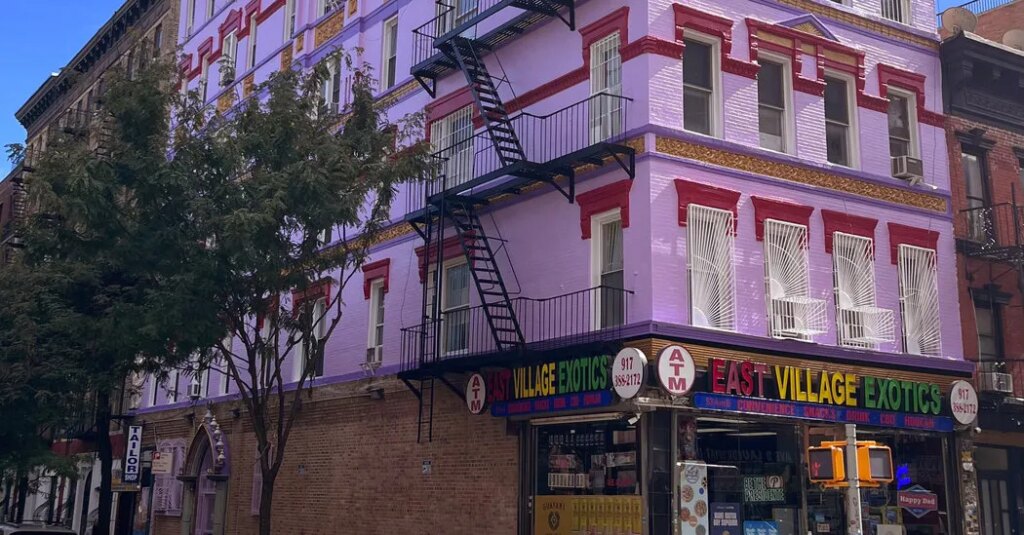
In the East Village, there’s a building that resembles … a birthday cake? A Mother’s Day bouquet? A block of Baskin-Robbins Pink Bubblegum ice cream?
It is owned by Antonio Echeverri, known as Tony, who sees the six-story building on the corner of Avenue B and East Fourth Street as an antidote to gray and glassy buildings everywhere.
“It’s something different,” said Mr. Echeverri, 79.
The building has been a standout for years, painted red, blue and gold, to represent the colors of the flag of Colombia, where Mr. Echeverri was born. Keeping his building colorful is a homage, he said, to the vibrant hues of houses found there.
With the building in need of a fresh coat, Mr. Echeverri decided this year’s refresh would be less of an ode to the motherland and more a tribute to the human palette of New York City, where he has spent the last 54 years.
“I see all the colors representing all the people who are different colors,” he said. “All of us.”
From paint maker Benjamin Moore, Mr. Echeverri selected Spring Lilac for most of the exterior bricks. The paint looks pink in sunlight, lavender under clouds. Punctuating it, he selected Charmed Violet for decorative bands on each floor. Mr. Echeverri’s building now matches the regal shades of a gemstone the size of a sugar cube he wears on a gold band around his left ring finger. They are, he said, his favorite colors.
According to Village Preservation, a downtown nonprofit group, the six-story Old Law Italianate-style tenement was constructed by the architectural firm Schneider & Herter in 1891. Then, the neighborhood was a haven for German, Polish, Jewish, Hungarian and Italian immigrants.
Andrew Berman, the nonprofit’s executive director, said Mr. Echeverri had made the building celebrate “a kaleidoscope of ethnic groups that evolved over time.”
“It brings the immigrant history of the neighborhood into the present,” he said.
Part of Mr. Echeverri’s inspiration was Donald Trump’s relentless dedication to building skyscrapers in tribute to himself. Mr. Echeverri said he also hopes to evoke strong emotions.
“If Trump’s buildings can make people go,” he said, grimacing, “why can’t mine make people smile?”
The paint job cost more than $100,000, Mr. Echeverri said. He could have gotten it done for about $35,000 less, but he splurged in a few places, including for glittery gold paint for decorative friezes above Floors 2 and 3. Then there are the 15 rectangular panels that look like coats of arms with owls and lions.
Mr. Echeverri also applied the gold paint to a quartet of human faces looking north: two men appearing like characters out of antiquity and two angels. The roof, bracketed cornice, window-tops and crenelated bands of masonry around the third and fifth floors stayed Heritage Red.
“Oof, that gold cost too much,” Mr. Echeverri said, before smacking his right hand over his heart. “But I did it because I love it!”
The delight Mr. Echeverri takes in the coloration is transmissible. Ayoub Benkirane, 23, clerk at the ground-floor hookah shop East Village Exotics — whose green, yellow and blue signage clashes with the upper floors — said the paints boost his mood.
“It makes me feel happier to work underneath it,” he said.
A new building resident, Jenner McDonald, 23, said the color attracted her and a roommate.
“We wanted to move in because it’s pink,” she said. “It’s just really fun.”
The story of the building’s colors was told recently in the local blog, EV Grieve.
It is not without detractors. Neighborhood resident Steve Sinclair, 73, viewed it with resignation.
“I appreciate how vivacious it is, and it how it represents an American experience,” he said. “But I want to see it look as it did originally.”
Chasa Monica, 23, a restaurant hostess who stopped to stare said, “It reminds me of the Gilded Age; it’s very gaudy.”
Mr. Echeverri has a response for his critics.
“This is my idea, not your idea,” he said, dragging on a Marlboro.
Raised in Colombia as one of his father’s 17 children, Mr. Echeverri immigrated to New York City in 1972. Employed as a maintenance worker in five buildings, he raised two sons, helped his family in Colombia and in 1992 bought the building, which was slated for demolition. He said he paid around $450,000. A few years ago, a buyer offered him $11 million, he said, and he turned it down.
Mr. Echeverri shuddered as he recounted evicting armies of rats and fixing the boiler, wiring, stairs and apartments. From the roof, he watched Sept. 11. By the early 2000s, once-seedy Alphabet City sprouted chic cocktail bars and art galleries. He decided to add to the new atmosphere by whimsically decorating the Gothic arch around the front door. On one side he placed a figurine of a radiant sun, and on the other, a smiling crescent moon.
Around the door and along the building’s skirting he molded plaster stars and painted them pastel yellow, green and blue. Atop the door he mounted a statue of America’s national bird, the bald eagle, but colored slate gray like Columbia’s bird, the Andean condor.
Around 2003, he painted the whole building brightly. He did it again in 2012, and again in 2026.
It all symbolizes, Mr. Echeverri said, his immigration, working sunrise to moonrise, remembering Colombia and achieving his American dream.
“In my mind I feel happy I can do something in this world before dying,” he said.
The post Why Does This Building Look Purple (or Maybe Pink)? Diversity and Trump. appeared first on New York Times.