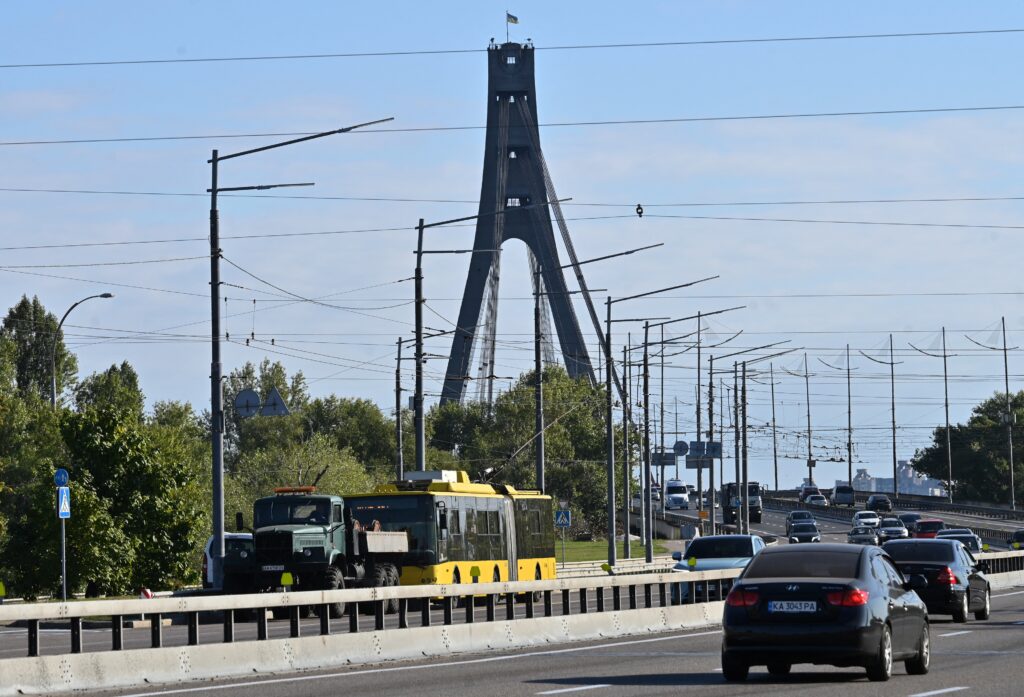
KYIV — A Russian drone hit Kyiv’s North Bridge on Saturday morning — the fifth strike on the Ukrainian capital’s bridges in three days.
Kyiv Mayor Vitali Klitschko confirmed that two people had been injured in the attack and that the tram network running across the bridge had been damaged, in statements posted to the Telegram messaging app. As of Saturday noon, car traffic had resumed across the bridge.
The city of Kyiv is split by the vast Dnieper river. Its left and right banks are connected by eight bridges; millions of people rely on these bridges to navigate the city.
On Thursday and Friday, several drones crashed into Kyiv’s South Bridge, which has since been closed. The capital was paralyzed with traffic Friday night as a result of the bridge’s closure. People were seen crossing the bridge by foot, abandoning their cars and walking 20 minutes to get to the other side of the city.
Olya, who spoke on the condition she was only identified by her first name to protect her privacy, was on Kyiv’s river beach below the South Bridge at the time of Thursday’s attack.
“When it hit, the flames went two meters up. It was horrible, I feel like we almost died,” she told The Washington Post.
Like most Kyivans, Olya feels trapped between the constant danger and anxiety and striving for a normal routine. Dressed in a bikini and wearing diamond earrings, she said she was still determined to get a tan and the strike had not deterred her: “The sun is shining today!”
But a sense of normality is becoming a privilege for those living in Ukraine’s big cities. Following the attacks, Kyiv’s Defense Council has held emergency crisis meetings and implemented public transport rerouting. Alternative ferry routes are reportedly under consideration.
President Volodymyr Zelensky told the Financial Times on Thursday that, according to intelligence intercepted by Kyiv, Russian President Vladimir Putin has instructed Russia’s military leaders to abandon the rules of war and has ordered an increase on strikes on civilian targets in Kyiv.
“He said there are no rules now,” Zelensky said, speaking from the bomb shelter of a school that had been hit by a Russian jet-powered drone that morning. Around 100 schoolchildren had been in the school’s shelter at the moment of impact. Zelensky said Moscow was gearing up to intensify attacks on Ukraine’s largest cities, to isolate, disrupt and freeze them as winter sets in.
Zelensky’s comments echo a report in the New York Times that Ukraine’s energy minister, Denys Shmyhal, recently briefed European counterparts on an intercepted Russian plan to use as many as 1,000 missiles, drones and bombs against Ukraine’s energy infrastructure. The targets include electrical substations, hydroelectric and thermal power plants, and boiler houses.
Analysts have warned Russia has plans to target water and sewage systems in big cities, in an effort to break “life-support systems of cities.”
“Ruining the livability of cities is actually a planning factor in some of their strategies. A desired effect and force multiplier is also chaos and displacement of civilians,” wrote Dara Massicot, a senior fellow at the Carnegie Endowment for International Peace, whose research focuses on Russian military strategy and defense issues. “The Russians have very specific target set guidelines and calculations on how to induce pain and humanitarian disasters to reach a military end.”
Out enjoying the last few sunlit days as the city’s leaves begin to turn, Kyivans are certainly feeling the relentlessness of Russia’s attacks. Many are concerned that the winter freeze and darkness they were readying for may hit the city earlier than they anticipated.
“The capital is in a very dramatic situation. And it’s no longer possible to pretend that we can live now as we do in peacetime,” said Mayor Klitschko on Friday. “The enemy is tearing Kyiv apart.”
Anastacia Galouchka contributed to this report.
The post Russia is hitting Kyiv’s bridges, hoping to make the capital unlivable by winter appeared first on Washington Post.