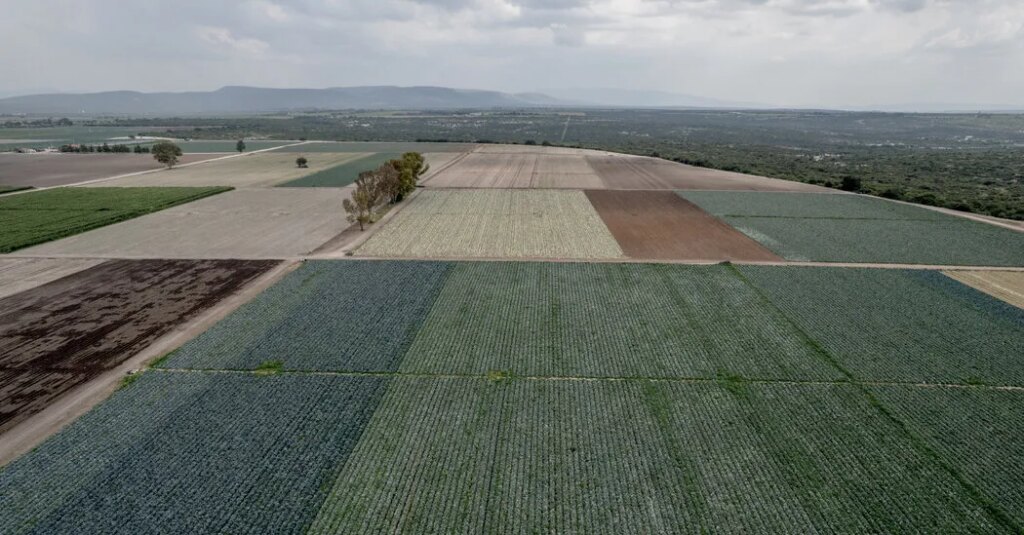
The Food and Drug Administration said on Friday that it had found two samples of the cyclospora parasite during its investigation of Taylor Farms facilities in Mexico, strong new evidence that an outbreak that sickened thousands in the United States this summer came from lettuce produced by the company.
The agency sent inspectors to the company’s processing plant and nearby farms in August, about a month after Taylor Farms recalled bags of lettuce sent to retailers across the nation. Friday’s announcement disclosed the first results of that inquiry: Inspectors discovered cyclospora in water from a tank that held outgoing wastewater from the Taylor Farms de Mexico processing facility, which chopped fresh lettuce. A second positive sample was found in sediment in a drainage ditch at an iceberg lettuce farm that the F.D.A. identified as a Taylor Farms supplier.
Over the course of the summer, the cyclospora outbreak linked to Taylor Farms caused nearly 13,000 illnesses, 570 hospitalizations and two deaths in 21 states. It was the nation’s largest outbreak of food-borne illness in decades. The Centers for Disease Control and Prevention declared the outbreak over in September.
The F.D.A. and the C.D.C. announced in July that the outbreak was most likely linked to the processing facility in Mexico after officials in Michigan interviewed hundreds of people who fell ill and examined supply chain records from Taco Bell.
Taylor Farms ultimately recalled 236,192 cases of lettuce sold to stores, restaurants and distributors including Walmart, Subway, Jack in the Box, Taco Bell and Sysco.
The F.D.A. said it is still working to determine if the genotype of the cyclospora samples found in Mexico matched samples collected from sick patients in the United States. Cases of cyclospora are challenging to link genetically because the parasite cannot be cultured in a laboratory the way that bacteria like salmonella or E. coli can. This means that investigators cannot easily identify whether different cases of cyclospora share a common strain.
“While there is currently not enough evidence to conclusively determine how contamination occurred in this outbreak, the positive samples show that cyclospora was present in the environment where lettuce was grown and processed,” the F.D.A. said in a statement. “This adds to the strong epidemiological data and traceback convergence supporting the link between this outbreak and recalled shredded iceberg lettuce from Taylor Farms de Mexico.”
Taylor Farms did not respond immediately to a request for comment on Friday. Previously, the company said it had invested more than $200 million per year in food safety protocols and hired experts to do a thorough review of its protocols in the Mexico processing center.
The company also said on a website dedicated to the recall that it “temporarily suspended production of all products” on July 18, but the current status is not clear.
Cyclospora, which can cause severe diarrhea and cramping, is known to spread only through human feces. So although the F.D.A. has not concluded how, exactly, the parasite ended up in the wastewater tank and drainage ditch, the water was most likely contaminated with traces of feces from people on or near the facilities who were infected with cyclospora themselves.
Also on Friday, the F.D.A. announced a series of actions intended to prevent future cyclospora outbreaks. Those included greater surveillance of foods that have caused past outbreaks, which can include cilantro and raspberries, and outreach to growers about how to reduce the risk of produce contamination with the parasite.
It is difficult to know whether those steps will be effective at preventing future outbreaks, since the F.D.A. has not yet determined how the lettuce at Taylor Farms was contaminated, said Jim Gorny, a produce safety expert who retired from the agency in 2024.
“Aside from that,” he said, “it’s just a recommitment to employ the same strategies and tactics over and over again hoping for a different outcome.”
Bill Marler, a lawyer based in Washington State whose office represents about 500 people sickened in the outbreak, said there is still more to learn from additional analysis of the samples from the inspection and stool samples of those who fell ill.
But before next growing season, he said, it would be ideal if federal officials could invest in the development of a water test to routinely surveil water for cyclospora, which does not currently exist. He would also like to see officials enforce a federal rule requiring food companies to hand over supply chain records in 24 hours after a product is implicated in an outbreak.
The F.D.A. finalized such a rule but delayed its implementation last year, potentially slowing down the response to this outbreak, The New York Times found.
Mr. Marler added two more items to his wish list: more inspections of facilities in Mexico like the Taylor Farms processor, which before August had not been inspected since 2019. And “an answer for the roughly 7,000 confirmed cases this summer that were never tied to any food,” he said, referring to cases that health officials confirmed but never linked to a specific source.
Frank Yiannas, a top food official at the F.D.A. from 2018 to 2023, said the agency had much more work to do to determine what went wrong this summer and how to prevent future outbreaks.
“Let’s hope this summer’s incident becomes a catalyst for a stronger, more collaborative call to action across both the public and private sectors,” he said.
The post F.D.A. Found Cyclospora During Taylor Farms Inspection in Mexico appeared first on New York Times.